Guo Fei, Yan Yuting, Sun Li, Han Ruili, Zheng Lanlan, Qin Yuan, Wang Shuang, Sun Xude, Ji Zhaohua, Gao Changjun
Department of Anesthesiology, Second Affiliated Hospital of Air Force Medical University, Xi'an, 710038, People's Republic of China.
Department of Epidemiology, School of Public Health, Ministry of Education Key Laboratory of Hazard Assessment and Control in Special Operational Environment, Air Force Medical University, Xi'an, 710032, People's Republic of China.
Neuropsychiatr Dis Treat. 2023 Apr 15;19:907-920. doi: 10.2147/NDT.S404805. eCollection 2023.
This meta-analysis of randomized controlled trials (RCTs) aims to evaluate the efficacy and safety of transcutaneous electrical acupoint stimulation (TEAS) for postoperative delirium (POD) in surgical patients.
Based on database searches of the Wanfang, China National Knowledge Infrastructure (CNKI), VIP, Chinese Biology Medicine (CBM), PubMed, Cochrane Library, and Web of Science, relevant RCTs published before December 30, 2022, were extracted. Outcome indicators included the incidence of POD, changes in Confusion Assessment Method (CAM) scores, Visual Analogue Scale (VAS) scores, and the intraoperative consumption of anesthetics. Data were pooled and analyzed by Review Manager 5.3, and publication bias detection was conducted using Stata 17.0.
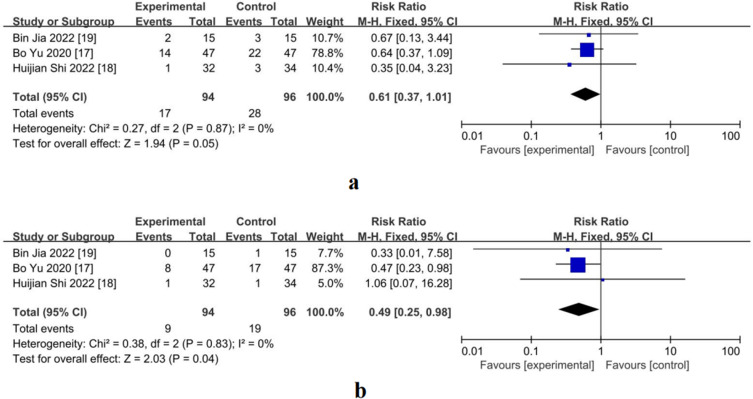
A meta-analysis containing 715 experimental and 717 control participants from 12 RCTs was performed. The overall results showed that TEAS had obvious superiority with a lower incidence of POD on any day during the postoperative 1 week. In subgroup analyses, the CAM scores on the third postoperative day were significantly lower in the TEAS group than in the control group (MD = -0.52, 95% CI: -1.02 to -0.03, P = 0.04), the VAS scores on the first postoperative day were significantly lower in the TEAS group than in the control group (MD = -0.19, 95% CI: -0.36 to -0.02, P = 0.03), the consumption of propofol and remifentanil were both significantly lower in the TEAS group compared with the control group (MD = -23.1, 95% CI: -37.27 to -8.94, P = 0.001; MD = -105.69, 95% CI: -174.20 to -37.19, P = 0.002). No serious adverse events of TEAS were reported in any of the referenced studies.
TEAS has an obvious curative effect in preventing POD and pain in the earlier stage of surgical patients. It could be a promising assisted anesthesia technique in the future.
本随机对照试验的荟萃分析旨在评估经皮穴位电刺激(TEAS)对手术患者术后谵妄(POD)的疗效和安全性。
通过检索万方、中国知网(CNKI)、维普、中国生物医学文献数据库(CBM)、PubMed、Cochrane图书馆和Web of Science等数据库,提取2022年12月30日前发表的相关随机对照试验。结局指标包括POD的发生率、意识模糊评估法(CAM)评分、视觉模拟评分法(VAS)评分以及术中麻醉药的消耗量。采用RevMan 5.3对数据进行合并和分析,并使用Stata 17.0进行发表偏倚检测。
对来自12项随机对照试验的715例试验组参与者和717例对照组参与者进行了荟萃分析。总体结果显示,TEAS具有明显优势,术后1周内任何一天POD的发生率均较低。在亚组分析中,TEAS组术后第3天的CAM评分显著低于对照组(MD = -0.52,95%CI:-1.02至-0.03,P = 0.04),TEAS组术后第1天的VAS评分显著低于对照组(MD = -0.19,95%CI:-0.36至-0.02,P = 0.03),TEAS组丙泊酚和瑞芬太尼的消耗量均显著低于对照组(MD = -23.1,95%CI:-37.27至-8.94,P = 0.001;MD = -105.69,95%CI:-174.20至-37.19,P = 0.002)。在任何一项纳入研究中均未报告TEAS的严重不良事件。
TEAS在预防手术患者早期POD和疼痛方面具有明显疗效。它可能是未来一种有前景的辅助麻醉技术。