Chen Sikai, Xi Miaomiao, Gao Feng, Li Min, Dong TaiWei, Geng Zhixin, Liu Chunyu, Huang Fengyu, Wang Jing, Li Xingyu, Wei Peifeng, Miao Feng
Shaanxi University of Chinese Medicine, Xianyang, China.
The Second Affiliated Hospital of Shaanxi University of Chinese Medicine, Xianyang, China.
Front Pharmacol. 2023 Apr 6;14:1045309. doi: 10.3389/fphar.2023.1045309. eCollection 2023.
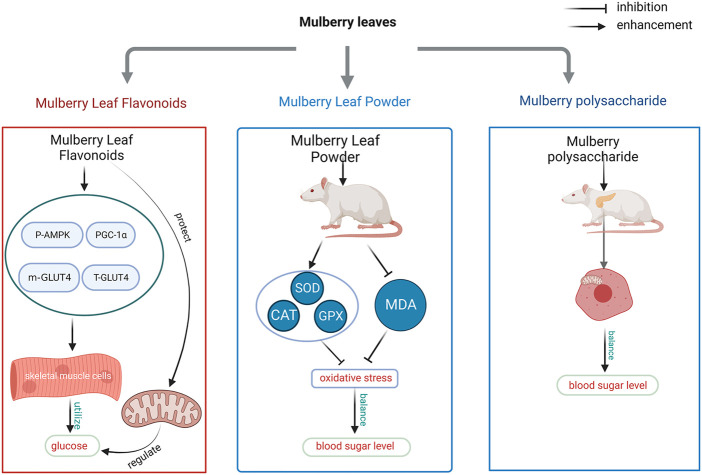
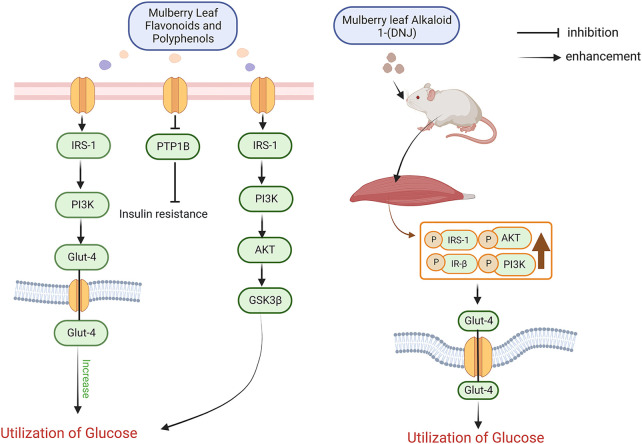
The effectiveness of herbal medicine in treating diabetes has grown in recent years, but the precise mechanism by which it does so is still unclear to both medical professionals and diabetics. In traditional Chinese medicine, mulberry leaf is used to treat inflammation, colds, and antiviral illnesses. Mulberry leaves are one of the herbs with many medicinal applications, and as mulberry leaf study grows, there is mounting evidence that these leaves also have potent anti-diabetic properties. The direct role of mulberry leaf as a natural remedy in the treatment of diabetes has been proven in several studies and clinical trials. However, because mulberry leaf is a more potent remedy for diabetes, a deeper understanding of how it works is required. The bioactive compounds flavonoids, alkaloids, polysaccharides, polyphenols, volatile oils, sterols, amino acids, and a variety of inorganic trace elements and vitamins, among others, have been found to be abundant in mulberry leaves. Among these compounds, flavonoids, alkaloids, polysaccharides, and polyphenols have a stronger link to diabetes. Of course, trace minerals and vitamins also contribute to blood sugar regulation. Inhibiting alpha glucosidase activity in the intestine, regulating lipid metabolism in the body, protecting pancreatic -cells, lowering insulin resistance, accelerating glucose uptake by target tissues, and improving oxidative stress levels in the body are some of the main therapeutic properties mentioned above. These mechanisms can effectively regulate blood glucose levels. The therapeutic effects of the bioactive compounds found in mulberry leaves on diabetes mellitus and their associated molecular mechanisms are the main topics of this paper's overview of the state of the art in mulberry leaf research for the treatment of diabetes mellitus.
近年来,草药治疗糖尿病的有效性有所提高,但医学专业人员和糖尿病患者对其确切作用机制仍不清楚。在传统中医中,桑叶用于治疗炎症、感冒和抗病毒疾病。桑叶是具有多种药用价值的草药之一,随着对桑叶研究的不断深入,越来越多的证据表明这些叶子还具有强大的抗糖尿病特性。多项研究和临床试验已证明桑叶作为治疗糖尿病的天然药物的直接作用。然而,由于桑叶是一种治疗糖尿病更有效的药物,因此需要更深入地了解其作用方式。已发现桑叶中富含生物活性化合物,如黄酮类、生物碱、多糖、多酚、挥发油、甾醇、氨基酸以及多种无机微量元素和维生素等。在这些化合物中,黄酮类、生物碱、多糖和多酚与糖尿病的关联更为密切。当然,微量矿物质和维生素也有助于调节血糖。上述主要治疗特性包括抑制肠道中的α-葡萄糖苷酶活性、调节体内脂质代谢、保护胰腺β细胞、降低胰岛素抵抗、加速靶组织对葡萄糖的摄取以及改善体内氧化应激水平等。这些机制可以有效调节血糖水平。桑叶中发现的生物活性化合物对糖尿病的治疗作用及其相关分子机制是本文对桑叶治疗糖尿病研究现状综述的主要主题。