Tutunchi Helda, Zolrahim Farideh, Nikbaf-Shandiz Mahlagha, Naeini Fatemeh, Ostadrahimi Alireza, Naghshi Sina, Salek Reza, Najafipour Farzad
Endocrine Research Center, Tabriz University of Medical Sciences, Tabriz, Iran.
Student Research Committee, Tabriz University of Medical Sciences, Tabriz, Iran.
Front Pharmacol. 2023 Apr 7;14:1144550. doi: 10.3389/fphar.2023.1144550. eCollection 2023.
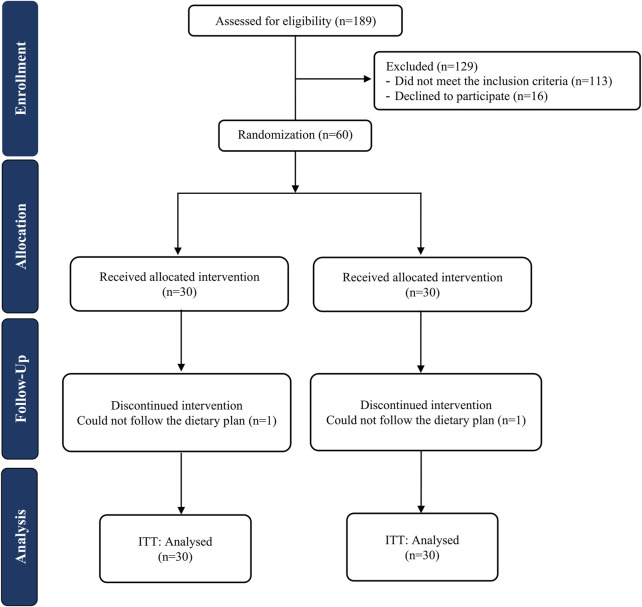
Oxidative stress is considered a major factor in the pathophysiology of non-alcoholic liver disease (NAFLD). A growing body of evidence indicates that oleoylethanolamide (OEA), a bioactive lipid mediator, has anti-inflammatory and antioxidant properties. This trial investigated the effects of OEA administration on inflammatory markers, oxidative stress and antioxidant parameters of patients with NAFLD. The present randomized controlled trial was conducted on 60 obese patients with NAFLD. The patients were treated with OEA (250 mg/day) or placebo along with a low-calorie diet for 12 weeks. Inflammatory markers and oxidative stress and antioxidant parameters were evaluated pre-and post-intervention. At the end of the study, neither the between-group changes, nor the within-group differences were significant for serum levels of high-sensitivity C-reactive protein (hs-CRP), interleukin-1 beta (IL-1β), IL-6, IL-10, and tumor necrosis-factor α (TNF-α). Serum levels of total antioxidant capacity (TAC) and superoxide dismutase (SOD) significantly increased and serum concentrations of malondialdehyde (MDA) and oxidized-low density lipoprotein (ox-LDL) significantly decreased in the OEA group compared to placebo at study endpoint ( = 0.039, 0.018, 0.003 and 0.001, respectively). Although, no significant between-group alterations were found in glutathione peroxidase and catalase. There were significant correlations between percent of changes in serum oxidative stress and antioxidant parameters with percent of changes in some anthropometric indices in the intervention group. OEA supplementation could improve some oxidative stress/antioxidant biomarkers without any significant effect on inflammation in NAFLD patients. Further clinical trials with longer follow-up periods are demanded to verify profitable effects of OEA in these patients. www.irct.ir, Iranian Registry of Clinical Trials IRCT20090609002017N32.
氧化应激被认为是非酒精性肝病(NAFLD)病理生理学中的一个主要因素。越来越多的证据表明,油酰乙醇胺(OEA)作为一种生物活性脂质介质,具有抗炎和抗氧化特性。本试验研究了给予OEA对NAFLD患者炎症标志物、氧化应激和抗氧化参数的影响。本随机对照试验针对60例肥胖的NAFLD患者开展。患者接受OEA(250毫克/天)或安慰剂治疗,并搭配低热量饮食,为期12周。在干预前后评估炎症标志物、氧化应激和抗氧化参数。研究结束时,高敏C反应蛋白(hs-CRP)、白细胞介素-1β(IL-1β)、IL-6、IL-10和肿瘤坏死因子α(TNF-α)的血清水平在组间变化和组内差异均无统计学意义。与安慰剂组相比,在研究终点时,OEA组的总抗氧化能力(TAC)和超氧化物歧化酶(SOD)血清水平显著升高,丙二醛(MDA)和氧化型低密度脂蛋白(ox-LDL)血清浓度显著降低(分别为P = 0.039、0.018、0.003和0.001)。尽管在谷胱甘肽过氧化物酶和过氧化氢酶方面未发现组间有显著变化。干预组中血清氧化应激和抗氧化参数的变化百分比与一些人体测量指标的变化百分比之间存在显著相关性。补充OEA可改善NAFLD患者的一些氧化应激/抗氧化生物标志物,而对炎症无显著影响。需要进行更长随访期的进一步临床试验,以验证OEA对这些患者是否有益。www.irct.ir,伊朗临床试验注册中心IRCT20090609002017N32