Baskozos Georgios, Hébert Harry L, Pascal Mathilde Mv, Themistocleous Andreas C, Macfarlane Gary J, Wynick David, Bennett David Lh, Smith Blair H
Neural Injury Group, Nuffield Department of Clinical Neuroscience, John Radcliffe Hospital, University of Oxford, Oxford, UK.
Chronic Pain Research Group, Division of Population Health and Genomics, Mackenzie Building, Ninewells Hospital & Medical School, University of Dundee, Dundee, UK.
Pain Rep. 2023 Mar;8(2):e1066. doi: 10.1097/PR9.0000000000001066.
: Previous epidemiological studies of neuropathic pain have reported a range of prevalences and factors associated with the disorder.
: This study aimed to verify these characteristics in a large UK cohort.
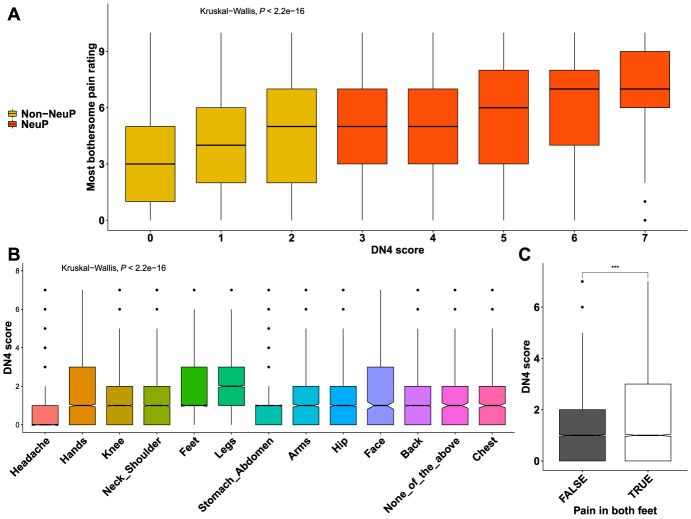
: A cross-sectional analysis was conducted of 148,828 UK Biobank participants who completed a detailed questionnaire on chronic pain. The (DN4) was used to distinguish between neuropathic pain (NeuP) and non-neuropathic pain (non-NeuP) in participants with pain of at least 3 months' duration. Participants were also identified with less than 3 months' pain or without pain (NoCP). Multivariable regression was used to identify factors associated with NeuP compared with non-NeuP and NoCP, respectively.
: Chronic pain was present in 76,095 participants (51.1%). The overall prevalence of NeuP was 9.2%. Neuropathic pain was significantly associated with worse health-related quality of life, having a manual or personal service type occupation, and younger age compared with NoCP. As expected, NeuP was associated with diabetes and neuropathy, but also other pains (pelvic, postsurgical, and migraine) and musculoskeletal disorders (rheumatoid arthritis, osteoarthritis, and fibromyalgia). In addition, NeuP was associated with pain in the limbs and greater pain intensity and higher body mass index compared with non-NeuP. Female sex was associated with NeuP when compared with NoCP, whereas male sex was associated with NeuP when compared with non-NeuP.
: This is the largest epidemiological study of neuropathic pain to date. The results confirm that the disorder is common in a population of middle- to older-aged people with mixed aetiologies and is associated with a higher health impact than non-neuropathic pain.
先前关于神经性疼痛的流行病学研究报告了该疾病的一系列患病率及相关因素。
本研究旨在验证英国一个大型队列中的这些特征。
对148,828名完成了关于慢性疼痛详细问卷的英国生物银行参与者进行了横断面分析。使用神经病理性疼痛4项问卷(DN4)来区分疼痛持续至少3个月的参与者中的神经性疼痛(NeuP)和非神经性疼痛(non-NeuP)。还识别出疼痛持续时间少于3个月或无疼痛的参与者(NoCP)。多变量回归用于分别确定与NeuP相关的因素,与non-NeuP和NoCP进行比较。
76,095名参与者(51.1%)存在慢性疼痛。NeuP的总体患病率为9.2%。与NoCP相比,神经性疼痛与较差的健康相关生活质量、从事体力或个人服务类职业以及较年轻显著相关。正如预期的那样,NeuP与糖尿病和神经病变相关,但也与其他疼痛(盆腔、术后和偏头痛)以及肌肉骨骼疾病(类风湿性关节炎、骨关节炎和纤维肌痛)相关。此外,与non-NeuP相比,NeuP与肢体疼痛、更高的疼痛强度和更高的体重指数相关。与NoCP相比,女性与NeuP相关,而与non-NeuP相比,男性与NeuP相关。
这是迄今为止关于神经性疼痛的最大规模流行病学研究。结果证实,该疾病在病因混合的中老年人中很常见,并且与比非神经性疼痛更高的健康影响相关。