Xu Gang, Tang Weizhen, Zhou Chaosheng, Xu Jie, Cheng Chao, Gong Weiwei, Dong Shihong, Zhang Yu
Department of Rehabilitation Medicine, Affiliated Tenth People's Hospital of Tongji University, Shanghai Tenth People's Hospital, Shanghai, 200072, People's Republic of China.
Department of Rehabilitation Medicine, Tongji University School of Medicine, Shanghai, 200092, People's Republic of China.
J Pain Res. 2023 Apr 15;16:1267-1284. doi: 10.2147/JPR.S404713. eCollection 2023.
To evaluate the efficacy and pain fluctuations of methylcobalamin in combination with lidocaine local injection treatment for subacute herpetic neuralgia (SHN).
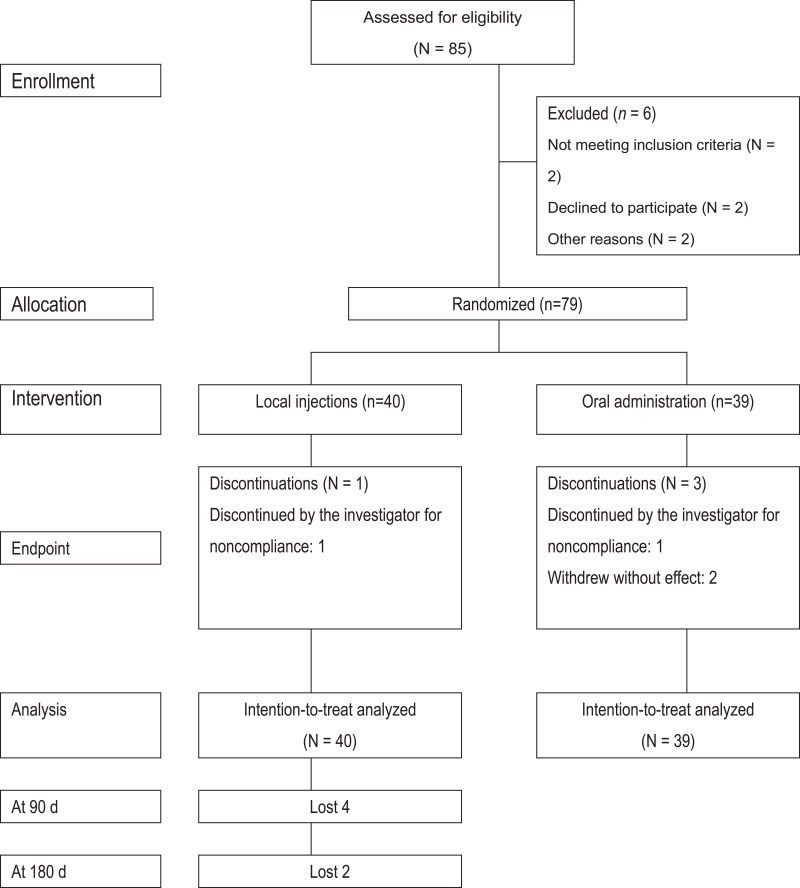
Seventy-nine women (60.4 ± 2.7 years) with thoracic SHN were enrolled and randomized to receive a combination of methylcobalamin and lidocaine local injection (MI, N=40), or a combination of lidocaine patch 5% and oral methylcobalamin (PO, N=39) for four weeks. Repeated-measures analyses of variance were used to evaluate the effect on pain levels. Generalized estimation equations were used to analyze the cause-effect relationship between pain fluctuations and influencing factors.
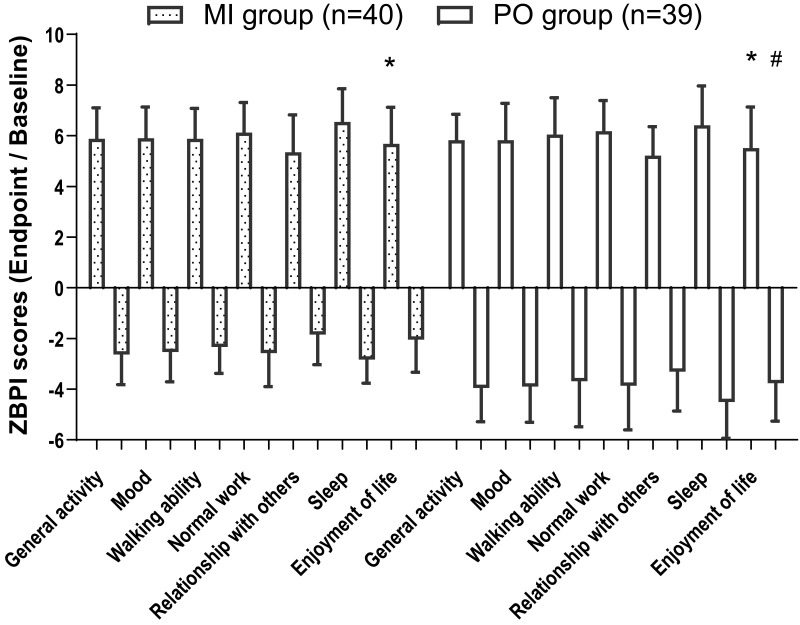
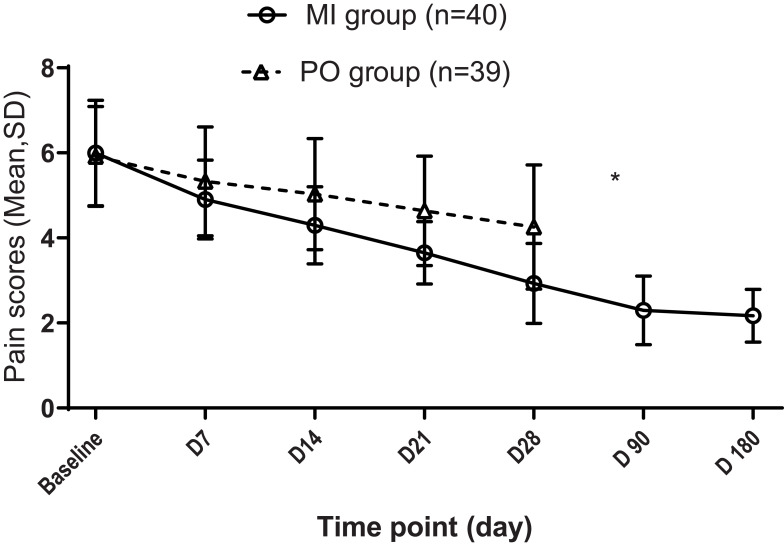
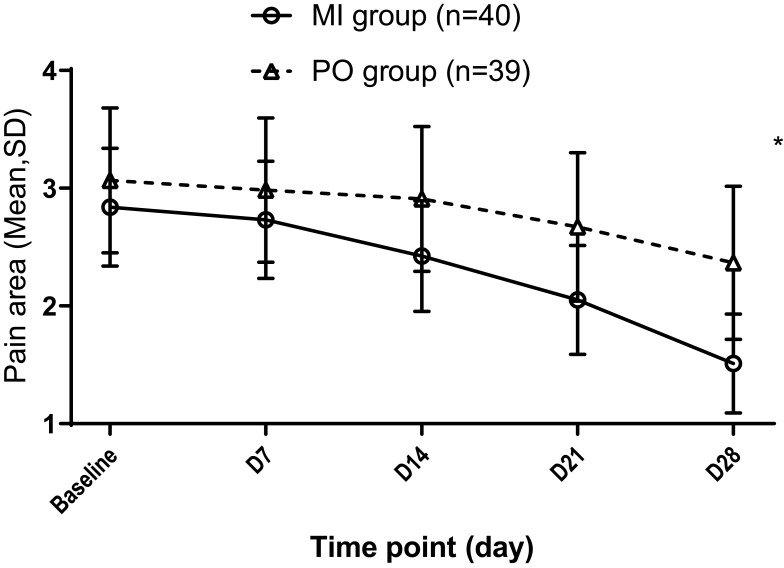
At the treatment endpoint, the group, treatment time, and group interacted with treatment time effects of the pain scores and area were statistically significant (<0.001), The pain scores were 2.9 ±0.9 (MI) and 4.3 ± 1.5 (PO). 80.00% (MI) or 28.21% (PO) of patients had pain scores ≤ 3, the odds ratio was 2.84 (95% CI: 1.68 to 4.79). The incidence of postherpetic neuralgia was 5.0% (2/40) at 3 months. Pain fluctuated repeatedly during treatment. The pain fluctuation increased from 8.75 log folds in the afternoon, to 79.85 log folds at night. With the ADLs level increasing from 1 to 3, the pain fluctuated from 4.28 to 17.70 log folds. Allodynia, itching, sleep quality, and ADLs were the significant influencing factors (P<0.05).
This study validated the efficacy of methylcobalamin combined with lidocaine for SHN, and confirmed that pain levels in patients with SHN had an obvious circadian rhythm. ADLs were an important cause of pain fluctuations.
评估甲钴胺联合利多卡因局部注射治疗亚急性带状疱疹后神经痛(SHN)的疗效及疼痛波动情况。
纳入79例胸段SHN女性患者(60.4±2.7岁),随机分为两组,分别接受甲钴胺联合利多卡因局部注射(MI组,N = 40)或5%利多卡因贴剂联合口服甲钴胺(PO组,N = 39)治疗4周。采用重复测量方差分析评估对疼痛水平的影响。使用广义估计方程分析疼痛波动与影响因素之间的因果关系。
在治疗终点,组、治疗时间以及组与治疗时间的交互作用对疼痛评分和面积的影响具有统计学意义(<0.001),疼痛评分分别为2.9±0.9(MI组)和4.3±1.5(PO组)。80.00%(MI组)或28.21%(PO组)的患者疼痛评分≤3,优势比为2.84(95%CI:1.68至4.79)。3个月时带状疱疹后神经痛的发生率为5.0%(2/40)。治疗期间疼痛反复波动。疼痛波动从下午的8.75对数倍增加到夜间的79.85对数倍。随着日常生活活动能力(ADLs)水平从1增加到3,疼痛波动从4.28对数倍增加到17.70对数倍。痛觉过敏、瘙痒、睡眠质量和ADLs是显著的影响因素(P<0.05)。
本研究验证了甲钴胺联合利多卡因治疗SHN的疗效,并证实SHN患者的疼痛水平具有明显的昼夜节律。ADLs是疼痛波动的重要原因。