Guo Hai, Tang Hong-Tao, Hu Wen-Long, Wang Jun-Jie, Liu Pei-Zhi, Yang Jun-Jie, Hou Sen-Lin, Zuo Yu-Jie, Deng Zhi-Qiang, Zheng Xiang-Yun, Yan Hao-Ji, Jiang Kai-Yuan, Huang Heng, Zhou Hai-Ning, Tian Dong
Department of Thoracic Surgery, West China Hospital, Sichuan University, Chengdu, China.
Department of Thoracic Surgery, Sichuan Tianfu New Area People's Hospital, Chengdu, China.
Front Oncol. 2023 Apr 6;13:1082960. doi: 10.3389/fonc.2023.1082960. eCollection 2023.
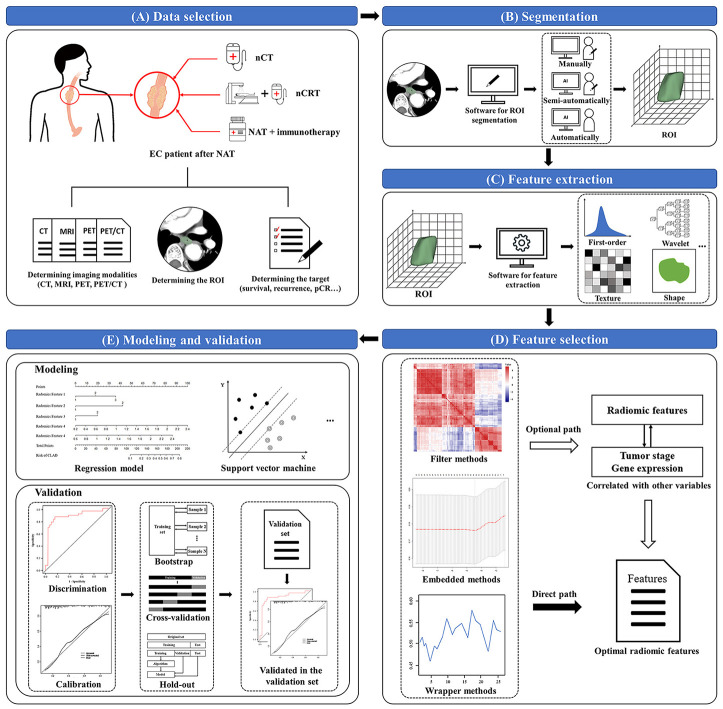
Esophageal cancer (EC) is one of the fatal malignant neoplasms worldwide. Neoadjuvant therapy (NAT) combined with surgery has become the standard treatment for locally advanced EC. However, the treatment efficacy for patients with EC who received NAT varies from patient to patient. Currently, the evaluation of efficacy after NAT for EC lacks accurate and uniform criteria. Radiomics is a multi-parameter quantitative approach for developing medical imaging in the era of precision medicine and has provided a novel view of medical images. As a non-invasive image analysis method, radiomics is an inevitable trend in NAT efficacy prediction and prognosis classification of EC by analyzing the high-throughput imaging features of lesions extracted from medical images. In this literature review, we discuss the definition and workflow of radiomics, the advances in efficacy prediction after NAT, and the current application of radiomics for predicting efficacy after NAT.
食管癌(EC)是全球范围内致命的恶性肿瘤之一。新辅助治疗(NAT)联合手术已成为局部晚期EC的标准治疗方法。然而,接受NAT的EC患者的治疗效果因人而异。目前,EC患者NAT后疗效评估缺乏准确统一的标准。放射组学是精准医学时代用于医学成像发展的多参数定量方法,为医学图像提供了新视角。作为一种非侵入性图像分析方法,放射组学通过分析从医学图像中提取的病变高通量成像特征,是NAT疗效预测和EC预后分类的必然趋势。在这篇文献综述中,我们讨论了放射组学的定义和工作流程、NAT后疗效预测的进展以及放射组学在NAT后疗效预测中的当前应用。