State Key Laboratory of Molecular Vaccinology and Molecular Diagnostics, National Institute of Diagnostics and Vaccine Development in Infectious Diseases, Center for Molecular Imaging and Translational Medicine, School of Public Health & School of Life Sciences, Xiamen University, Xiamen, 361102, China.
State Key Laboratory of Emerging Infectious Diseases, School of Public Health, Li Ka Shing Faculty of Medicine, The University of Hong Kong, Hong Kong, SAR, 999077, China.
Adv Sci (Weinh). 2023 Jun;10(17):e2207249. doi: 10.1002/advs.202207249. Epub 2023 Apr 25.
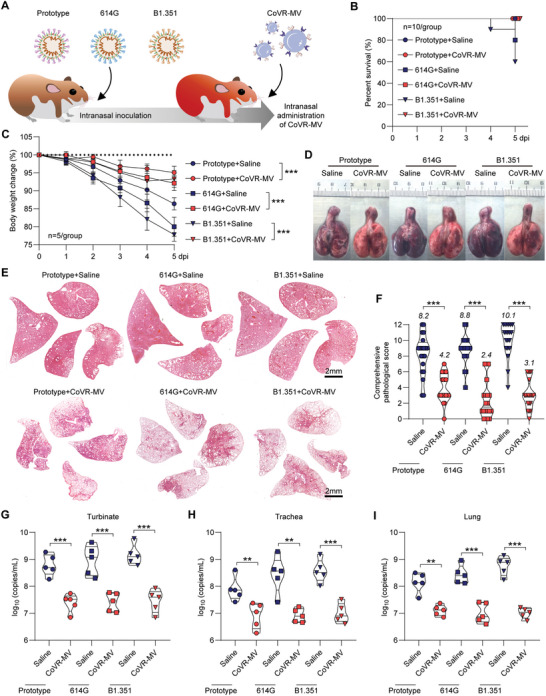
Highly pathogenic coronavirus (CoV) infection induces a defective innate antiviral immune response coupled with the dysregulated release of proinflammatory cytokines and finally results in acute respiratory distress syndrome (ARDS). A timely and appropriate triggering of innate antiviral response is crucial to inhibit viral replication and prevent ARDS. However, current medical countermeasures can rarely meet this urgent demand. Here, an antiviral nanobiologic named CoVR-MV is developed, which is polymerized of CoVs receptors based on a biomimetic membrane vesicle system. The designed CoVR-MV interferes with the viral infection by absorbing the viruses with maximized viral spike target interface, and mediates the clearance of the virus through its inherent interaction with macrophages. Furthermore, CoVR-MV coupled with the virus promotes a swift production and signaling of endogenous type I interferon via deregulating 7-dehydrocholesterol reductase (DHCR7) inhibition of interferon regulatory factor 3 (IRF3) activation in macrophages. These sequential processes re-modulate the innate immune responses to the virus, trigger spontaneous innate antiviral defenses, and rescue infected Syrian hamsters from ARDS caused by SARS-CoV-2 and all tested variants.
高致病性冠状病毒(CoV)感染会引起先天抗病毒免疫反应缺陷,伴发促炎细胞因子失调释放,最终导致急性呼吸窘迫综合征(ARDS)。及时、适当的先天抗病毒反应触发对于抑制病毒复制和预防 ARDS 至关重要。然而,目前的医疗对策很少能满足这一紧迫需求。本研究开发了一种名为 CoVR-MV 的抗病毒纳米生物技术,它是基于仿生膜泡系统聚合 CoV 受体而成的。设计的 CoVR-MV 通过最大化病毒刺突靶位界面吸附病毒,干扰病毒感染,并通过其与巨噬细胞的固有相互作用介导病毒清除。此外,CoVR-MV 与病毒结合后,通过抑制巨噬细胞中 7-脱氢胆固醇还原酶(DHCR7),解除对干扰素调节因子 3(IRF3)激活的抑制,迅速促进内源性 I 型干扰素的产生和信号转导。这些连续的过程重新调节了对病毒的先天免疫反应,触发自发的先天抗病毒防御,并使感染 SARS-CoV-2 及所有测试变体的叙利亚仓鼠免于 ARDS。