National Clinical Research Center for Digestive Diseases and Xijing Hospital of Digestive Diseases, Xijing Hospital, Air Force Medical University, Xi'an, 710032, Shaanxi, China.
Department of Aerospace Hygiene, School of Aerospace Medicine, Air Force Medical University, Xi'an, 710032, Shaanxi, China.
Hepatol Int. 2023 Aug;17(4):979-988. doi: 10.1007/s12072-023-10522-z. Epub 2023 Apr 25.
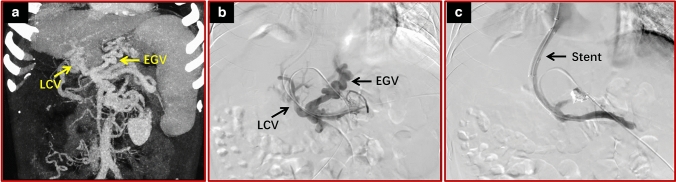
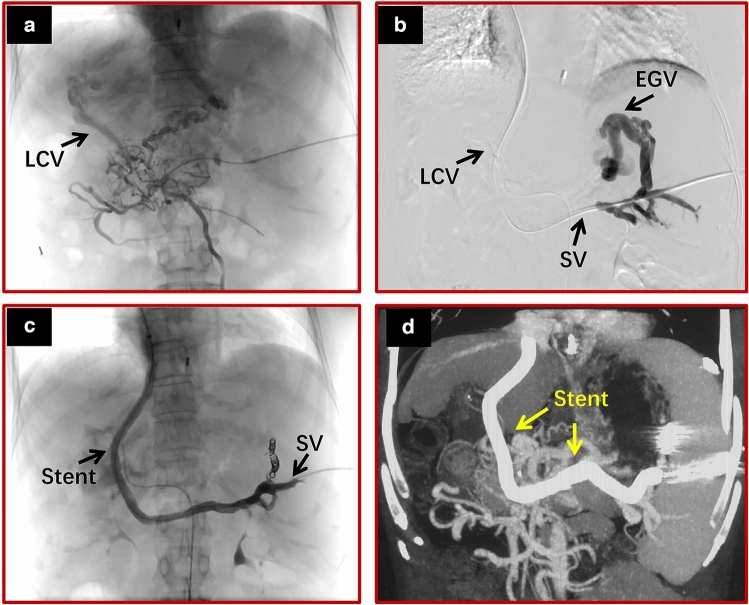
The transjugular intrahepatic portal collateral-systemic shunt (transcollateral TIPS) is used to treat portal hypertension-related complications in patients with cavernous transformation of the portal vein (CTPV) and whose main portal vein cannot be recanalized. It is still not clear whether transcollateral TIPS can be as effective as portal vein recanalization-transjugular intrahepatic portosystemic shunt (PVR-TIPS). This study aimed to evaluate the efficacy and safety of transcollateral TIPS in the treatment of refractory variceal bleeding with CTPV.
Patients with refractory variceal bleeding caused by CTPV were selected from the database of consecutive patients treated with TIPS in Xijing Hospital from January 2015 to March 2022. They were divided into the transcollateral TIPS group and the PVR-TIPS group. The rebleeding rate, overall survival, shunt dysfunction, overt hepatic encephalopathy (OHE) and operation-related complications were analyzed.
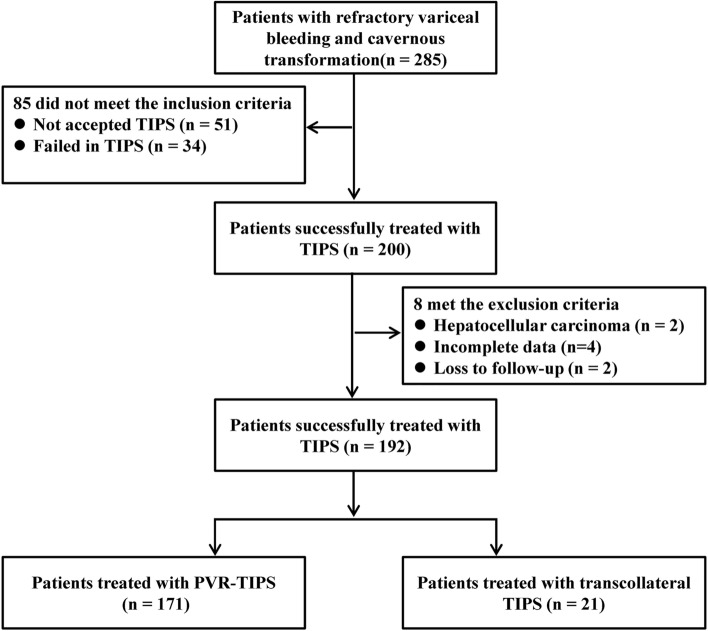
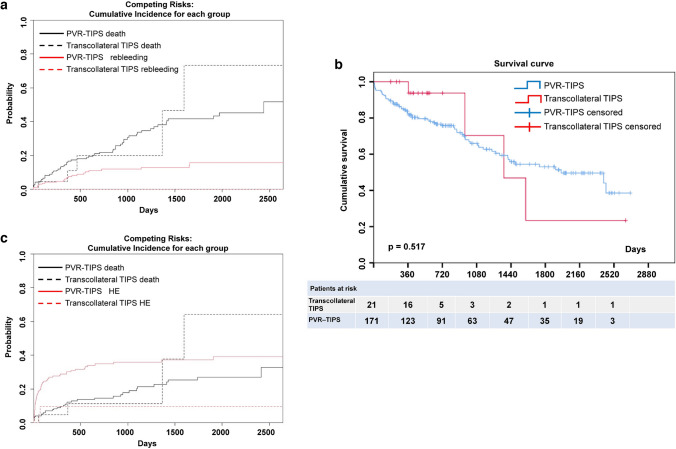
A total of 192 patients were enrolled, including 21 patients with transcollateral TIPS and 171 patients with PVR-TIPS. Compared with the patients with PVR-TIPS, the patients with transcollateral TIPS had more noncirrhosis (52.4 vs. 19.9%, p = 0.002), underwent fewer splenectomies (14.3 vs. 40.9%, p = 0.018), and had more extensive thromboses (38.1 vs. 15.2%, p = 0.026). There were no differences in rebleeding, survival, shunt dysfunction, or operation-related complication rates between the transcollateral TIPS and PVR-TIPS groups. However, the OHE rate was significantly lower in the transcollateral TIPS group (9.5 vs. 35.1%, p = 0.018).
Transcollateral TIPS is an effective treatment for CTPV with refractory variceal bleeding.
经颈静脉肝内门体分流术(transcollateral TIPS)用于治疗海绵窦样门静脉转化(CTPV)伴主门静脉无法再通的门静脉高压相关并发症。经颈静脉肝内门体分流术(transcollateral TIPS)是否能像门静脉再通-经颈静脉肝内门体分流术(PVR-TIPS)一样有效仍不清楚。本研究旨在评估 transcollateral TIPS 治疗 CTPV 伴难治性静脉曲张出血的疗效和安全性。
从 2015 年 1 月至 2022 年 3 月西京医院连续 TIPS 治疗患者数据库中选择 CTPV 引起难治性静脉曲张出血的患者。将患者分为 transcollateral TIPS 组和 PVR-TIPS 组。分析再出血率、总生存率、分流功能障碍、显性肝性脑病(OHE)和手术相关并发症。
共纳入 192 例患者,其中 transcollateral TIPS 组 21 例,PVR-TIPS 组 171 例。与 PVR-TIPS 组患者相比,transcollateral TIPS 组患者中非肝硬化(52.4%比 19.9%,p=0.002)、脾切除术(14.3%比 40.9%,p=0.018)和广泛血栓形成(38.1%比 15.2%,p=0.026)较少。两组患者再出血、生存率、分流功能障碍或手术相关并发症发生率无差异。但 transcollateral TIPS 组 OHE 发生率明显较低(9.5%比 35.1%,p=0.018)。
transcollateral TIPS 是治疗 CTPV 伴难治性静脉曲张出血的有效方法。