Zengil Sertaç, Laloğlu Esra
Department of Psychiatry, University of Health Sciences, Erzurum Regional Training and Research Hospital, Erzurum, Türkiye.
Department of Biochemistry, Ataturk University, Faculty of Medicine, Erzurum, Türkiye.
Psychiatry Investig. 2023 Apr;20(4):382-389. doi: 10.30773/pi.2022.0234. Epub 2023 Apr 20.
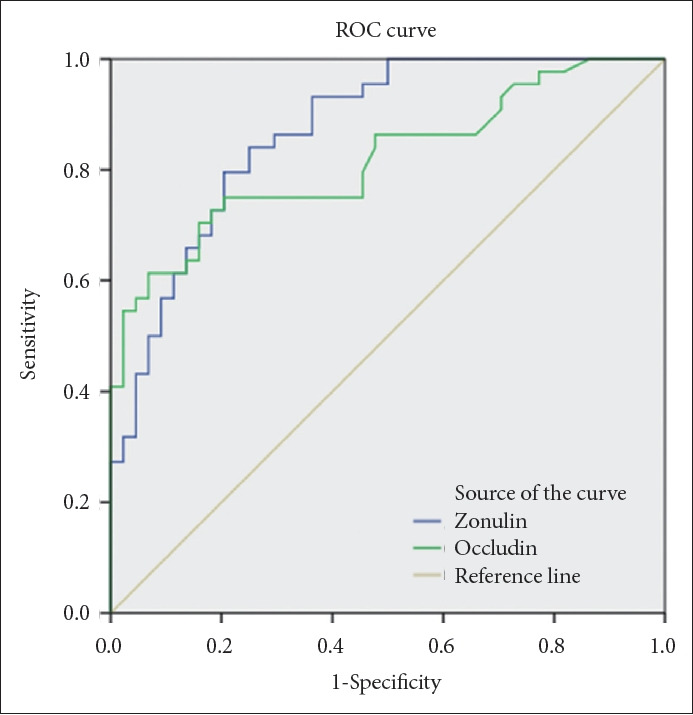
The etiology of bipolar disorder (BD) is still not fully understood. Little is currently known about the relationship between the interaction the gastrointestinal system and brain function and BD. Zonulin is the only known physiological modulator of tight junctions and is a biomarker for intestinal permeability (IP). Occludin is an integral transmembrane tight junction protein involved in the maintenance and assembly of such junctions. The current study aims to determine whether zonulin and occludin levels are altered in BD and whether they can serve as clinical biomarkers of disease.
Forty-four patients with BD and 44 healthy controls were included in this study. The Young Mania Rating Scale (YMRS) was used to determine the severity of manic symptoms, while the Hamilton Depression Rating Scale (HDRS) was used to determine the severity of depressive symptoms, and the Brief Functioning Rating Scale (FAST) to assess functionality. Venous blood samples were taken from all participants and serum zonulin and occludin levels were measured.
The mean serum zonulin and occludin levels of the patients were significantly higher compared to the healthy control group. There was no difference between manic, depressive, and euthymic patients in terms of zonulin and occludin levels. There was no correlation between the total number of attacks, duration of disease, YMRS, HDRS, FAST scores, and zonulin and occludin levels in the patient group. The groups were divided into three according to body mass index as normal, overweight, and obese. Zonulin and occludin levels increased as body mass index increased and were highest in the obese group.
The study shows that zonulin and occludin levels in BD increase independently of the disease stage. Consideration of the role of IP in the pathogenesis of BD may be helpful in determining the appropriate treatment modality.
双相情感障碍(BD)的病因仍未完全明确。目前对于胃肠系统与脑功能相互作用和双相情感障碍之间的关系知之甚少。闭合蛋白是已知唯一的紧密连接生理调节因子,是肠道通透性(IP)的生物标志物。闭合素是一种参与此类连接维持和组装的完整跨膜紧密连接蛋白。本研究旨在确定双相情感障碍患者体内闭合蛋白和闭合素水平是否发生改变,以及它们是否可作为该疾病的临床生物标志物。
本研究纳入了44例双相情感障碍患者和44名健康对照者。使用杨氏躁狂评定量表(YMRS)确定躁狂症状的严重程度,使用汉密尔顿抑郁评定量表(HDRS)确定抑郁症状的严重程度,并使用简易功能评定量表(FAST)评估功能状态。采集所有参与者的静脉血样本,测量血清中闭合蛋白和闭合素水平。
与健康对照组相比,患者的平均血清闭合蛋白和闭合素水平显著更高。在闭合蛋白和闭合素水平方面,躁狂、抑郁和心境正常的患者之间没有差异。患者组的发作总次数、病程、YMRS、HDRS、FAST评分与闭合蛋白和闭合素水平之间没有相关性。根据体重指数将这些组分为正常、超重和肥胖三组。随着体重指数增加,闭合蛋白和闭合素水平升高,在肥胖组中最高。
该研究表明,双相情感障碍患者体内的闭合蛋白和闭合素水平升高与疾病阶段无关。考虑肠道通透性在双相情感障碍发病机制中的作用可能有助于确定合适的治疗方式。