Assoum Mohamad, Lau Colleen L, Thai Phong K, Ahmed Warish, Mueller Jochen F, Thomas Kevin V, Choi Phil Min, Jackson Greg, Selvey Linda A
School of Public Health, Faculty of Medicine, The University of Queensland, Brisbane, QLD 4006, Australia.
Queensland Alliance for Environmental Health Sciences (QAEHS), The University of Queensland, Woolloongabba, QLD 4102, Australia.
Trop Med Infect Dis. 2023 Mar 31;8(4):211. doi: 10.3390/tropicalmed8040211.
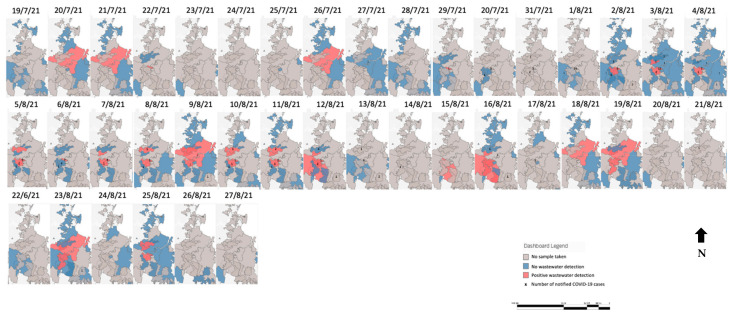
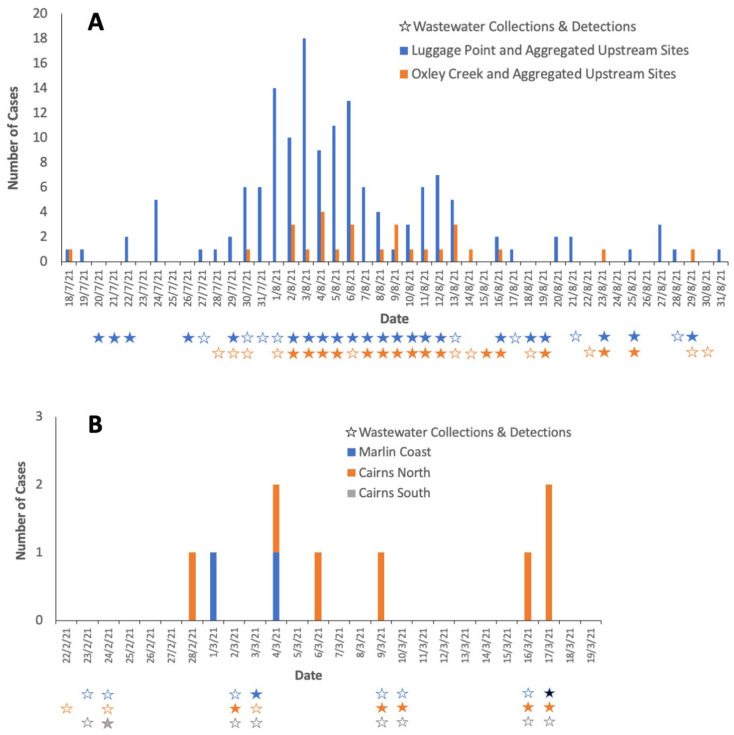
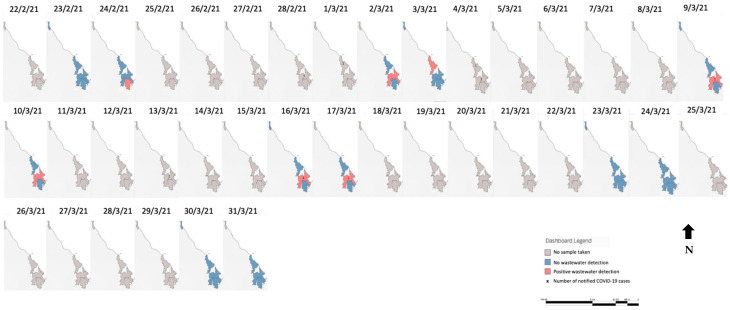
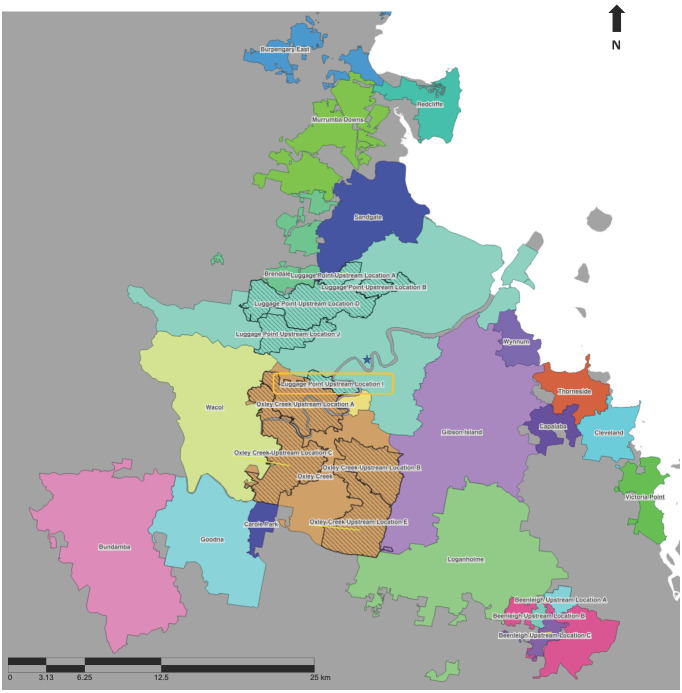
During the first two years of the COVID-19 pandemic, Australia implemented a series of international and interstate border restrictions. The state of Queensland experienced limited COVID-19 transmission and relied on lockdowns to stem any emerging COVID-19 outbreaks. However, early detection of new outbreaks was difficult. In this paper, we describe the wastewater surveillance program for SARS-CoV-2 in Queensland, Australia, and report two case studies in which we aimed to assess the potential for this program to provide early warning of new community transmission of COVID-19. Both case studies involved clusters of localised transmission, one originating in a Brisbane suburb (Brisbane Inner West) in July-August 2021, and the other originating in Cairns, North Queensland in February-March 2021.
Publicly available COVID-19 case data derived from the notifiable conditions (NoCs) registry from the Queensland Health data portal were cleaned and merged spatially with the wastewater surveillance data using statistical area 2 (SA2) codes. The positive predictive value and negative predictive value of wastewater detection for predicting the presence of COVID-19 reported cases were calculated for the two case study sites.
Early warnings for local transmission of SARS-CoV-2 through wastewater surveillance were noted in both the Brisbane Inner West cluster and the Cairns cluster. The positive predictive value of wastewater detection for the presence of notified cases of COVID-19 in Brisbane Inner West and Cairns were 71.4% and 50%, respectively. The negative predictive value for Brisbane Inner West and Cairns were 94.7% and 100%, respectively.
Our findings highlight the utility of wastewater surveillance as an early warning tool in low COVID-19 transmission settings.
在新冠疫情的头两年,澳大利亚实施了一系列国际和州际边境限制措施。昆士兰州的新冠病毒传播有限,依靠封锁措施来遏制任何新出现的新冠疫情。然而,早期发现新的疫情爆发很困难。在本文中,我们描述了澳大利亚昆士兰州针对严重急性呼吸综合征冠状病毒2(SARS-CoV-2)的废水监测项目,并报告了两个案例研究,旨在评估该项目对新冠病毒新的社区传播提供早期预警的潜力。两个案例研究均涉及局部传播集群,一个起源于2021年7月至8月布里斯班的一个郊区(布里斯班内西区),另一个起源于2021年2月至3月北昆士兰的凯恩斯。
从昆士兰卫生数据门户的法定传染病(NoCs)登记处获取的公开可用新冠病例数据,使用统计区域2(SA2)代码进行清理,并与废水监测数据进行空间合并。针对两个案例研究地点,计算了废水检测对预测新冠病毒报告病例存在情况的阳性预测值和阴性预测值。
在布里斯班内西区集群和凯恩斯集群中,均通过废水监测发现了SARS-CoV-2局部传播的早期预警。布里斯班内西区和凯恩斯废水检测对新冠病毒报告病例存在情况的阳性预测值分别为71.4%和50%。布里斯班内西区和凯恩斯的阴性预测值分别为94.7%和100%。
我们的研究结果突出了废水监测在新冠病毒低传播环境中作为早期预警工具的效用。