Fraenkel Carl-Johan, Starlander Gustaf, Tano Eva, Sütterlin Susanne, Melhus Åsa
Department of Infectious Diseases and Hospital Infection Control, Lund University Hospital, SE-22185 Lund, Sweden.
Section of Clinical Microbiology, Department of Medical Sciences, Uppsala University, SE-75185 Uppsala, Sweden.
Microorganisms. 2023 Apr 8;11(4):974. doi: 10.3390/microorganisms11040974.
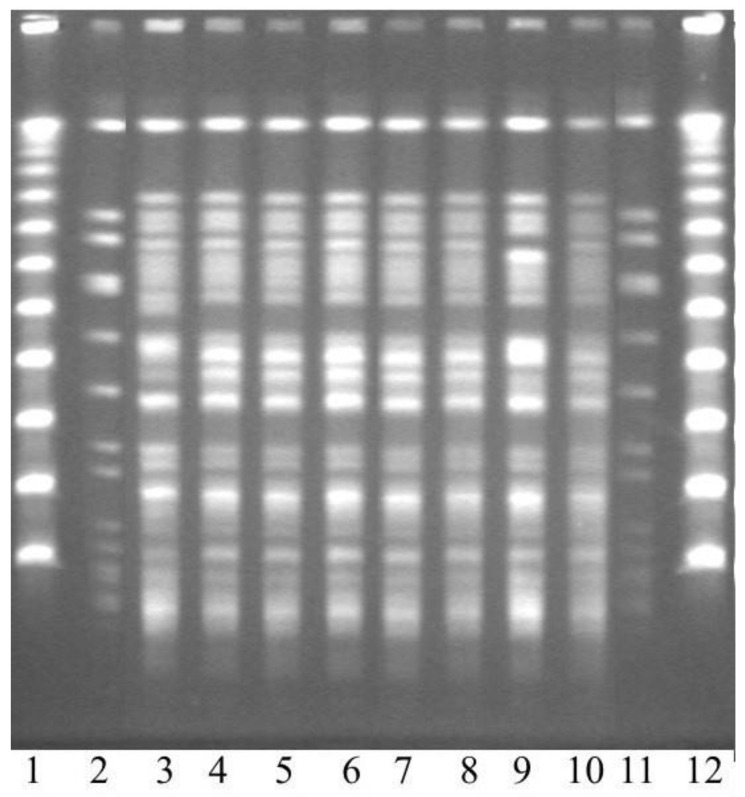
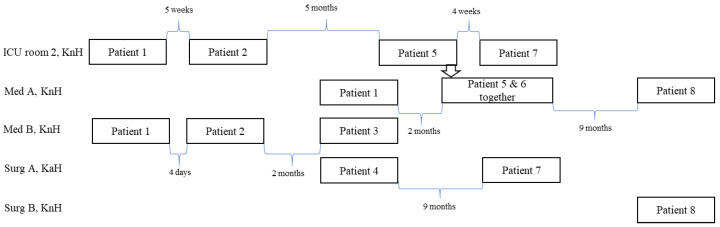
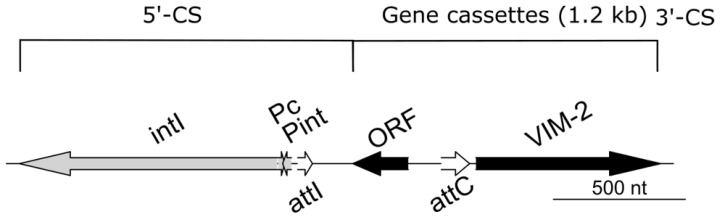
Multidrug-resistant is an increasing clinical problem worldwide. The aim of this study was to describe the first outbreak of a Verona integron-borne metallo-ß-lactamase (VIM)-2-producing strain in Sweden and its expansion in the region. A cluster of multidrug-resistant appeared at two neighbouring hospitals in 2006. The isolates were characterized by PCR, pulsed-field gel electrophoresis (PFGE), and whole-genome sequencing. Patient charts, laboratory records, and hygiene routines were reviewed, and patients, staff, and the environment were screened. The investigation revealed a clonal outbreak of a VIM-2-producing strain belonging to the high-risk clonal complex 111, susceptible only to gentamicin and colistin. No direct contact between patients could be established, but most of them had stayed in certain rooms/wards weeks to months apart. Cultures from two sinks yielded growth of the same strain. The outbreak ended when control measures against the sinks were taken, but new cases occurred in a tertiary care hospital in the region. In conclusion, when facing prolonged outbreaks with this bacterium, sinks and other water sources in the hospital environment should be considered. By implementing proactive control measures to limit the bacterial load in sinks, the waterborne transmission of may be reduced.
耐多药在全球范围内是一个日益严重的临床问题。本研究的目的是描述瑞典首例携带维罗纳整合子介导的金属β-内酰胺酶(VIM)-2的菌株暴发及其在该地区的传播情况。2006年,在两家相邻医院出现了一群耐多药菌株。通过聚合酶链反应(PCR)、脉冲场凝胶电泳(PFGE)和全基因组测序对分离株进行了鉴定。查阅了患者病历、实验室记录和卫生常规,并对患者、工作人员和环境进行了筛查。调查发现了一株产VIM-2的菌株的克隆性暴发,该菌株属于高危克隆复合体111,仅对庆大霉素和黏菌素敏感。无法确定患者之间有直接接触,但他们中的大多数人在相隔数周或数月的时间里曾住在某些病房。两个水槽的培养物培养出了相同的菌株。当对水槽采取控制措施后暴发结束,但该地区一家三级护理医院出现了新病例。总之,面对这种细菌的长期暴发时,应考虑医院环境中的水槽和其他水源。通过实施积极的控制措施来限制水槽中的细菌载量,可能会减少该菌的水传播。