Myburgh Nellie, Mulaudzi Mamakiri, Tshabalala Gugulethu, Beta Norest, Gutu Kimberley, Vermaak Stefanie, Lau Charles, Hill Catherine, Stanberry Lawrence, James Wilmot, Madhi Shabir, Makadzange Tariro, Dietrich Janan Janine
Vaccines and Infectious Disease Analytics (VIDA) Research Unit, Faculty of Health Sciences, University of the Witwatersrand, Johannesburg 2000, South Africa.
African Social Sciences Unit of Research and Evaluation (ASSURE), Wits Health Consortium, Faculty of Health Sciences, University of the Witwatersrand, Johannesburg 2000, South Africa.
Vaccines (Basel). 2023 Mar 25;11(4):729. doi: 10.3390/vaccines11040729.
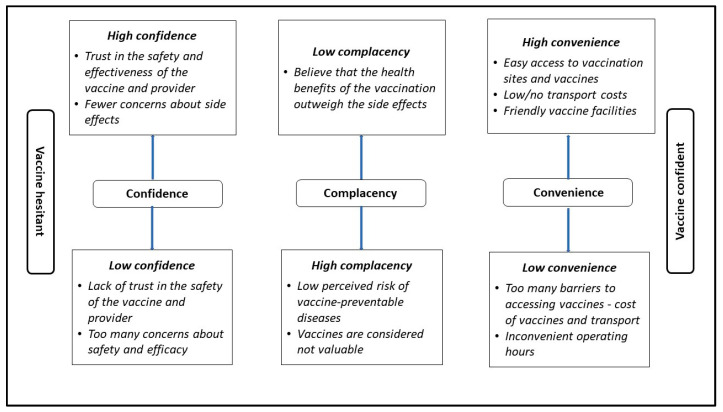
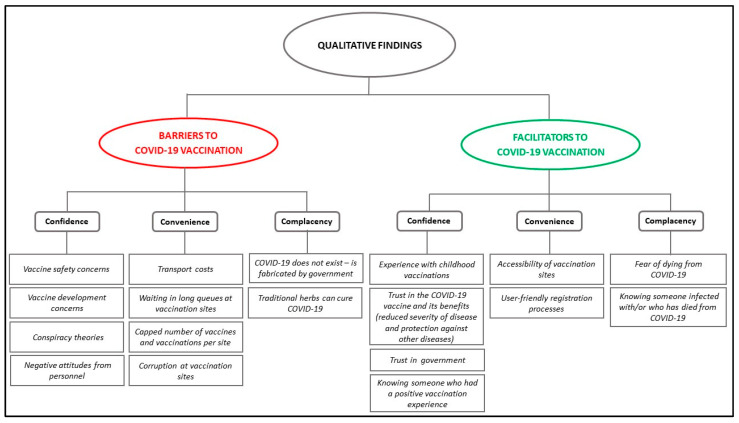
While vaccines are a well-established method of controlling the spread of infectious diseases, vaccine hesitancy jeopardizes curbing the spread of COVID-19. Through the Vaccine Information Network (VIN), this study explored barriers and motivators to COVID-19 vaccine uptake. We conducted 18 focus group discussions with male and female community members, stratified by country, age group, and-for Zimbabwe only-by HIV status. Participants' median age across both countries was 40 years (interquartile range of 22-40), and most (65.9%) were female. We conceptualized the key themes within the World Health Organization's Strategic Advisory Group of Experts on Immunization (SAGE) 3C (convenience, confidence, complacency) vaccine hesitancy model. Barriers to vaccine uptake-lack of convenience, low confidence, and high complacency-included inaccessibility of vaccines and vaccination sites, vaccine safety and development concerns, and disbelief in COVID-19's existence. Motivators to vaccine uptake-convenience, confidence, and low complacency-included accessibility of vaccination sites, user-friendly registration processes, trust in governments and vaccines, fear of dying from COVID-19, and knowing someone who had died from or become infected with COVID-19. Overall, vaccine hesitancy in South Africa and Zimbabwe was influenced by inconvenience, a lack of confidence, and high complacency around COVID-19 vaccines.
虽然疫苗是控制传染病传播的一种成熟方法,但疫苗犹豫会危及遏制新冠病毒的传播。通过疫苗信息网络(VIN),本研究探讨了新冠疫苗接种的障碍和动机。我们与男性和女性社区成员进行了18次焦点小组讨论,按国家、年龄组进行分层,在津巴布韦还按艾滋病毒感染状况进行分层。两国参与者的年龄中位数为40岁(四分位间距为22 - 40),大多数(65.9%)为女性。我们将关键主题纳入世界卫生组织免疫战略咨询专家组(SAGE)的3C(便利性、信心、自满)疫苗犹豫模型。疫苗接种的障碍——缺乏便利性、信心不足和高度自满——包括疫苗和接种点难以获取、对疫苗安全性和研发的担忧以及对新冠病毒存在的怀疑。疫苗接种的动机——便利性、信心和低度自满——包括接种点的可及性、用户友好的登记流程、对政府和疫苗的信任、对死于新冠病毒的恐惧以及认识死于新冠病毒或感染新冠病毒的人。总体而言,南非和津巴布韦的疫苗犹豫受到新冠疫苗不便获取、信心不足和高度自满的影响。