Gillis Timber, Garrison Scott
Department of Family Medicine University of Alberta Edmonton, AB Canada.
JMIR Infodemiology. 2022 Jul 19;2(2):e34464. doi: 10.2196/34464. eCollection 2022 Jul-Dec.
Internet search volume for medical information, as tracked by Google Trends, has been used to demonstrate unexpected seasonality in the symptom burden of a variety of medical conditions. However, when more technical medical language is used (eg, diagnoses), we believe that this technique is confounded by the cyclic, school year-driven internet search patterns of health care students.
This study aimed to (1) demonstrate that artificial "academic cycling" of Google Trends' search volume is present in many health care terms, (2) demonstrate how signal processing techniques can be used to filter academic cycling out of Google Trends data, and (3) apply this filtering technique to some clinically relevant examples.
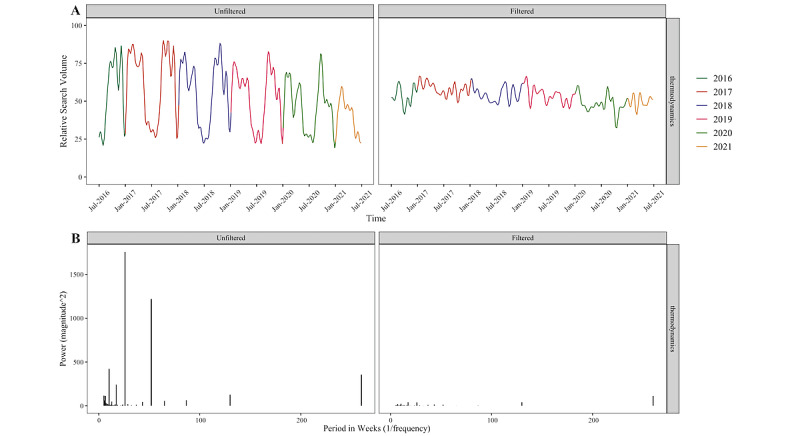
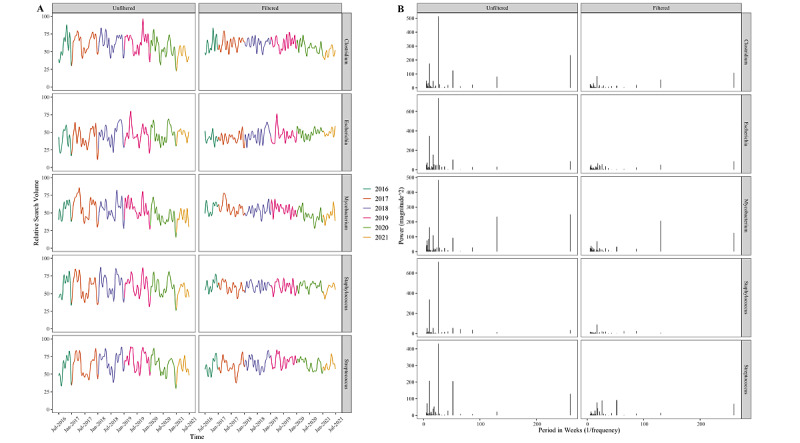
We obtained the Google Trends search volume data for a variety of academic terms demonstrating strong academic cycling and used a Fourier analysis technique to (1) identify the frequency domain fingerprint of this modulating pattern in one particularly strong example, and (2) filter that pattern out of the original data. After this illustrative example, we then applied the same filtering technique to internet searches for information on 3 medical conditions believed to have true seasonal modulation (myocardial infarction, hypertension, and depression), and all bacterial genus terms within a common medical microbiology textbook.
Academic cycling explains much of the seasonal variation in internet search volume for many technically oriented search terms, including the bacterial genus term ["Staphylococcus"], for which academic cycling explained 73.8% of the variability in search volume (using the squared Spearman rank correlation coefficient, <.001). Of the 56 bacterial genus terms examined, 6 displayed sufficiently strong seasonality to warrant further examination post filtering. This included (1) ["Aeromonas" + "Plesiomonas"] (nosocomial infections that were searched for more frequently during the summer), (2) ["Ehrlichia"] (a tick-borne pathogen that was searched for more frequently during late spring), (3) ["Moraxella"] and ["Haemophilus"] (respiratory infections that were searched for more frequently during late winter), (4) ["Legionella"] (searched for more frequently during midsummer), and (5) ["Vibrio"] (which spiked for 2 months during midsummer). The terms ["myocardial infarction"] and ["hypertension"] lacked any obvious seasonal cycling after filtering, whereas ["depression"] maintained an annual cycling pattern.
Although it is reasonable to search for seasonal modulation of medical conditions using Google Trends' internet search volume and lay-appropriate search terms, the variation in more technical search terms may be driven by health care students whose search frequency varies with the academic school year. When this is the case, using Fourier analysis to filter out academic cycling is a potential means to establish whether additional seasonality is present.

谷歌趋势所追踪的医学信息互联网搜索量,已被用于证明多种医学病症症状负担中存在意想不到的季节性。然而,当使用更具专业性的医学语言(例如诊断)时,我们认为该技术会受到医护专业学生受学年驱动的周期性互联网搜索模式的干扰。
本研究旨在(1)证明谷歌趋势搜索量中存在许多医护相关术语的人为“学术周期”,(2)展示如何使用信号处理技术从谷歌趋势数据中滤除学术周期,以及(3)将此过滤技术应用于一些临床相关示例。
我们获取了多种显示出强烈学术周期的学术术语的谷歌趋势搜索量数据,并使用傅里叶分析技术来(1)在一个特别明显的示例中识别这种调制模式的频域指纹,以及(2)从原始数据中滤除该模式。在这个示例之后,我们将相同的过滤技术应用于互联网上对3种被认为具有真正季节性调制的医学病症(心肌梗死、高血压和抑郁症)的信息搜索,以及一本常见医学微生物学教科书中的所有细菌属术语。
学术周期解释了许多技术导向型搜索词在互联网搜索量中的大部分季节性变化,包括细菌属术语["葡萄球菌"],其学术周期解释了搜索量变化的73.8%(使用平方斯皮尔曼等级相关系数,<.001)。在所检查的56个细菌属术语中,有6个显示出足够强的季节性,在过滤后值得进一步研究。这包括(1)["气单胞菌" + "邻单胞菌"](夏季搜索频率更高的医院感染),(2)["埃立克体"](一种蜱传病原体,在春末搜索频率更高),(3)["莫拉克斯氏菌"]和["嗜血杆菌"](冬末搜索频率更高的呼吸道感染),(4)["军团菌"](仲夏搜索频率更高),以及(5)["弧菌"](在仲夏期间飙升了2个月)。过滤后,术语["心肌梗死"]和["高血压"]没有任何明显的季节性周期,而["抑郁症"]保持年度周期模式。
虽然使用谷歌趋势的互联网搜索量和适合大众的搜索词来搜索医学病症的季节性调制是合理的,但更具专业性的搜索词的变化可能是由搜索频率随学年变化的医护专业学生驱动的。在这种情况下,使用傅里叶分析滤除学术周期是确定是否存在其他季节性的一种潜在方法。