Lawson Brodie A J, Dos Santos Rodrigo Weber, Turner Ian W, Bueno-Orovio Alfonso, Burrage Pamela, Burrage Kevin
Centre for Data Science, Queensland University of Technology, 2 George Street, Brisbane, 4000, Queensland, Australia.
ARC Centre of Excellence for Mathematical and Statistical Frontiers, Queensland University of Technology, 2 George Street, Brisbane, 4000, Queensland, Australia.
Commun Nonlinear Sci Numer Simul. 2023 Jan;116:None. doi: 10.1016/j.cnsns.2022.106794.
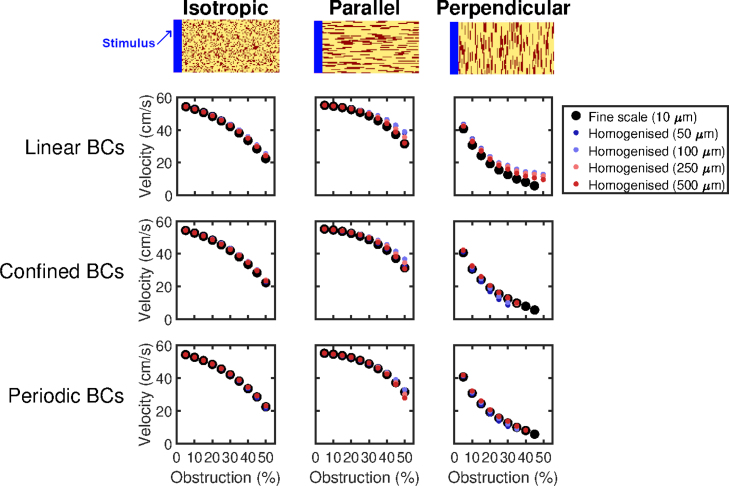
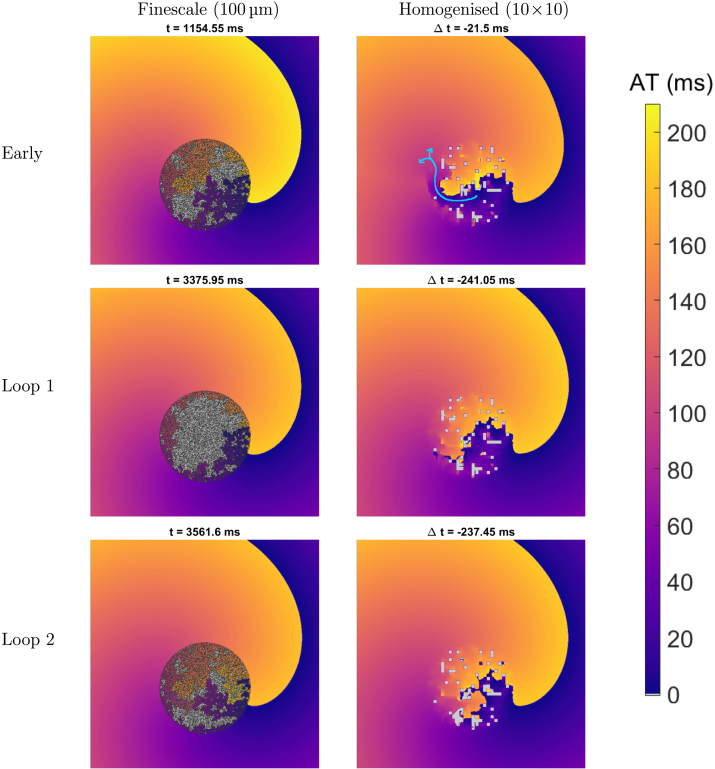
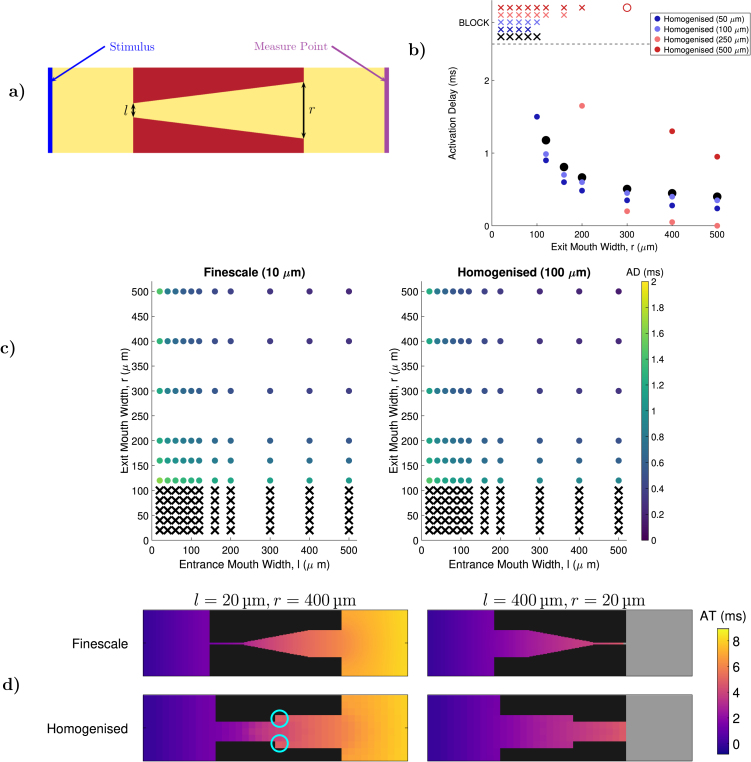
Computational models in cardiac electrophysiology are notorious for long runtimes, restricting the numbers of nodes and mesh elements in the numerical discretisations used for their solution. This makes it particularly challenging to incorporate structural heterogeneities on small spatial scales, preventing a full understanding of the critical arrhythmogenic effects of conditions such as cardiac fibrosis. In this work, we explore the technique of homogenisation by volume averaging for the inclusion of non-conductive micro-structures into larger-scale cardiac meshes with minor computational overhead. Importantly, our approach is not restricted to periodic patterns, enabling homogenised models to represent, for example, the intricate patterns of collagen deposition present in different types of fibrosis. We first highlight the importance of appropriate boundary condition choice for the closure problems that define the parameters of homogenised models. Then, we demonstrate the technique's ability to correctly upscale the effects of fibrotic patterns with a spatial resolution of into much larger numerical mesh sizes of 100- . The homogenised models using these coarser meshes correctly predict critical pro-arrhythmic effects of fibrosis, including slowed conduction, source/sink mismatch, and stabilisation of re-entrant activation patterns. As such, this approach to homogenisation represents a significant step towards whole organ simulations that unravel the effects of microscopic cardiac tissue heterogeneities.
心脏电生理学中的计算模型因运行时间长而声名狼藉,这限制了用于求解的数值离散化中的节点数和网格单元数。这使得在小空间尺度上纳入结构异质性变得特别具有挑战性,阻碍了对诸如心脏纤维化等病症的关键致心律失常作用的全面理解。在这项工作中,我们探索了通过体积平均进行均匀化的技术,以便将非导电微结构纳入具有较小计算开销的大规模心脏网格中。重要的是,我们的方法不限于周期性模式,使均匀化模型能够表示例如不同类型纤维化中存在的复杂胶原沉积模式。我们首先强调了为定义均匀化模型参数的封闭问题选择合适边界条件的重要性。然后,我们展示了该技术能够以 的空间分辨率将纤维化模式的影响正确地放大到100 - 的大得多的数值网格尺寸。使用这些较粗网格的均匀化模型正确地预测了纤维化的关键促心律失常作用,包括传导减慢、源/汇不匹配以及折返激活模式的稳定。因此,这种均匀化方法代表了朝着揭示微观心脏组织异质性影响的全器官模拟迈出的重要一步。