Simula Research Laboratory, Oslo, Norway.
Sci Rep. 2024 Jul 23;14(1):16954. doi: 10.1038/s41598-024-67431-w.
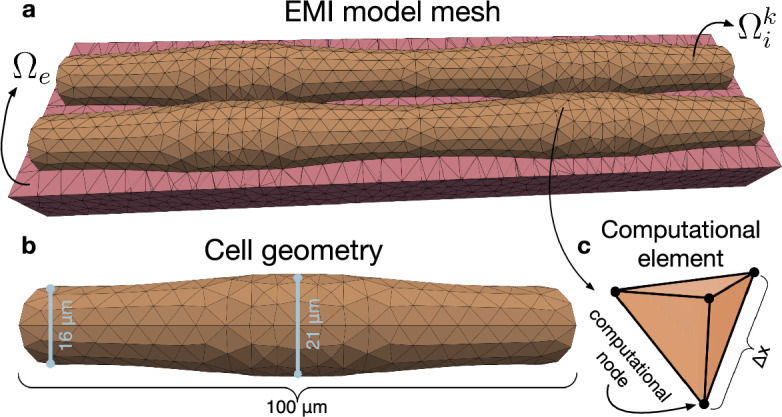
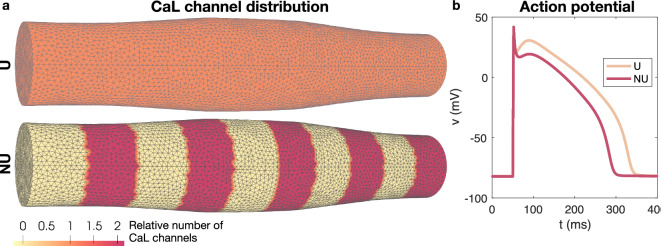
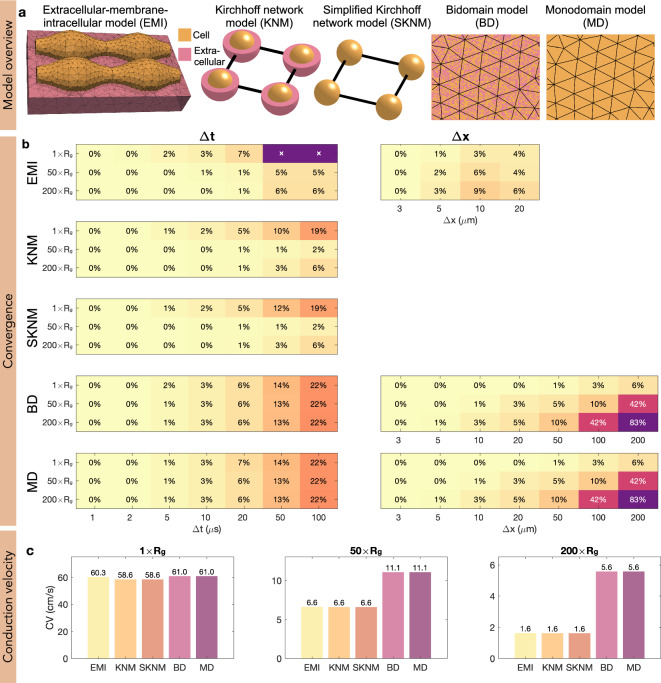
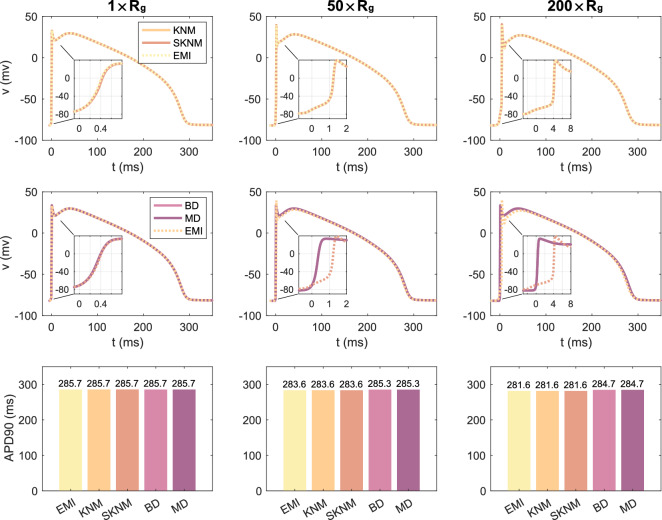
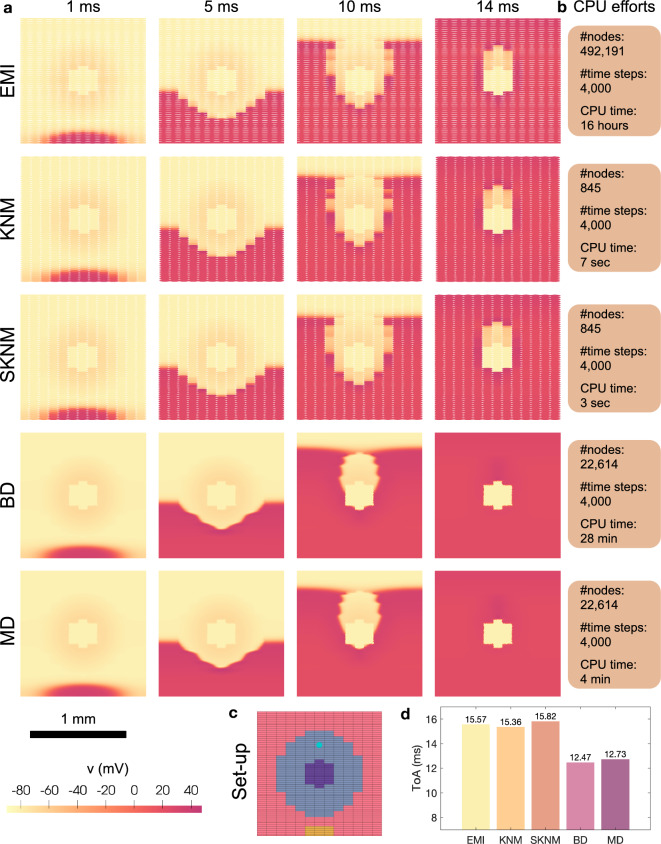
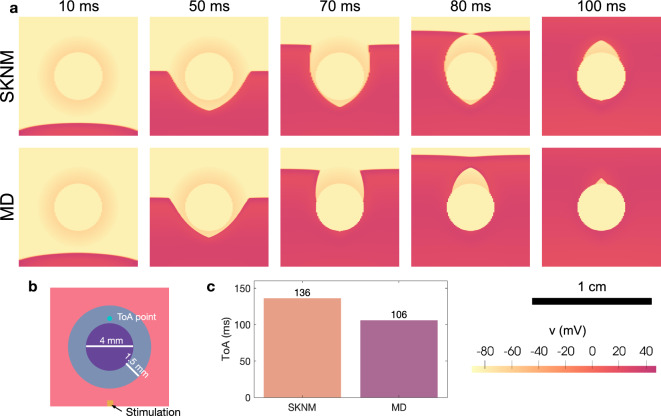
Computational techniques have significantly advanced our understanding of cardiac electrophysiology, yet they have predominantly concentrated on averaged models that do not represent the intricate dynamics near individual cardiomyocytes. Recently, accurate models representing individual cells have gained popularity, enabling analysis of the electrophysiology at the micrometer level. Here, we evaluate five mathematical models to determine their computational efficiency and physiological fidelity. Our findings reveal that cell-based models introduced in recent literature offer both efficiency and precision for simulating small tissue samples (comprising thousands of cardiomyocytes). Conversely, the traditional bidomain model and its simplified counterpart, the monodomain model, are more appropriate for larger tissue masses (encompassing millions to billions of cardiomyocytes). For simulations requiring detailed parameter variations along individual cell membranes, the EMI model emerges as the only viable choice. This model distinctively accounts for the extracellular (E), membrane (M), and intracellular (I) spaces, providing a comprehensive framework for detailed studies. Nonetheless, the EMI model's applicability to large-scale tissues is limited by its substantial computational demands for subcellular resolution.
计算技术极大地提高了我们对心脏电生理学的理解,但它们主要集中在平均模型上,这些模型无法代表单个心肌细胞附近的复杂动力学。最近,代表单个细胞的准确模型越来越受欢迎,使得能够在微米级水平上分析电生理学。在这里,我们评估了五个数学模型,以确定它们的计算效率和生理保真度。我们的研究结果表明,最近文献中引入的基于细胞的模型为模拟小组织样本(包含数千个心肌细胞)提供了效率和精度。相反,传统的双域模型及其简化版本,即单域模型,更适合于更大的组织质量(包含数百万到数十亿个心肌细胞)。对于需要沿单个细胞膜进行详细参数变化模拟的情况,EMI 模型是唯一可行的选择。该模型独特地考虑了细胞外(E)、膜(M)和细胞内(I)空间,为详细研究提供了全面的框架。然而,由于需要亚细胞分辨率,EMI 模型的计算需求很大,因此其在大规模组织中的应用受到限制。