Institute for Biological and Medical Engineering, Schools of Engineering, Medicine and Biological Sciences, Pontificia Universidad Católica de Chile, Santiago, Chile.
Department of Structural and Geotechnical Engineering, School of Engineering, Pontificia Universidad Católica de Chile, Santiago, Chile.
PLoS Comput Biol. 2020 Feb 25;16(2):e1007232. doi: 10.1371/journal.pcbi.1007232. eCollection 2020 Feb.
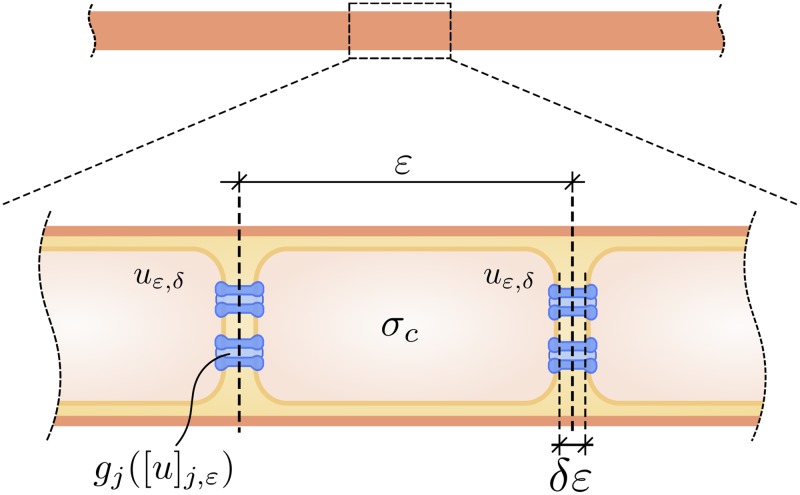
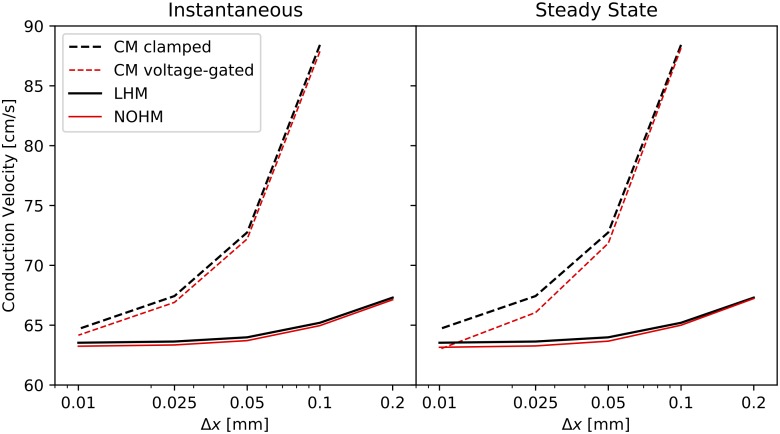
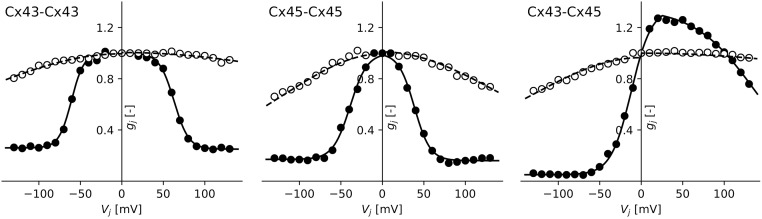
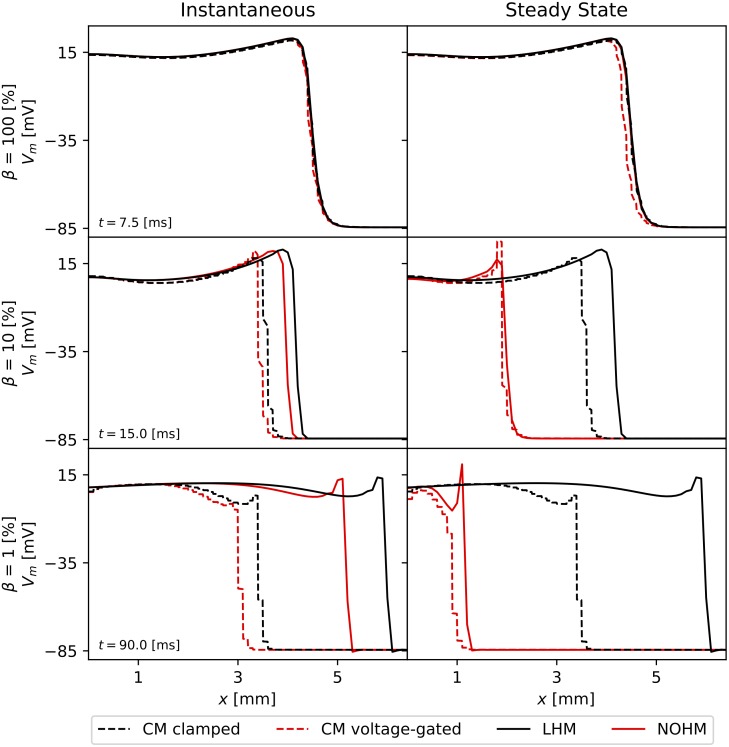
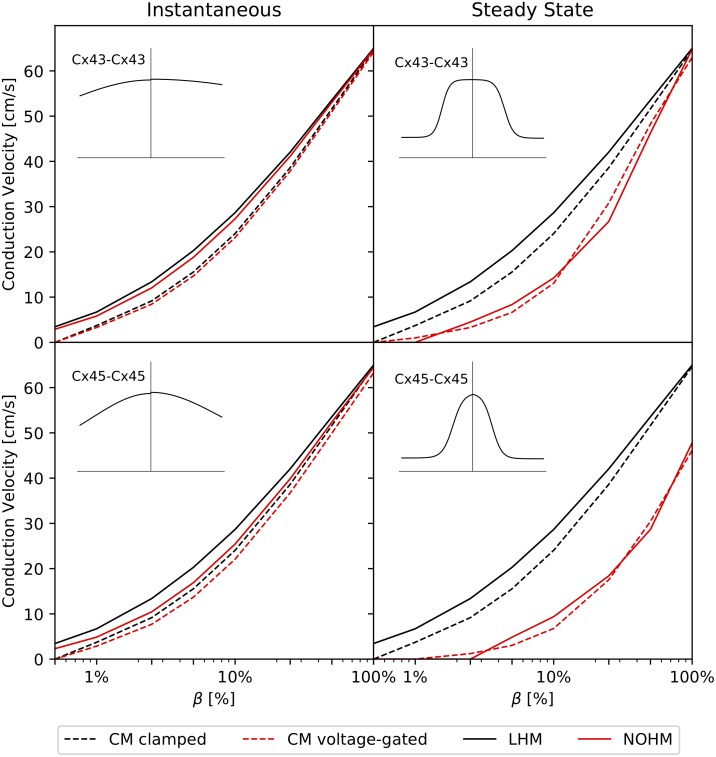
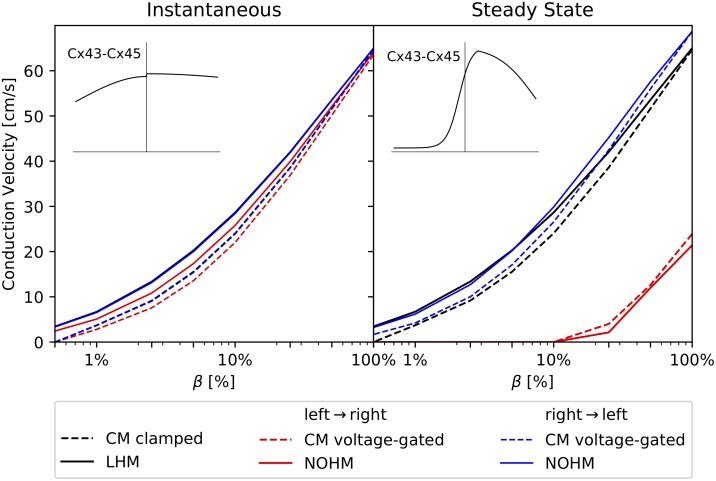
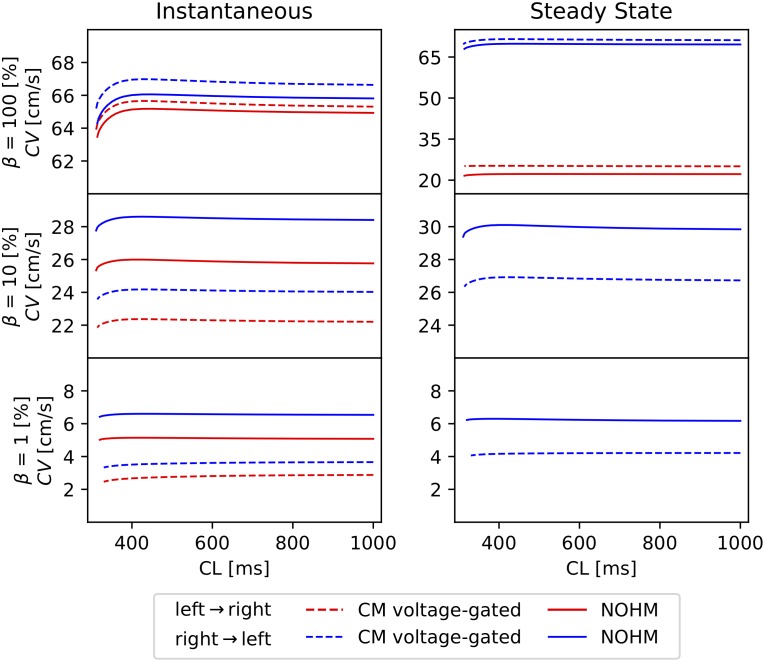
Gap junctions are key mediators of intercellular communication in cardiac tissue, and their function is vital to sustaining normal cardiac electrical activity. Conduction through gap junctions strongly depends on the hemichannel arrangement and transjunctional voltage, rendering the intercellular conductance highly non-Ohmic, particularly under steady-state regimes of conduction. Despite this marked non-linear behavior, current tissue-level models of cardiac conduction are rooted in the assumption that gap-junctions conductance is constant (Ohmic), which results in inaccurate predictions of electrical propagation, particularly in the low junctional-coupling regime observed under pathological conditions. In this work, we present a novel non-Ohmic homogenization model (NOHM) of cardiac conduction that is suitable to tissue-scale simulations. Using non-linear homogenization theory, we develop a conductivity model that seamlessly upscales the voltage-dependent conductance of gap junctions, without the need of explicitly modeling gap junctions. The NOHM model allows for the simulation of electrical propagation in tissue-level cardiac domains that accurately resemble that of cell-based microscopic models for a wide range of junctional coupling scenarios, recovering key conduction features at a fraction of the computational complexity. A unique feature of the NOHM model is the possibility of upscaling the response of non-symmetric gap-junction conductance distributions, which result in conduction velocities that strongly depend on the direction of propagation, thus allowing to model the normal and retrograde conduction observed in certain regions of the heart. We envision that the NOHM model will enable organ-level simulations that are informed by sub- and inter-cellular mechanisms, delivering an accurate and predictive in-silico tool for understanding the heart function. Codes are available for download at https://github.com/dehurtado/NonOhmicConduction.
间隙连接是心肌细胞间通讯的关键介质,其功能对维持正常心脏电活动至关重要。间隙连接的传导强烈依赖于半通道排列和跨连接电压,使得细胞间电导呈现高度非线性,尤其是在传导的稳态状态下。尽管存在这种明显的非线性行为,但当前的心脏传导组织水平模型基于间隙连接电导恒定(欧姆)的假设,这导致对电传播的预测不准确,特别是在病理条件下观察到的低连接耦合状态下。在这项工作中,我们提出了一种新的心脏传导非欧姆均匀化模型(NOHM),适用于组织尺度模拟。利用非线性均匀化理论,我们开发了一种电导率模型,该模型无缝地上调了间隙连接电压依赖性电导,而无需显式地对间隙连接进行建模。NOHM 模型允许对组织尺度心脏域中的电传播进行模拟,该模型与广泛的连接耦合情况下的基于细胞的微观模型非常相似,在计算复杂度的一小部分内恢复了关键的传导特征。NOHM 模型的一个独特特征是能够对非对称间隙连接电导分布的响应进行上采样,从而导致传导速度强烈依赖于传播方向,从而能够模拟心脏某些区域中观察到的正常和逆行传导。我们设想,NOHM 模型将能够进行器官水平的模拟,这些模拟受亚细胞和细胞间机制的启发,为理解心脏功能提供准确和可预测的计算工具。代码可在 https://github.com/dehurtado/NonOhmicConduction 下载。