Agarwal Ashok, Farkouh Ala'a, Saleh Ramadan, Abdel-Meguid Hamoda Taha Abo-Almagd, Harraz Ahmed M, Kavoussi Parviz, Arafa Mohamed, Salvio Gianmaria, Rambhatla Amarnath, Toprak Tuncay, Gül Murat, Phuoc Nguyen Ho Vinh, Boitrelle Florence, Birowo Ponco, Ghayda Ramy Abou, Cannarella Rossella, Kuroda Shinnosuke, Durairajanayagam Damayanthi, Zini Armand, Wyns Christine, Sarikaya Selcuk, Tremellen Kelton, Mostafa Taymour, Sokolakis Ioannis, Evenson Donald P, Henkel Ralf, Zohdy Wael, Chung Eric, Ziouziou Imad, Falcone Marco, Russo Giorgio I, Al-Hashimi Manaf, Calogero Aldo E, Ko Edmund, Colpi Giovanni, Lewis Sheena, Serefoglu Ege Can, Bahar Fahmi, Martinez Marlon, Nguyen Quang, Ambar Rafael F, Bakircioglu Mustafa Emre, Kandil Hussein, Mogharabian Nasser, Sabbaghian Marjan, Taniguchi Hisanori, Tsujimura Akira, Sajadi Hesamoddin, Ibrahim Wael, Atmoko Widi, Vogiatzi Paraskevi, Gunes Sezgin, Sadighi Gilani Mohammad Ali, Roychoudhury Shubhadeep, Güngör Nur Dokuzeylül, Hakim Lukman, Adriansjah Ricky, Kothari Priyank, Jindal Sunil, Amar Edouard, Park Hyun Jun, Long Tran Quang Tien, Homa Sheryl, Karthikeyan Vilvapathy Senguttuvan, Zilaitiene Birute, Maldonado Rosas Israel, Marino Angelo, Pescatori Edoardo, Ozer Cevahir, Akhavizadegan Hamed, Garrido Nicolas, Busetto Gian Maria, Adamyan Aram, Al-Marhoon Mohamed, Elbardisi Haitham, Dolati Parisa, Darbandi Mahsa, Darbandi Sara, Balercia Giancarlo, Pinggera Germar-Michael, Micic Sava, Ho Christopher Chee Kong, Moussa Mohamad, Preto Mirko, Zenoaga-Barbăroșie Cătălina, Smith Ryan P, Kosgi Raghavender, de la Rosette Jean, El-Sakka Ahmed I, Abumelha Saad Mohammed, Mierzwa Tiago Cesar, Ong Teng Aik, Banihani Saleem A, Bowa Kasonde, Fukuhara Shinichiro, Boeri Luca, Danacıoğlu Yavuz Onur, Gokalp Fatih, Selim Osama Mohamed, Cho Chak-Lam, Tadros Nicholas N, Ugur Muhammet Rasit, Ozkent Mehmet Serkan, Chiu Peter, Kalkanli Arif, Khalafalla Kareim, Vishwakarma Ranjit B, Finocchi Federica, Andreadakis Sotiris, Giulioni Carlo, Çeker Gökhan, Ceyhan Erman, Malhotra Vineet, Yilmaz Mehmet, Timpano Massimiliano, Barrett Trenton L, Kim Shannon Hee Kyung, Ahn Sun-Tae, Giacone Filippo, Palani Ayad, Duarsa Gede Wirya Kusuma, Kadioglu Ates, Gadda Franco, Zylbersztejn Daniel Suslik, Aydos Kaan, Kulaksız Deniz, Gupte Deepak, Calik Gokhan, Karna Keshab Kumar, Drakopoulos Panagiotis, Baser Aykut, Kumar Vijay, Molina Juan Manuel Corral, Rajmil Osvaldo, Ferreira Raphael H, Leonardi Sofia, Avoyan Armen, Sogutdelen Emrullah, Franco Giorgio, Ramsay Jonathan, Ramirez Liliana, Shah Rupin
Global Andrology Forum, American Center for Reproductive Medicine, Moreland Hills, OH, USA.
Cleveland Clinic Foundation, Cleveland, OH, USA.
World J Mens Health. 2023 Jul;41(3):575-602. doi: 10.5534/wjmh.220282. Epub 2023 Apr 10.
Sperm DNA fragmentation (SDF) testing was recently added to the sixth edition of the World Health Organization laboratory manual for the examination and processing of human semen. Many conditions and risk factors have been associated with elevated SDF; therefore, it is important to identify the population of infertile men who might benefit from this test. The purpose of this study was to investigate global practices related to indications for SDF testing, compare the relevant professional society guideline recommendations, and provide expert recommendations.
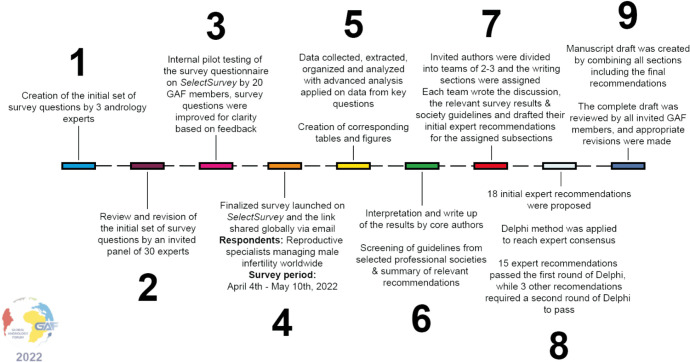
Clinicians managing male infertility were invited to take part in a global online survey on SDF clinical practices. This was conducted following the CHERRIES checklist criteria. The responses were compared to professional society guideline recommendations related to SDF and the appropriate available evidence. Expert recommendations on indications for SDF testing were then formulated, and the Delphi method was used to reach consensus.
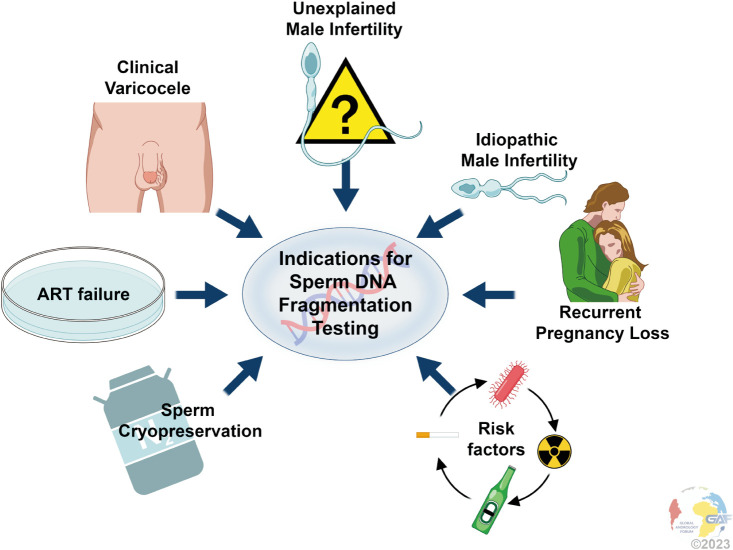
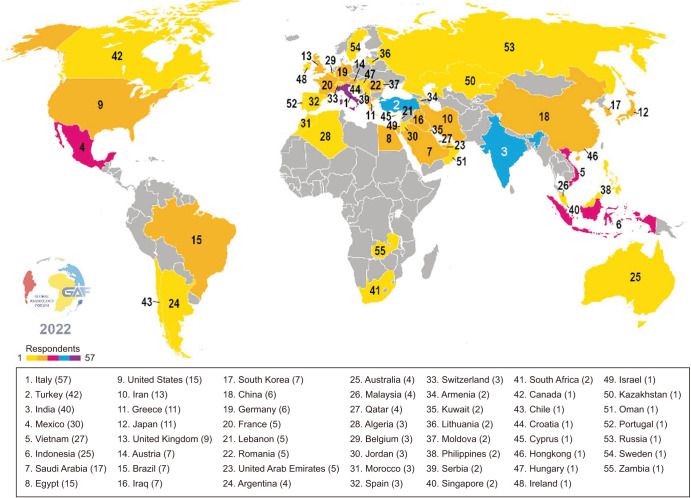
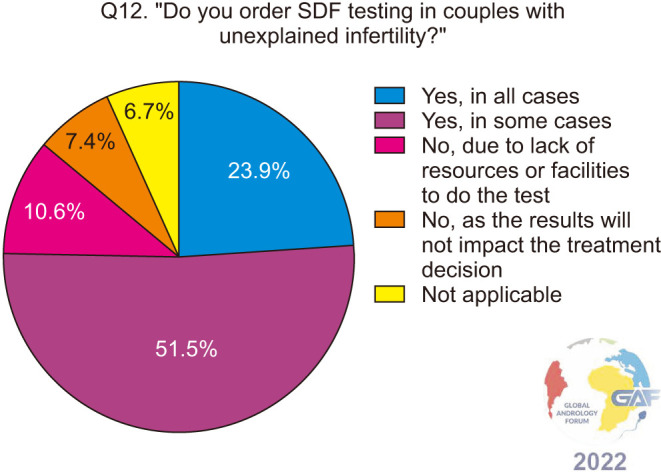
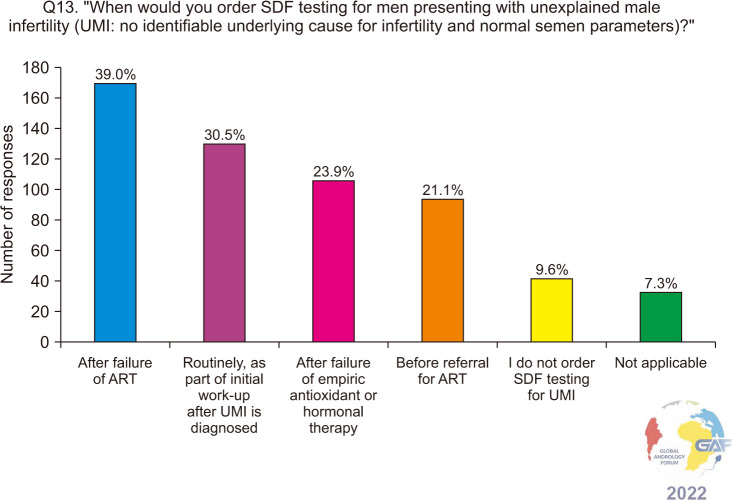
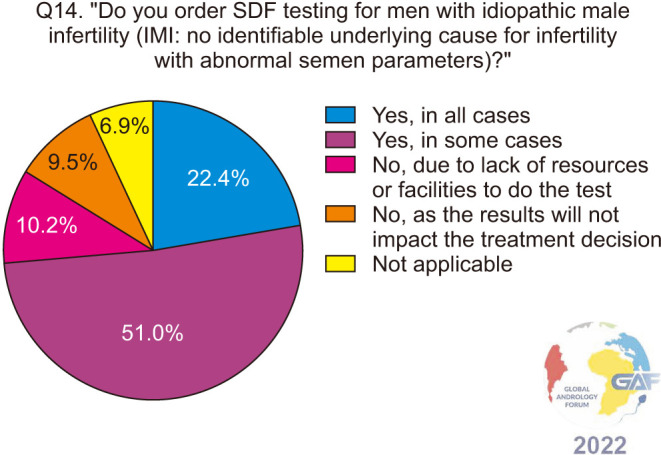
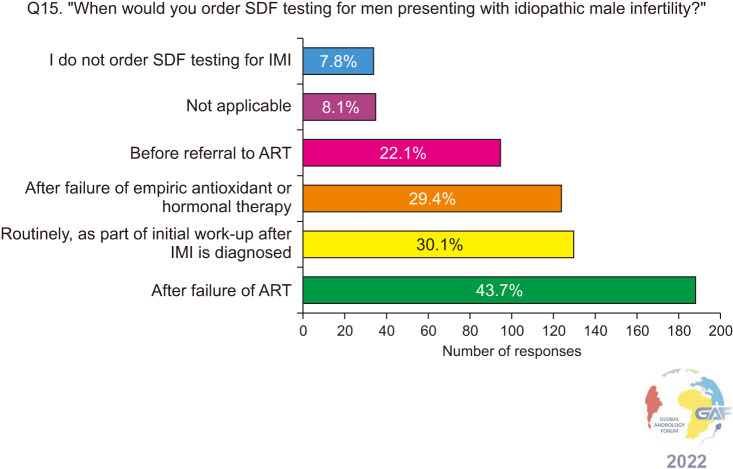
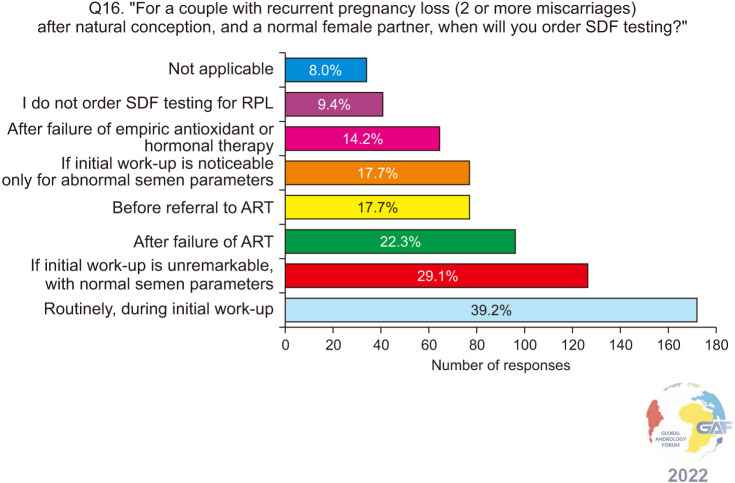
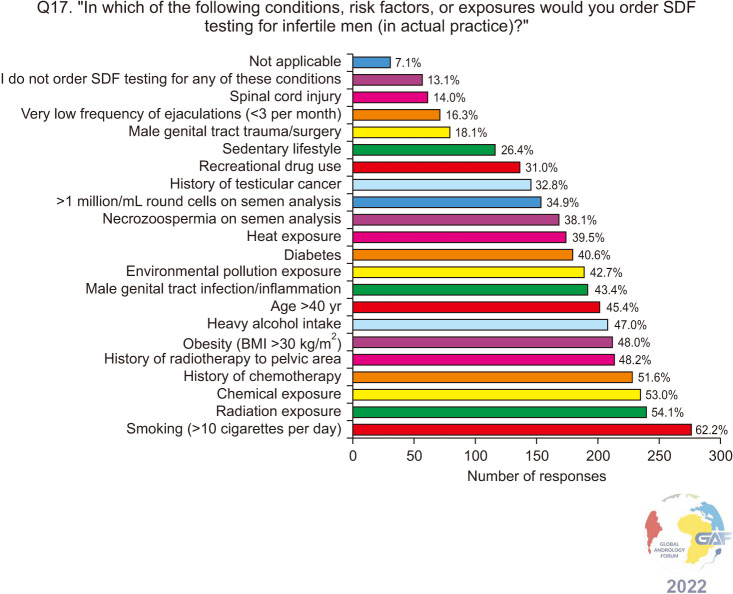
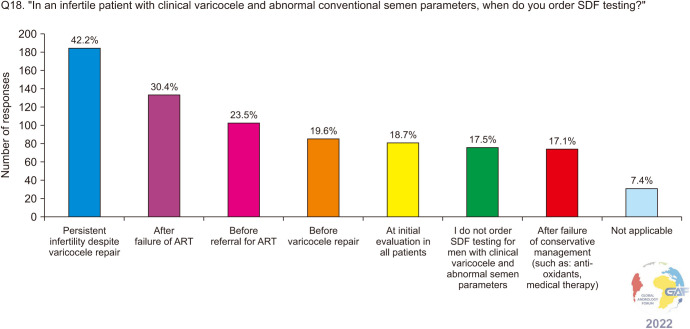
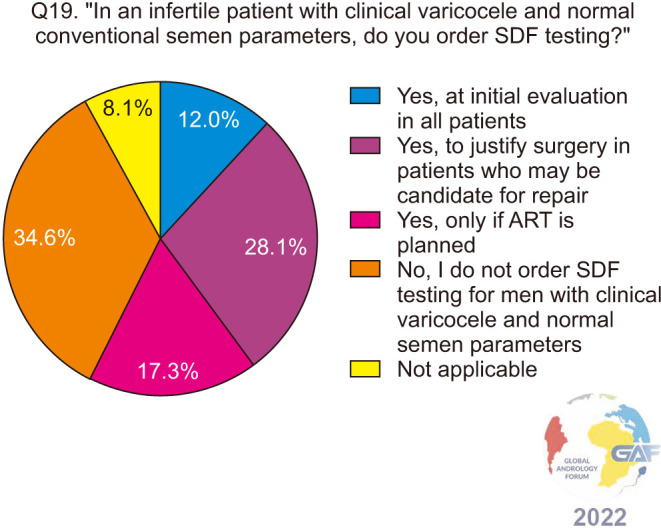
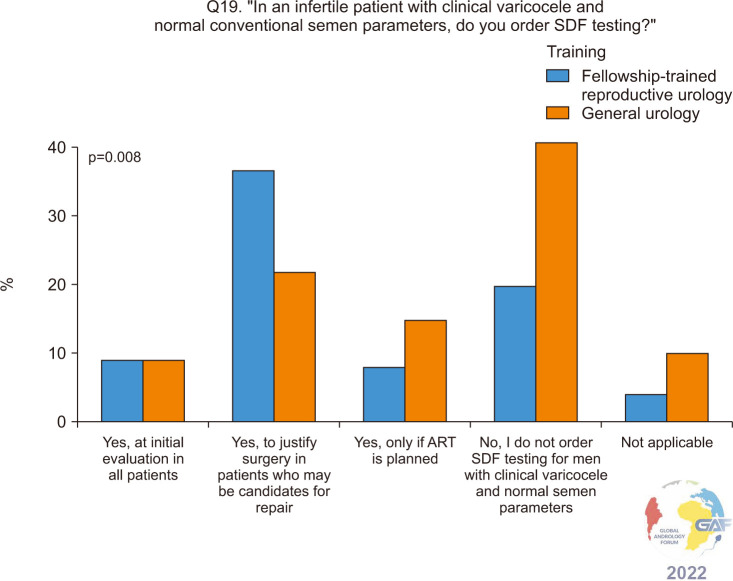
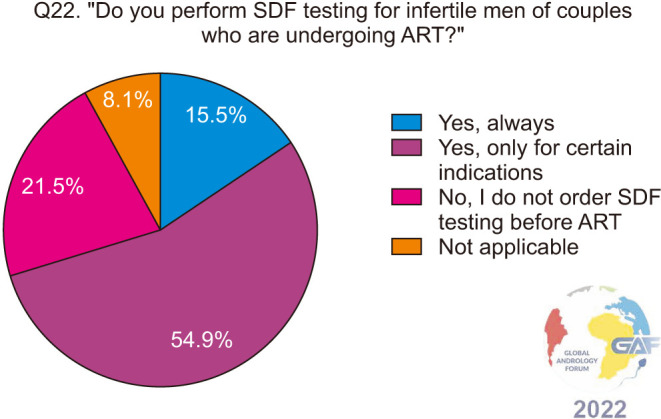
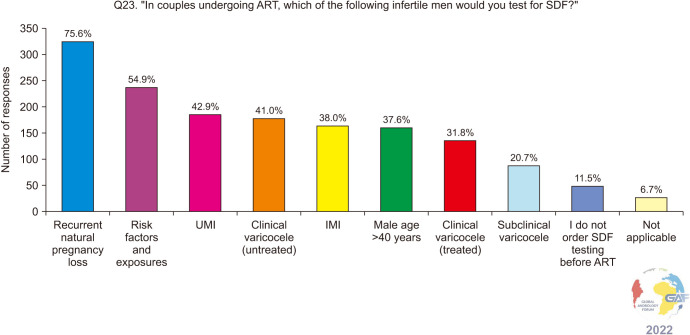
The survey was completed by 436 experts from 55 countries. Almost 75% of respondents test for SDF in all or some men with unexplained or idiopathic infertility, 39% order it routinely in the work-up of recurrent pregnancy loss (RPL), and 62.2% investigate SDF in smokers. While 47% of reproductive urologists test SDF to support the decision for varicocele repair surgery when conventional semen parameters are normal, significantly fewer general urologists (23%; p=0.008) do the same. Nearly 70% would assess SDF before assisted reproductive technologies (ART), either always or for certain conditions. Recurrent ART failure is a common indication for SDF testing. Very few society recommendations were found regarding SDF testing.
This article presents the largest global survey on the indications for SDF testing in infertile men, and demonstrates diverse practices. Furthermore, it highlights the paucity of professional society guideline recommendations. Expert recommendations are proposed to help guide clinicians.
精子DNA碎片化(SDF)检测最近被纳入世界卫生组织人类精液检查与处理实验室手册第六版。许多情况和风险因素都与SDF升高有关;因此,确定可能从该检测中受益的不育男性群体很重要。本研究的目的是调查与SDF检测适应症相关的全球实践,比较相关专业协会的指南建议,并提供专家建议。
邀请处理男性不育的临床医生参与一项关于SDF临床实践的全球在线调查。该调查遵循CHERRIES清单标准进行。将调查结果与与SDF相关的专业协会指南建议及适当的现有证据进行比较。然后制定关于SDF检测适应症的专家建议,并采用德尔菲法达成共识。
来自55个国家的436名专家完成了该调查。近75%的受访者对所有或部分不明原因或特发性不育男性进行SDF检测,39%在复发性流产(RPL)检查中常规进行该项检测,62.2%对吸烟者进行SDF检测。虽然47%的生殖泌尿科医生在常规精液参数正常时检测SDF以支持精索静脉曲张修复手术的决策,但进行同样检测的普通泌尿科医生明显较少(23%;p = 0.008)。近70%的人会在辅助生殖技术(ART)之前评估SDF,无论是始终如此还是针对某些情况。反复ART失败是SDF检测的常见适应症。关于SDF检测的协会建议很少。
本文展示了关于不育男性SDF检测适应症的最大规模全球调查,并证明了实践的多样性。此外,它突出了专业协会指南建议的匮乏。提出专家建议以帮助指导临床医生。