Shanghai University, Chengzhong Road, 201800 Shanghai, China.
Anhui University of Science and Technology, 168 Taifeng Street, 232000 Huainan, China.
Int J Med Inform. 2023 Jul;175:105073. doi: 10.1016/j.ijmedinf.2023.105073. Epub 2023 Apr 25.
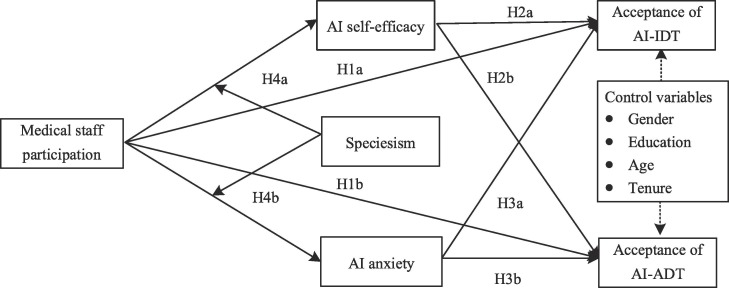
Medical artificial intelligence (AI) in varying degrees has exerted significant influence on many medical fields, especially in the midst of the COVID-19 pandemic. However, little is known regarding how to address the reluctance of medical staff to use AI technology. While recent research has highlighted the importance of medical staff participation in the development of AI, the current understanding of influence of medical staff participation on acceptance of AI is limited.
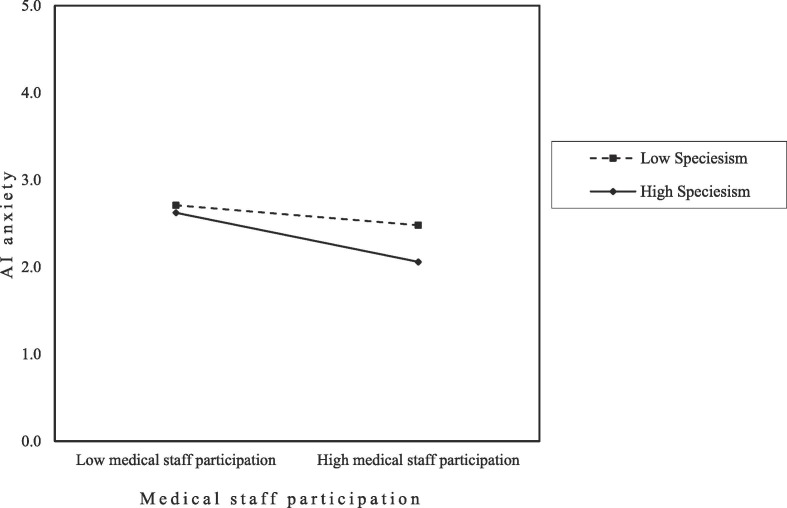
To provide insights into the mechanism that how medical staff participation impacts on the medical staff's acceptance of AI and to examine the moderating effect of speciesism.
This study was conducted from 6th August to 3rd September. Data was collected from doctors and nurses and a total of 288 valid questionnaires were obtained. Smart PLS 3.2.8 was used as partial least square (PLS) software to validate the research model.
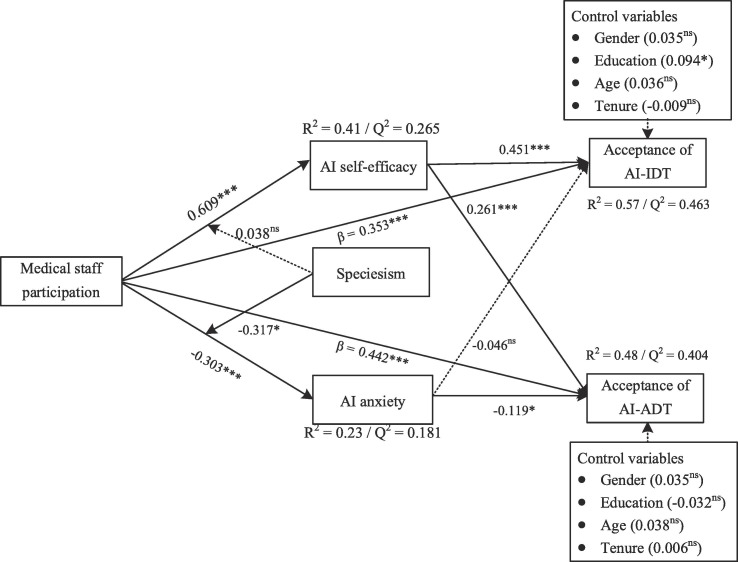
The study determined that medical staff participation had a significant impact on acceptance of medical AI-IDT (β = 0.35, p ≤ 0.001) and acceptance of medical AI-ADT (β = 0.44, p ≤ 0.001). The results also show that AI self-efficacy and AI anxiety have significant mediating effects and speciesism has significant moderating effects among the theoretical model.
This study provides insights into ways to explore influence factors of acceptance of AI based on user participation perspective. The results indicate that medical staff participation enhances acceptance of medical AI through the cognitive path (i.e., AI self-efficacy) and the affective path (i.e., AI anxiety). These results have practical implications for how organizations assist the staff to accommodate themselves to AI technology in the future.
医疗人工智能(AI)在不同程度上对许多医学领域产生了重大影响,尤其是在 COVID-19 大流行期间。然而,对于如何解决医务人员对使用 AI 技术的抵触情绪,人们知之甚少。尽管最近的研究强调了医务人员参与 AI 开发的重要性,但目前对于医务人员参与对 AI 接受度的影响的理解有限。
深入了解医务人员参与如何影响医务人员对 AI 的接受度,并检验物种主义的调节作用。
本研究于 2023 年 8 月 6 日至 9 月 3 日进行。数据采集自医生和护士,共获得 288 份有效问卷。使用 Smart PLS 3.2.8 作为偏最小二乘法(PLS)软件验证研究模型。
研究表明,医务人员参与对医疗 AI-IDT(β=0.35,p≤0.001)和医疗 AI-ADT(β=0.44,p≤0.001)的接受度有显著影响。结果还表明,AI 自我效能感和 AI 焦虑感在理论模型中具有显著的中介作用,而物种主义具有显著的调节作用。
本研究提供了一种基于用户参与视角探索 AI 接受度影响因素的方法。研究结果表明,医务人员参与通过认知路径(即 AI 自我效能感)和情感路径(即 AI 焦虑感)增强了对医疗 AI 的接受度。这些结果对于未来组织如何帮助员工适应 AI 技术具有实际意义。