Ge Yulong, Liu Xiaoqiang, Chen Hangwei, Li Gonghao, Xing Xing, Liu Junyi, Zhang Chunxia, Zhuge Ying, Wang Fang
Department of Cardiology, Shanghai General Hospital, Shanghai Jiao Tong University School of Medicine, Shanghai, China.
Department of Cardiology, The First People's Hospital of Lianyungang, Xuzhou Medical University Affiliated Hospital of Lianyungang, Lianyungang, China.
Front Physiol. 2023 Apr 13;14:1140856. doi: 10.3389/fphys.2023.1140856. eCollection 2023.
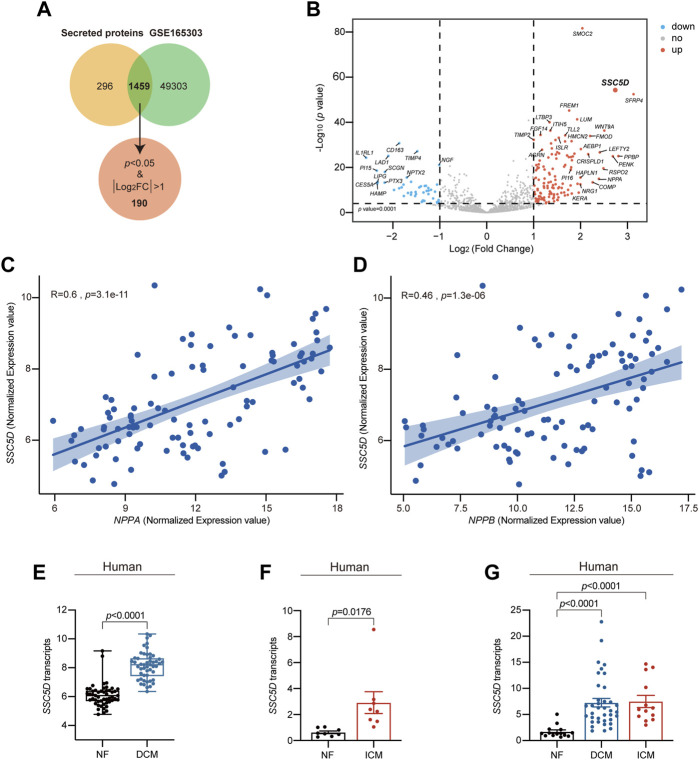
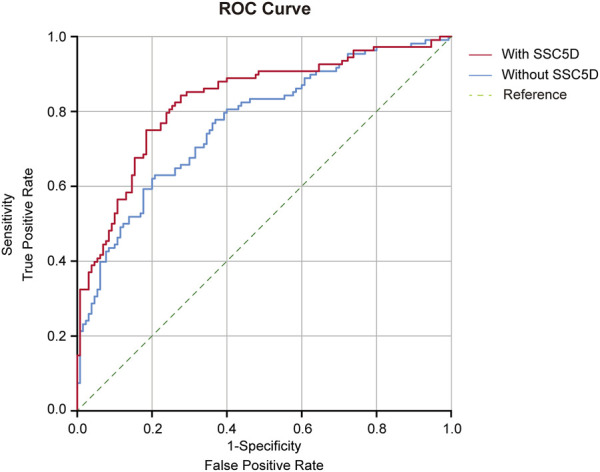
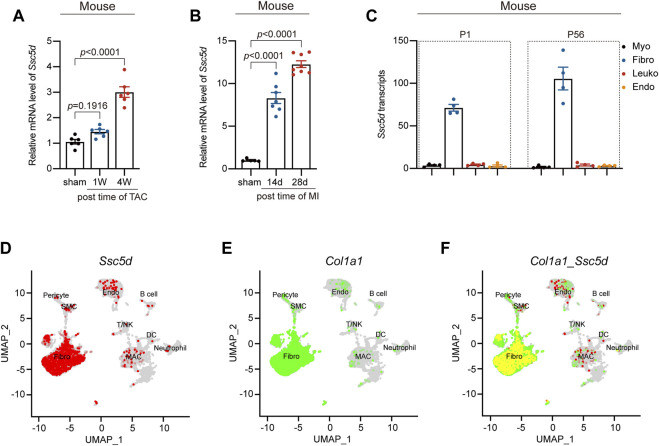
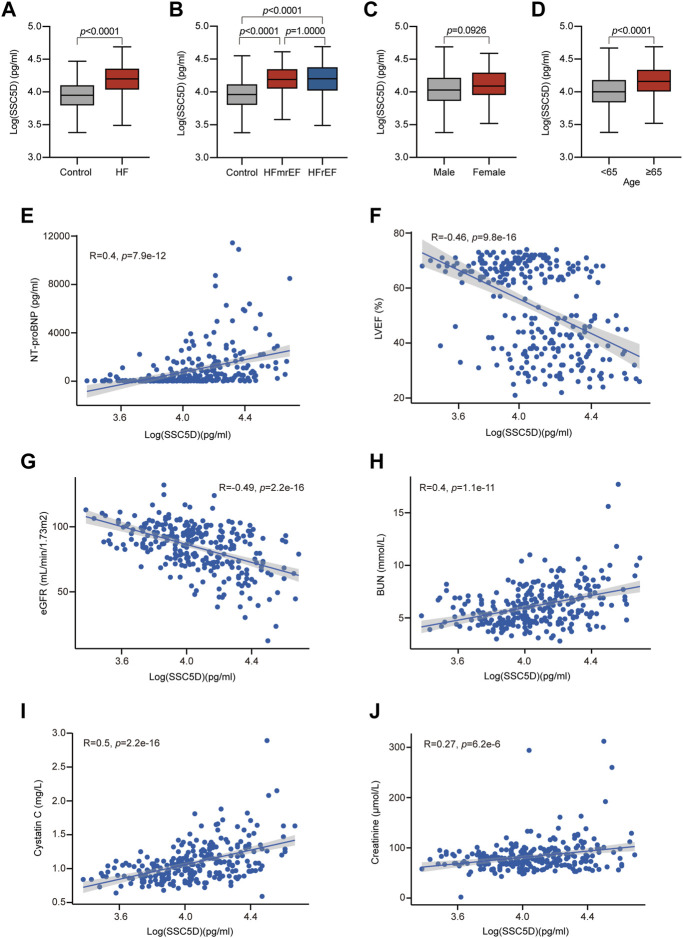
We aimed to explore the relationship between the serum Soluble Scavenger with 5 Domains (SSC5D) levels and heart failure (HF). We retrospectively enrolled 276 patients diagnosed with HF or normal during hospitalization in Shanghai General Hospital between September 2020 and December 2021. Previously published RNA sequencing data were re-analyzed to confirm the expression profile of in failing and non-failing human and mouse heart tissues. Quantitative real-time polymerase chain reaction assay was used to quantify mRNA levels in murine heart tissue after myocardial infarction and transverse aortic constriction surgery. To understand the HF-induced secreted proteins profile, 1,755 secreted proteins were investigated using human dilated cardiomyopathy RNA-seq data, and the results indicated that levels were significantly elevated in failing hearts compared to the non-failing. Using single-cell RNA sequencing data, we demonstrated that is predominantly expressed in cardiac fibroblasts. In a murine model of myocardial infarction or transverse aortic constriction, mRNA levels were markedly increased compared with those in the sham group. Similarly, serum SSC5D levels were considerably elevated in the HF group compared with the control group [15,789.35 (10,745.32-23,110.65) pg/mL, 95% CI (16,263.01-19,655.43) vs. 8,938.72 (6,154.97-12,778.81) pg/mL, 95% CI (9,337.50-11,142.93); < 0.0001]. Moreover, serum SSC5D levels were positively correlated with N-terminal pro-B-type natriuretic peptide (R = 0.4, = 7.9e-12) and inversely correlated with left ventricular ejection fraction (R = -0.46, = 9.8e-16). We concluded that SSC5D was a specific response to HF. Serum SSC5D may function as a novel biomarker and therapeutic target for patients with HF.
我们旨在探讨血清可溶性五结构域清道夫(SSC5D)水平与心力衰竭(HF)之间的关系。我们回顾性纳入了2020年9月至2021年12月期间在上海交通大学医学院附属瑞金医院住院诊断为HF或正常的276例患者。对先前发表的RNA测序数据进行重新分析,以确认SSC5D在衰竭和非衰竭的人类及小鼠心脏组织中的表达谱。采用定量实时聚合酶链反应法检测心肌梗死和主动脉缩窄手术后小鼠心脏组织中SSC5D mRNA水平。为了解HF诱导的分泌蛋白谱,利用人类扩张型心肌病RNA测序数据研究了1755种分泌蛋白,结果表明,与非衰竭心脏相比,SSC5D水平在衰竭心脏中显著升高。利用单细胞RNA测序数据,我们证明SSC5D主要在心脏成纤维细胞中表达。在心肌梗死或主动脉缩窄的小鼠模型中,与假手术组相比,SSC5D mRNA水平显著升高。同样,与对照组相比,HF组血清SSC5D水平显著升高[15789.35(10745.32 - 23110.65)pg/mL,95%CI(16263.01 - 19655.43)vs. 8938.72(6154.97 - 12778.81)pg/mL,95%CI(9337.50 - 11142.93);P < 0.0001]。此外,血清SSC5D水平与N末端B型利钠肽原呈正相关(R = 0.4,P = 7.9e - 12),与左心室射血分数呈负相关(R = -0.46,P = 9.8e - 16)。我们得出结论,SSC5D是对HF的一种特异性反应。血清SSC5D可能作为HF患者的一种新型生物标志物和治疗靶点。