Zheng Lanlan, Meng Linglei, Liang Huazheng, Yang Jiandao
Department of Neurology, Shanghai Jiangong Hospital, Shanghai, China.
Clinical Research Center for Anesthesiology and Perioperative Medicine, Shanghai Fourth People's Hospital, School of Medicine, Tongji University, Shanghai, China.
Front Neurosci. 2023 Apr 13;17:1149833. doi: 10.3389/fnins.2023.1149833. eCollection 2023.
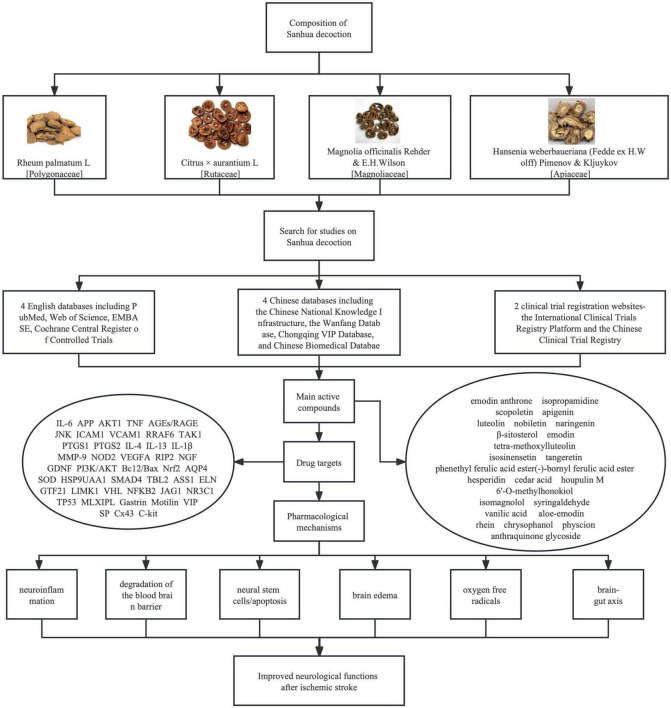
Both thrombolytic and endovascular therapies are optimal treatment options for patients with acute ischemic stroke, but only less than half of these patients can benefit from these treatments. Traditional Chinese medicine has a long history of successfully managing ischemic stroke using both herbal and physical therapeutics. Among herbal recipes, Sanhua decoction (SHD) is one of the classical prescriptions for ischemic stroke. The present review aimed to summarize evidence from both clinical and basic research to demonstrate its efficacy in managing ischemic stroke and the potential mechanisms underlying its therapeutic effects, which will provide evidence on the therapeutic effect of this herbal recipe and guide future studies on this recipe. SHD is composed of four herbs, L. [Polygonaceae], Rehder & E.H.Wilson [Magnoliaceae], Citrus × aurantium L. [Rutaceae], Hansenia weberbaueriana (Fedde ex H.Wolff) Pimenov & Kljuykov [Apiaceae]. We found that the majority of clinical studies on SHD are case reports and they showed positive therapeutic effect of SHD on both acute and chronic ischemic stroke. There are over 40 bioactive compounds identified in SHD, but few experimental studies have examined their individual molecular mechanisms. As an extract of SHD, it improves neurological functions through suppressing inflammation, protecting the blood brain barrier from degradation, restoring the number of neural stem cells, inhibiting apoptosis and brain edema, scavenging oxygen free radicals, and regulating the brain-gut axis. These will lay the theoretical foundation for future studies on this prescription and its clinical application. Future research may need to confirm its clinical efficacy in large-scale clinical trials and to disentangle its bioactive compounds and their potential mechanisms.
溶栓治疗和血管内治疗都是急性缺血性中风患者的最佳治疗选择,但只有不到一半的患者能从这些治疗中获益。中医使用草药和物理疗法成功治疗缺血性中风已有悠久历史。在草药配方中,三花汤(SHD)是治疗缺血性中风的经典方剂之一。本综述旨在总结临床和基础研究的证据,以证明其治疗缺血性中风的疗效及其治疗作用的潜在机制,这将为该草药配方的治疗效果提供证据,并指导未来对该配方的研究。三花汤由四种草药组成,分别是蓼科的[具体植物名1]、木兰科的[具体植物名2]、芸香科的酸橙和伞形科的[具体植物名3]。我们发现,关于三花汤的大多数临床研究都是病例报告,它们显示三花汤对急性和慢性缺血性中风均有积极治疗效果。三花汤中已鉴定出40多种生物活性化合物,但很少有实验研究探讨它们各自的分子机制。作为三花汤的提取物,它通过抑制炎症、保护血脑屏障不被降解、恢复神经干细胞数量、抑制细胞凋亡和脑水肿、清除氧自由基以及调节脑-肠轴来改善神经功能。这些将为该方剂未来的研究及其临床应用奠定理论基础。未来的研究可能需要在大规模临床试验中证实其临床疗效,并厘清其生物活性化合物及其潜在机制。