Wang Jun, Zou Dongna, Li Yuchao, Liu Pingping, Guo Chenyu
Department of Pharmacy, Shandong Provincial Hospital Affiliated to Shandong First Medical University, Jinan, China.
Department of Medical Ultrasound, Shandong Provincial Hospital Affiliated to Shandong First Medical University, Jinan, China.
Front Pharmacol. 2023 Apr 13;14:1161728. doi: 10.3389/fphar.2023.1161728. eCollection 2023.
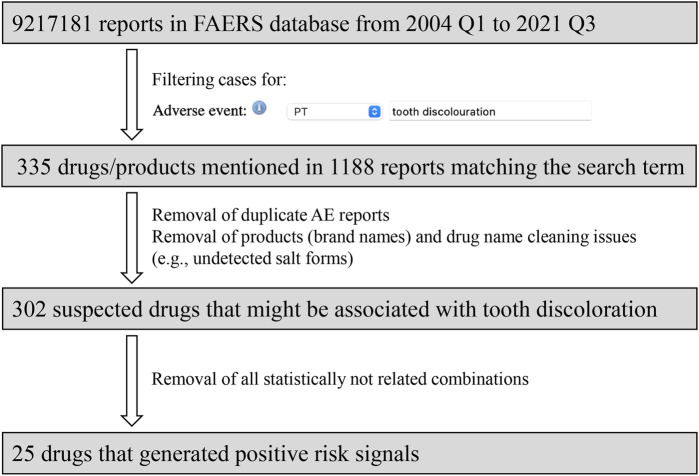
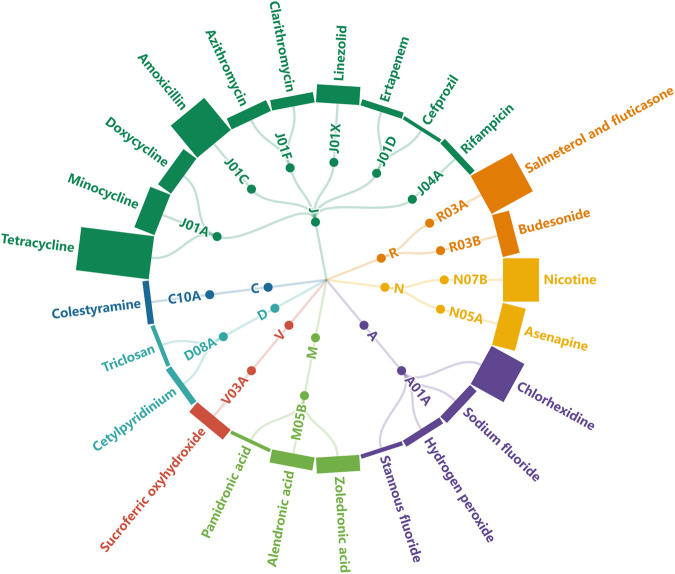
Certain drugs can cause intrinsic or extrinsic tooth discoloration, which is not only a clinical issue but also an esthetic problem. However, limited investigations have focused on drug-induced tooth discoloration. The present work aimed to determine the drugs causing tooth discoloration and to estimate their risks of causing tooth discoloration. An observational, retrospective, and pharmacovigilance analysis was conducted, in which we extracted adverse event (AE) reports involving tooth discoloration by using the data of the US Food and Drug Administration's Adverse Event Reporting System (FAERS) from the first quarter (Q1) of 2004 to the third quarter (Q3) of 2021. Disproportionality analyses were performed to examine risk signals for tooth discoloration and determine the drugs inducing tooth discoloration. Based on predefined inclusion criteria, 1188 AE reports involving 302 suspected drugs were identified. After data mining, 25 drugs generated positive risk signals for tooth discoloration, of which 10 were anti-infectives for systemic use. The top reported drug was tetracycline ( = 106), followed by salmeterol and fluticasone ( = 68), amoxicillin ( = 60), chlorhexidine ( = 54), and nicotine ( = 52). Cetylpyridinium (PRR = 472.2, ROR = 502.5), tetracycline (PRR = 220.4, ROR = 277), stannous fluoride (PRR = 254.3, ROR = 262.8), hydrogen peroxide (PRR = 240.0, ROR = 247.6), and chlorhexidine (PRR = 107.0, ROR = 108.4) showed stronger associations with tooth discoloration than the remaining drugs. Of 625 AE reports involving 25 drugs with positive risk signals, tooth discoloration was mostly reported in patients aged 45-64 ( = 110) and ≤18 ( = 95), and 29.4% (192/652) of the reports recorded serious outcomes. This study revealed that certain drugs are significantly associated with tooth discoloration. Caution should be exercised when using these drugs, especially during pregnancy and early childhood.
某些药物可导致牙齿内源性或外源性变色,这不仅是一个临床问题,也是一个美观问题。然而,针对药物性牙齿变色的研究较少。本研究旨在确定导致牙齿变色的药物,并评估其导致牙齿变色的风险。我们进行了一项观察性、回顾性的药物警戒分析,利用美国食品药品监督管理局不良事件报告系统(FAERS)2004年第一季度(Q1)至2021年第三季度(Q3)的数据,提取涉及牙齿变色的不良事件(AE)报告。进行不成比例分析以检查牙齿变色的风险信号,并确定导致牙齿变色的药物。根据预先设定的纳入标准,共识别出1188份涉及302种可疑药物的AE报告。经过数据挖掘,25种药物产生了牙齿变色的阳性风险信号,其中10种为全身用抗感染药物。报告最多的药物是四环素( = 106),其次是沙美特罗和氟替卡松( = 68)、阿莫西林( = 60)、氯己定( = 54)和尼古丁( = 52)。十六烷基吡啶(PRR = 472.2,ROR = 502.5)、四环素(PRR = 220.4,ROR = 277)、氟化亚锡(PRR = 254.3,ROR = 262.8)、过氧化氢(PRR = 240.0,ROR = 247.6)和氯己定(PRR = 107.0,ROR = 百零八四)与牙齿变色的关联比其他药物更强。在625份涉及25种有阳性风险信号药物的AE报告中,牙齿变色大多报告于45 - 64岁( = 110)和≤18岁( = 95)的患者,29.4%(192/652)的报告记录了严重后果。本研究表明某些药物与牙齿变色显著相关。使用这些药物时应谨慎,尤其是在孕期和儿童早期。