Braga Anthony A, Turchan Brandon, Papachristos Andrew V, Hureau David M
School of Criminology and Criminal Justice Northeastern University Boston Massachusetts.
Department of Sociology Northwestern University Evanston Illinois.
Campbell Syst Rev. 2019 Sep 8;15(3):e1046. doi: 10.1002/cl2.1046. eCollection 2019 Sep.
In recent years, crime scholars and practitioners have pointed to the potential benefits of focusing crime prevention efforts on crime places. A number of studies suggest that there is significant clustering of crime in small places, or "hot spots," that generate half of all criminal events. Researchers have argued that many crime problems can be reduced more efficiently if police officers focused their attention to these deviant places. The appeal of focusing limited resources on a small number of high-activity crime places is straightforward. If crime can be prevented at these hot spots, then citywide crime totals could be reduced.
To assess the effects of focused police crime prevention interventions at crime hot spots. The review also examined whether focused police actions at specific locations result in crime displacement (i.e., crime moving around the corner) or diffusion (i.e., crime reduction in surrounding areas) of crime control benefits.
A keyword search was performed on 15 abstract databases. Bibliographies of past narrative and empirical reviews of literature that examined the effectiveness of police crime control programs were reviewed and forward searches for works that cited seminal hot spots policing studies were performed. Bibliographies of past completed Campbell systematic reviews of police crime prevention efforts were reviewed and hand searches of leading journals in the field were completed. Experts in the field were consulted and relevant citations were obtained.
To be eligible for this review, interventions used to control crime hot spots were limited to police-led prevention efforts. Suitable police-led crime prevention efforts included traditional tactics such as directed patrol and heightened levels of traffic enforcement as well as alternative strategies such as aggressive disorder enforcement and problem-oriented policing. Studies that used randomized controlled experimental or quasiexperimental designs were selected. The units of analysis were limited to crime hot spots or high-activity crime "places" rather than larger areas such as neighborhoods. The control group in each study received routine levels of traditional police crime prevention tactics.
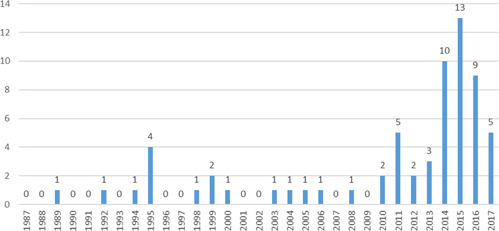
Sixty-five studies containing 78 tests of hot spots policing interventions were identified and full narratives of these studies were reported. Twenty-seven of the selected studies used randomized experimental designs and 38 used quasiexperimental designs. A formal meta-analysis was conducted to determine the crime prevention effects in the eligible studies. Random effects models were used to calculate mean effect sizes.
Sixty-two of 78 tests of hot spots policing interventions reported noteworthy crime and disorder reductions. The meta-analysis of key reported outcome measures revealed a small statistically significant mean effect size favoring the effects of hot spots policing in reducing crime outcomes at treatment places relative to control places. The effect was smaller for randomized designs but still statistically significant and positive. When displacement and diffusion effects were measured, a diffusion of crime prevention benefits was associated with hot spots policing.
AUTHORS' CONCLUSIONS: The extant evaluation research suggests that hot spots policing is an effective crime prevention strategy. The research also suggests that focusing police efforts on high-activity crime places does not inevitably lead to crime displacement; rather, crime control benefits may diffuse into the areas immediately surrounding the targeted locations.
近年来,犯罪学学者和从业者指出将预防犯罪工作聚焦于犯罪场所可能带来的益处。多项研究表明,犯罪在一些小区域,即“热点地区”存在显著的聚集现象,这些地区产生了所有犯罪事件的一半。研究人员认为,如果警察将注意力集中在这些异常区域,许多犯罪问题可以得到更有效的减少。将有限资源集中于少数高犯罪活动场所的吸引力显而易见。如果能在这些热点地区预防犯罪,那么全市的犯罪总量就可能会减少。
评估警察针对犯罪热点地区进行的预防犯罪干预措施的效果。该综述还考察了警察在特定地点采取的行动是否会导致犯罪转移(即犯罪转移到街角)或犯罪控制效益的扩散(即周边地区犯罪减少)。
在15个摘要数据库中进行了关键词检索。查阅了过去对警察犯罪控制项目有效性进行叙述性和实证性文献综述的参考文献,并对引用开创性热点地区治安研究的文献进行了向前检索。查阅了过去已完成的坎贝尔对警察预防犯罪工作的系统综述的参考文献,并完成了该领域主要期刊的手工检索。咨询了该领域的专家并获取了相关参考文献。
为符合本综述要求,用于控制犯罪热点地区的干预措施仅限于警察主导的预防工作。合适的警察主导的预防犯罪工作包括传统策略,如定向巡逻和加强交通执法,以及替代策略,如积极整治混乱和以问题为导向的警务。选择使用随机对照实验或准实验设计的研究。分析单位仅限于犯罪热点地区或高犯罪活动“场所”,而非更大的区域,如社区。每项研究中的对照组接受常规水平的传统警察预防犯罪策略。
识别出65项包含78次热点地区治安干预测试的研究,并报告了这些研究的完整叙述。所选研究中有27项使用了随机实验设计,38项使用了准实验设计。进行了正式的荟萃分析以确定符合条件的研究中的预防犯罪效果。使用随机效应模型计算平均效应大小。
78次热点地区治安干预测试中有62次报告了犯罪和混乱的显著减少。对关键报告结果指标的荟萃分析显示,相对于对照场所,热点地区治安在减少治疗场所犯罪结果方面具有小的统计学显著平均效应大小。随机设计的效应较小,但仍具有统计学显著性且为正向。在测量转移和扩散效应时,犯罪预防效益的扩散与热点地区治安相关。
现有评估研究表明,热点地区治安是一种有效的预防犯罪策略。研究还表明,将警察工作集中于高犯罪活动场所并不必然导致犯罪转移;相反,犯罪控制效益可能会扩散到目标地点周围的区域。


