Ma Peng-Fei, Dai Qun, Chu Jing, Zhuo Lin, Chen Yi, Cheng Rong, Wu Cheng, Yuan Li-Ping
Department of Pediatrics, The First Affiliated Hospital of Anhui Medical University, Hefei, China.
Department of Gastroenterology, Children's Hospital of Fudan University at Anhui (Anhui Provincial Children's Hospital), Hefei, China.
Front Pediatr. 2023 Apr 17;11:1157777. doi: 10.3389/fped.2023.1157777. eCollection 2023.
(HP) is a major cause of upper digestive tract diseases. However, the relationship between HP infection and 25-hydroxyvitamin D [25(OH)D] levels in children has not been fully elucidated. This study investigated the levels of 25(OH)D in children of different ages and with varying degrees of HP infection and immunological features as well as the correlations between 25(OH)D levels in children infected with HP and their ages and degrees of infection.
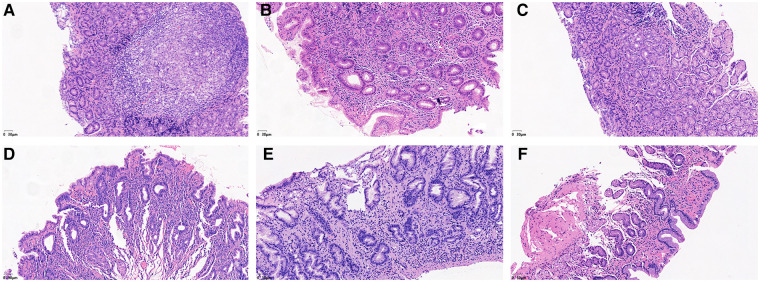
Ninety-four children who underwent upper digestive endoscopy were divided into an HP-positive group without peptic ulcers (Group A), an HP-positive group with peptic ulcers (Group B) and an HP-negative control group (Group C). The serum levels of 25(OH)D and immunoglobulin and the percentages of lymphocyte subsets were determined. HP colonization, the degree of inflammation, and the degree of activity were further evaluated by HE staining and immunohistochemical staining in gastric mucosal biopsy.
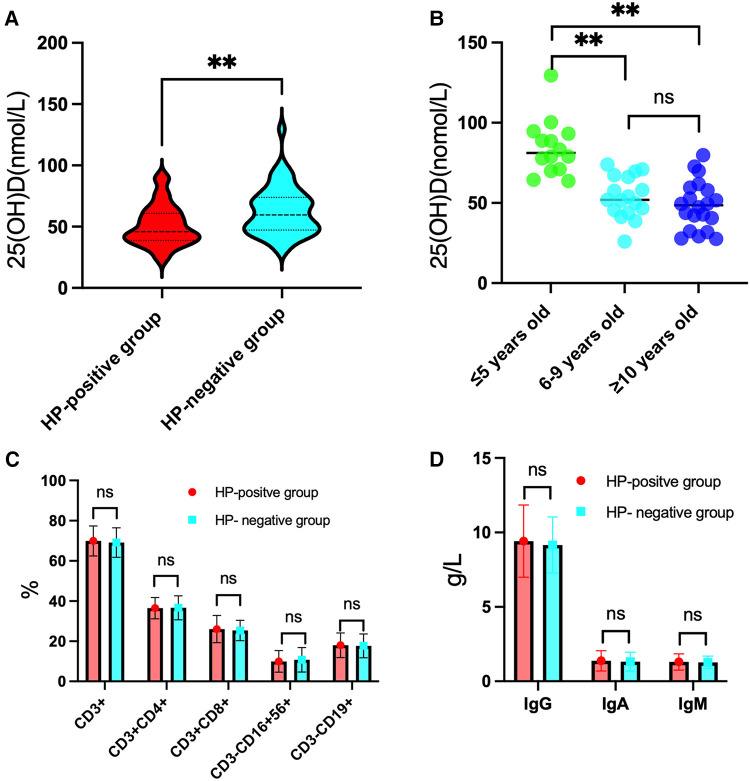
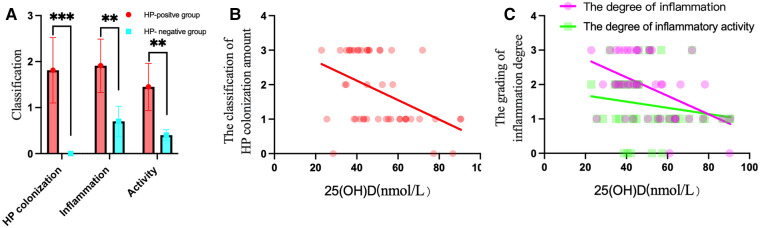
The 25(OH)D level of the HP-positive groups (50.93 ± 16.51 nmol/L) was significantly lower than that of the HP-negative group (62.89 ± 19.18 nmol/L). The 25(OH)D level of Group B (47.79 ± 14.79 nmol/L) was lower than that of Group A (51.53 ± 17.05 nmol/L) and was significantly lower than that of Group C (62.89 ± 19.18 nmol/L). The 25(OH)D level decreased with increasing age, and there was a significant difference between Group C subjects who were ≤5 years old and those who were aged 6-9 years and ≥10 years. The 25(OH)D level was negatively correlated with HP colonization ( = -0.411, < 0.01) and the degree of inflammation ( = -0.456, < 0.01). The percentages of lymphocyte subsets and immunoglobulin levels among Groups A, B and C were not significantly different.
The 25(OH)D level was negatively correlated with HP colonization and the degree of inflammation. As the age of the children increased, the level of 25(OH)D decreased, and the susceptibility to HP infection increased.
幽门螺杆菌(HP)是上消化道疾病的主要病因。然而,儿童HP感染与25-羟基维生素D[25(OH)D]水平之间的关系尚未完全阐明。本研究调查了不同年龄、不同HP感染程度儿童的25(OH)D水平、免疫特征,以及HP感染儿童的25(OH)D水平与其年龄和感染程度之间的相关性。
94例行上消化道内镜检查的儿童被分为无消化性溃疡的HP阳性组(A组)、有消化性溃疡的HP阳性组(B组)和HP阴性对照组(C组)。测定血清25(OH)D水平、免疫球蛋白水平及淋巴细胞亚群百分比。通过胃黏膜活检的HE染色和免疫组化染色进一步评估HP定植、炎症程度和活动程度。
HP阳性组的25(OH)D水平(50.93±16.51 nmol/L)显著低于HP阴性组(62.89± 19.18 nmol/L)。B组的25(OH)D水平(47.79±14.79 nmol/L)低于A组(51.53±17.05 nmol/L),且显著低于C组(62.89±19.18 nmol/L)。25(OH)D水平随年龄增长而降低,≤5岁的C组受试者与6-9岁及≥10岁的受试者之间存在显著差异。25(OH)D水平与HP定植(r=-0.411,P<0.01)和炎症程度(r=-0.456,P<0.01)呈负相关。A、B、C三组之间淋巴细胞亚群百分比和免疫球蛋白水平无显著差异。
25(OH)D水平与HP定植和炎症程度呈负相关。随着儿童年龄的增长,25(OH)D水平降低,HP感染易感性增加。