Am J Epidemiol. 2023 Aug 4;192(8):1415-1423. doi: 10.1093/aje/kwad090.
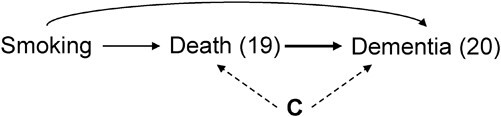
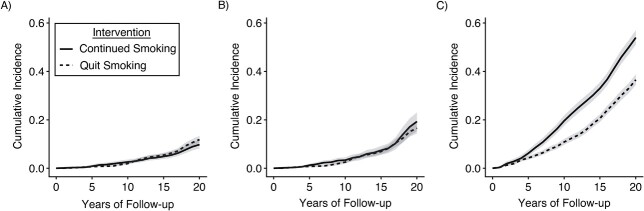
Studying causal exposure effects on dementia is challenging when death is a competing event. Researchers often interpret death as a potential source of bias, although bias cannot be defined or assessed if the causal question is not explicitly specified. Here we discuss 2 possible notions of a causal effect on dementia risk: the "controlled direct effect" and the "total effect." We provide definitions and discuss the "censoring" assumptions needed for identification in either case and their link to familiar statistical methods. We illustrate concepts in a hypothetical randomized trial on smoking cessation in late midlife, and emulate such a trial using observational data from the Rotterdam Study, the Netherlands, 1990-2015. We estimated a total effect of smoking cessation (compared with continued smoking) on 20-year dementia risk of 2.1 (95% confidence interval: -0.1, 4.2) percentage points and a controlled direct effect of smoking cessation on 20-year dementia risk had death been prevented of -2.7 (95% confidence interval: -6.1, 0.8) percentage points. Our study highlights how analyses corresponding to different causal questions can have different results, here with point estimates on opposite sides of the null. Having a clear causal question in view of the competing event and transparent and explicit assumptions are essential to interpreting results and potential bias.
当死亡是一个竞争事件时,研究因果暴露效应对痴呆的影响具有挑战性。研究人员通常将死亡解释为潜在的偏倚来源,尽管如果没有明确指定因果问题,则无法定义或评估偏倚。在这里,我们讨论了对痴呆风险的因果效应的 2 种可能概念:“受控直接效应”和“总效应”。我们提供了定义,并讨论了在这两种情况下进行识别所需的“删失”假设及其与熟悉的统计方法的联系。我们在一项关于中年后期戒烟的假设随机试验中说明了这些概念,并使用来自荷兰鹿特丹研究(1990-2015 年)的观察性数据模拟了这样一项试验。我们估计了戒烟(与继续吸烟相比)对 20 年痴呆风险的总效应为 2.1(95%置信区间:-0.1,4.2)个百分点,并且如果避免了死亡,戒烟对 20 年痴呆风险的受控直接效应为-2.7(95%置信区间:-6.1,0.8)个百分点。我们的研究强调了对应于不同因果问题的分析可能会产生不同的结果,这里的点估计值在零假设的两侧。考虑到竞争事件,明确因果问题并透明和明确的假设对于解释结果和潜在偏倚至关重要。