Center of Research and Water Technologies (CERTE), Laboratory of Treatment and Valorization of Water Rejects (LTVRH), Techno Park of Borj-Cédria, 8020, Tunis, Tunisia.
Faculty of Mathematical, Physical and Natural Sciences of Tunis, University of Tunis El Manar, 2092, Tunis, Tunisia.
Food Environ Virol. 2023 Sep;15(3):224-235. doi: 10.1007/s12560-023-09557-0. Epub 2023 May 4.
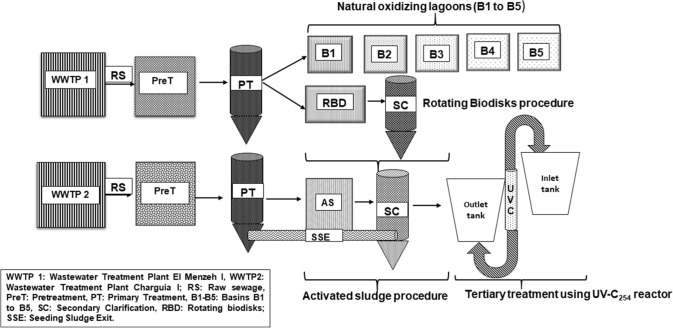
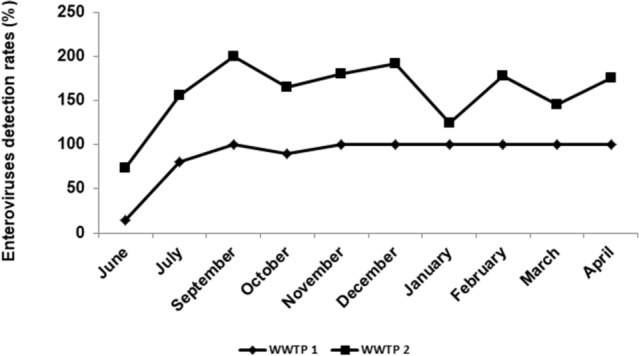
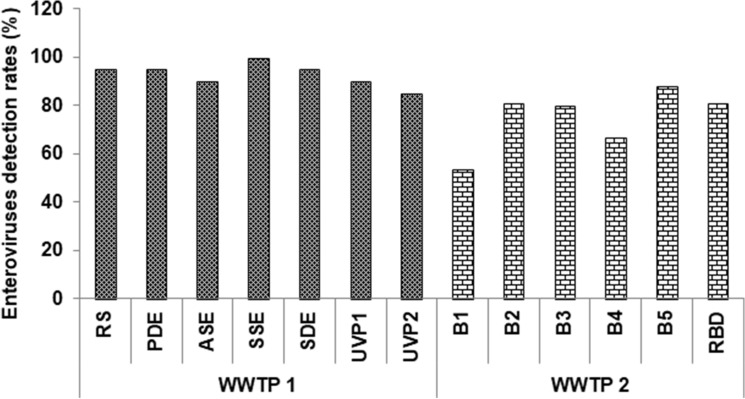
Monitoring the circulation of enteric viruses in environmental wastewater is a valuable tool for preventing the emergence of waterborne and food-borne diseases in humans. The detection of viruses was performed in five Tunisian wastewater treatment plants, three located in the Grand Tunis City (WWTP 1, WWTP 2, WWTP 3) and two in the Sahel of Tunisia (WWTP 4, WWTP 4), known as very developed and crowded zones, to assess the effectiveness of three biological wastewater treatment procedures namely natural oxidizing lagoons, rotating biodisks procedure, activated sludge procedure, and one tertiary sewage treatment using UV-C reactor for this enteric viruses' removal. Thus, 242 sewage samples were collected between June 2019 and May 2020 from different lines of wastewater treatment procedures implemented in the five wastewater treatment plants investigated. SARS-CoV-2 was analyzed using real-time multiplex reverse-transcription polymerase chain reaction (multiplex real-time RT-PCR) and enteroviruses using reverse-transcription polymerase chain reaction (RT-PCR). The enteroviruses detection showed 93% and 73% respective high frequencies only in the two WWTPs of the Grand Tunis (WWTP 1 and WWTP 2). SARS-CoV-2 was detected in 58% of the all wastewater samples collected from the five studied WWTPs with a respective dominance of N gene (47%), S gene (42%), RdRp gene (42%) and at last E gene (20%). These enteroviruses and SARS-CoV-2 detection were revealed in all steps of the wastewater treatment procedures, so poor virological quality is found at the exit of each biological and tertiary step of treatment investigated. For the first time in Tunisia, these results highlighted the enterovirus and SARS-CoV-2 detection with high rates, and the ineffectiveness of the biological and UV-C254 treatment implemented to remove these viruses. The preliminary results of SARS-CoV-2 circulation in Tunisian wastewater confirmed the wide positivity rate underlined by other works worldwide and allowed showing a move towards integrating wastewater as a way for this virus to spread in different areas and environments. So, this last result about SARS-CoV-2 circulation allowed us to caution about the strong probability of diffusion of this hazardous virus through water and sewage; despite its enveloped character and nature, as a labile and sensitive virus in these environments. Thus, establishing a national surveillance strategy is needed to improve the sanitary quality of treated wastewater and prevent public health problems related to these viruses in treated wastewater.
监测环境废水中肠道病毒的循环是预防人类水传播和食源性疾病出现的一种有价值的工具。在突尼斯的五个污水处理厂进行了病毒检测,其中三个位于大突尼斯市(WWTP1、WWTP2、WWTP3),两个位于突尼斯萨赫勒(WWTP4、WWTP4),这些地区非常发达和拥挤,以评估三种生物污水处理程序的有效性,即自然氧化池、旋转生物转盘程序、活性污泥程序和一种使用 UV-C 反应器的三级污水治疗方法,以去除这些肠道病毒。因此,2019 年 6 月至 2020 年 5 月,从五个调查污水处理厂实施的不同污水处理线采集了 242 个污水样本。使用实时多重逆转录聚合酶链反应(多重实时 RT-PCR)分析 SARS-CoV-2,使用逆转录聚合酶链反应(RT-PCR)分析肠道病毒。肠道病毒检测显示,只有在大突尼斯的两个 WWTP(WWTP1 和 WWTP2)中,分别以 93%和 73%的高频率出现。在从五个研究 WWTP 采集的所有废水样本中检测到 SARS-CoV-2,分别以 N 基因(47%)、S 基因(42%)、RdRp 基因(42%)和最后 E 基因(20%)为主导。这些肠道病毒和 SARS-CoV-2 的检测在污水处理过程的所有步骤中都被发现,因此在所研究的每个生物和三级处理步骤的出口处都发现了较差的病毒学质量。在突尼斯,首次发现肠道病毒和 SARS-CoV-2 的高检出率,以及实施的生物和 UV-C254 处理去除这些病毒的无效性。突尼斯废水循环中 SARS-CoV-2 的初步结果证实了其他世界各地研究工作强调的高阳性率,并表明该病毒在不同地区和环境中传播的可能性更大。因此,关于 SARS-CoV-2 循环的最后一个结果使我们警惕到这种危险病毒通过水和污水传播的可能性很大;尽管它具有包膜特征和性质,但在这些环境中,它是一种不稳定和敏感的病毒。因此,需要建立国家监测策略,以提高处理后废水的卫生质量,并防止与处理后废水中这些病毒有关的公共卫生问题。