Department of Psychiatry and Behavioral Sciences, University of Texas at Austin, Austin, TX, USA.
Department of Psychology and Social Sciences, John Cabot University, Rome, Italy.
Psychol Res. 2023 Nov;87(8):2533-2547. doi: 10.1007/s00426-023-01832-w. Epub 2023 May 6.
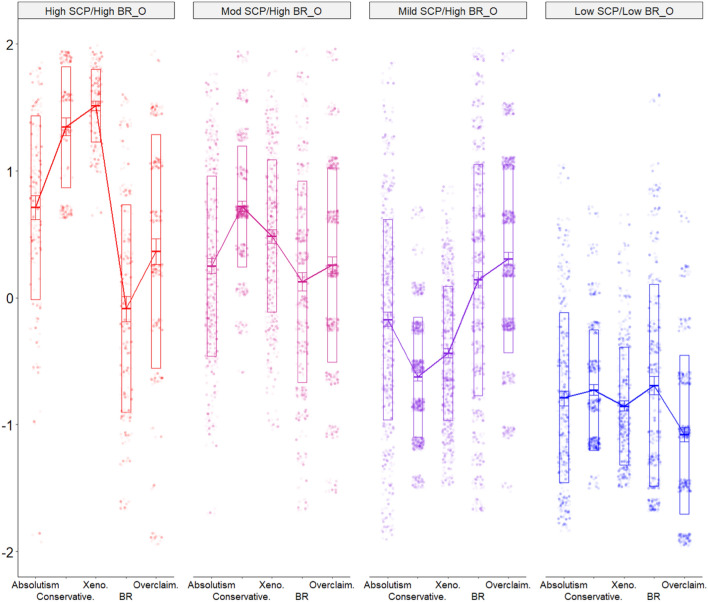
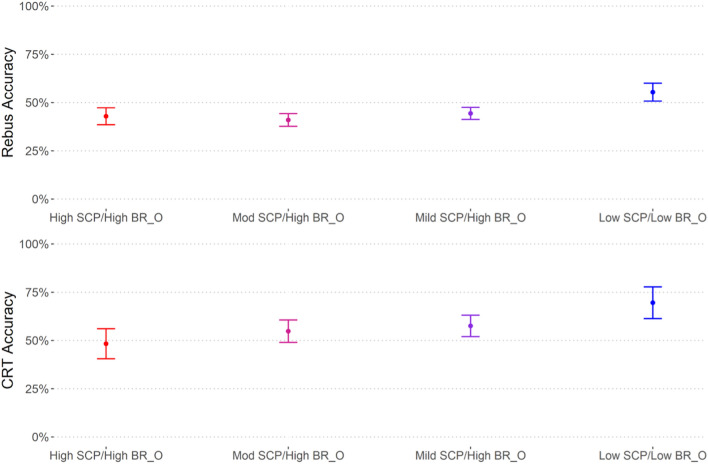
Recent research has proposed a relationship between rigid political ideologies and underlying 'cognitive styles'. However, there remain discrepancies in how both social and cognitive rigidity are defined and measured. Problem-solving, or the ability to generate novel ideas by exploring unusual reasoning paths and challenging rigid perspectives around us, is often used to operationalize cognitive flexibility. Thus, we hypothesized a relation between forms of social rigidity, including Socio-cognitive polarization (i.e., a factor capturing conservative political ideology, absolutism/intolerance of ambiguity, and xenophobia), bullshit receptivity (i.e., overestimating pseudo-profound statements), overclaiming (tendency to self-enhance), and cognitive rigidity (i.e., problem-solving). Our results showed differences in performance on problem-solving tasks between four latent profiles of social rigidity identified in our sample. Specifically, those low in socio-cognitive polarization, bullshit, and overclaiming (i.e., less rigid) performed the best on problem-solving. Thus, we conclude that social and cognitive rigidity may share an underlying socio-cognitive construct, wherein those who are more socially rigid are also more likely to be also cognitively rigid when processing non-social information.
最近的研究提出了僵化的政治意识形态与潜在的“认知风格”之间的关系。然而,在如何定义和衡量社会和认知僵化方面仍存在差异。解决问题的能力,或者通过探索不寻常的推理路径和挑战我们周围僵化的观点来产生新颖想法的能力,通常用于操作认知灵活性。因此,我们假设社会僵化的形式之间存在关系,包括社会认知极化(即,捕捉保守政治意识形态、绝对主义/对歧义的不容忍和仇外心理的因素)、接受胡说八道的能力(即高估伪深刻的陈述)、夸大(自我提升的倾向)和认知僵化(即解决问题)。我们的研究结果表明,在我们的样本中确定的四种社会僵化潜在特征中,解决问题任务的表现存在差异。具体来说,那些社会认知极化、胡说八道和夸大程度较低(即不那么僵化)的人在解决问题方面表现最好。因此,我们得出结论,社会和认知僵化可能具有共同的社会认知结构,即那些在处理非社会信息时更具社会僵化的人也更有可能具有认知僵化。