Liang Yin, Li Qiyan, Liu Yulin, Guo Yajie, Li Qingjiao
Department of Laboratory Medicine, The Eighth Affiliated Hospital, Sun Yat-Sen University, Shenzhen, 518033, China.
Department of Emergency, The Eighth Affiliated Hospital, Sun Yat-Sen University, Shenzhen, 518033, China.
Discov Oncol. 2023 May 6;14(1):57. doi: 10.1007/s12672-023-00670-x.
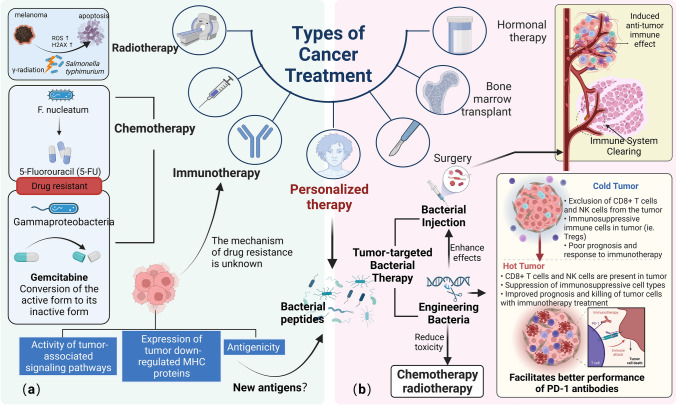
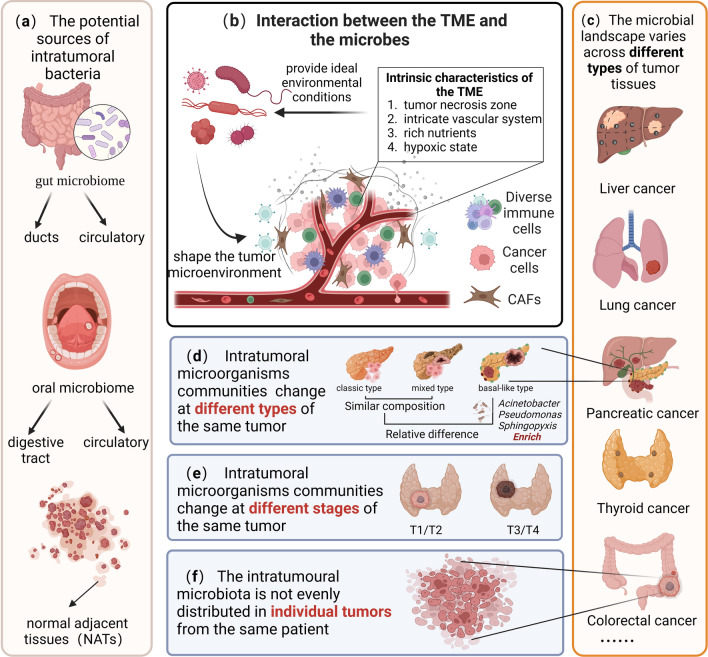
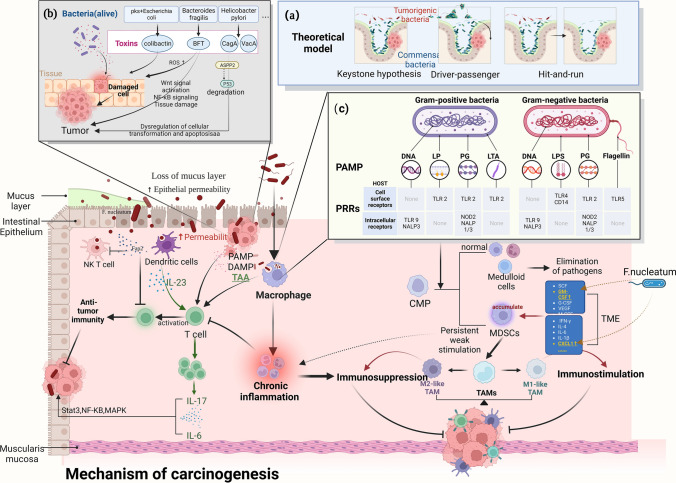
Hitherto, the recognition of the microbiota role in tumorigenesis and clinical studies mostly focused on the intestinal flora. In contrast to the gut microbiome, microorganisms resident in tumor tissue are in close contact with cancer cells and therefore have the potential to have similar or even different functional patterns to the gut flora. Some investigations have shown intratumoral bacteria, which might come from commensal microbiota in mucosal areas including the gastrointestinal tract and oral cavity, or from nearby normal tissues. The existence, origin, and interactions of intratumoral bacteria with the tumor microenvironment all contribute to intratumoral microorganism heterogeneity. Intratumoral bacteria have a significant role in tumor formation. They can contribute to cancer at the genetic level by secreting poisons that directly damage DNA and also intimately related to immune system response at the systemic level. Intratumoral bacteria have an impact on chemotherapy and immunotherapy in cancer. Importantly, various properties of bacteria such as targeting and ease of modification make them powerful candidates for precision therapy, and combining microbial therapies with other therapies is expected to improve the effectiveness of cancer treatment. In this review, we mainly described the heterogeneity and potential sources of intratumoral bacteria, overviewed the important mechanisms by which they were involved in tumor progression, and summarized their potential value in oncology therapy. At last, we highlight the problems of research in this field, and look forward to a new wave of studies using the various applications of intratumoral microorganisms in cancer therapy.
迄今为止,对微生物群在肿瘤发生中的作用的认识以及临床研究大多集中在肠道菌群上。与肠道微生物群不同,肿瘤组织中的微生物与癌细胞密切接触,因此有可能具有与肠道菌群相似甚至不同的功能模式。一些研究表明,肿瘤内细菌可能来自包括胃肠道和口腔在内的黏膜区域的共生微生物群,或来自附近的正常组织。肿瘤内细菌的存在、来源以及与肿瘤微环境的相互作用都导致了肿瘤内微生物的异质性。肿瘤内细菌在肿瘤形成中起着重要作用。它们可以通过分泌直接损伤DNA的毒素在基因水平上促进癌症发生,并且在全身水平上也与免疫系统反应密切相关。肿瘤内细菌对癌症的化疗和免疫治疗有影响。重要的是,细菌的各种特性,如靶向性和易于修饰性,使其成为精准治疗的有力候选者,将微生物疗法与其他疗法相结合有望提高癌症治疗的有效性。在这篇综述中,我们主要描述了肿瘤内细菌的异质性和潜在来源,概述了它们参与肿瘤进展的重要机制,并总结了它们在肿瘤学治疗中的潜在价值。最后,我们强调了该领域研究存在的问题,并期待利用肿瘤内微生物在癌症治疗中的各种应用开展新一轮的研究。