Franz Kristina, Deutschbein Johannes, Riedlinger Dorothee, Pigorsch Mareen, Schenk Liane, Lindner Tobias, Möckel Martin, Norman Kristina, Müller-Werdan Ursula
Charité - Universitätsmedizin Berlin, Corporate Member of Freie Universität Berlin and Humboldt-Universität zu Berlin, Department of Geriatrics and Medical Gerontology, Geriatrics Research Group, Berlin, Germany.
Charité - Universitätsmedizin Berlin, Corporate Member of Freie Universität Berlin and Humboldt-Universität zu Berlin, Institute of Medical Sociology and Rehabilitation Science, Berlin, Germany.
Front Med (Lausanne). 2023 Apr 20;10:1173528. doi: 10.3389/fmed.2023.1173528. eCollection 2023.
Hip fractures in older people are a common health problem often associated with malnutrition that might affect outcomes. Screening for malnutrition is not a routine examination in emergency departments (ED). This analysis of the EMAAge study, a prospective, multicenter cohort study, aimed to evaluate the nutritional status of older patients (≥ 50 years) with hip fracture, factors associated with malnutrition risk, and the association between malnutrition and the six-months mortality.
Risk of malnutrition was evaluated using the Short Nutritional Assessment Questionnaire. Clinical data as well as data on depression and physical activity were determined. Mortality was captured for the first six months after the event. To assess factors associated with malnutrition risk we used a binary logistic regression. A Cox proportional hazards model was used to assess the association of malnutrition risk with six-month survival adjusted for other relevant risk factors.
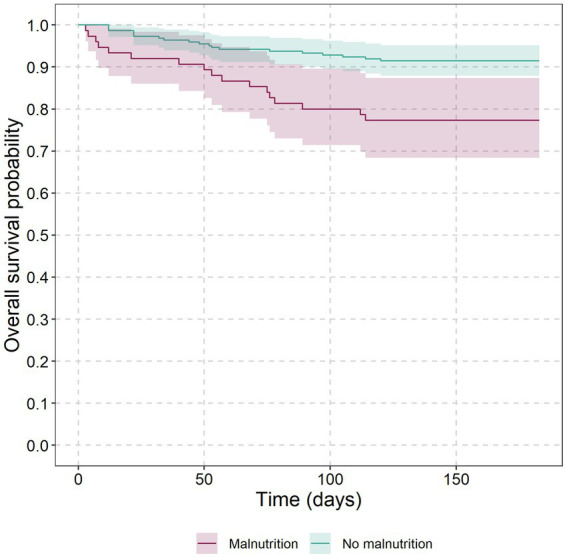
The sample consisted of = 318 hip fracture patients aged 50 to 98 (68% women). The prevalence of malnutrition risk was 25.3% ( = 76) at the time of injury. There were no differences in triage categories or routine parameters measured in the ED that could point to malnutrition. 89% of the patients ( = 267) survived for six months. The mean survival time was longer in those without malnutrition risk (171.9 (167.1-176.9) days vs. 153.1 (140.0-166.2) days). The Kaplan Meier curves and the unadjusted Cox regression (Hazard Ratio (HR) 3.08 (1.61-5.91)) showed differences between patients with and patients without malnutrition risk. In the adjusted Cox regression model, risk of death was associated with malnutrition risk (HR 2.61, 1.34-5.06), older age (70-76 years: HR 2.5 (0.52-11.99); 77-82 years: HR 4.25 (1.15-15.62); 83-99 years: HR 3.82 (1.05-13.88)) and a high burden of comorbidities (Charlson Comorbidity Index ≥3: HR 5.4 (1.53-19.12)).
Risk of malnutrition was associated with higher mortality after hip fracture. ED parameters did not differentiate between patients with nutritional deficiencies and those without. Therefore, it is particularly important to pay attention to malnutrition in EDs to detect patients at risk of adverse outcomes and to initiate early interventions.
老年人髋部骨折是一个常见的健康问题,常与可能影响预后的营养不良相关。营养不良筛查并非急诊科的常规检查项目。本项对EMAAge研究(一项前瞻性、多中心队列研究)的分析旨在评估髋部骨折老年患者(≥50岁)的营养状况、与营养不良风险相关的因素,以及营养不良与六个月死亡率之间的关联。
使用简易营养评估问卷评估营养不良风险。确定临床数据以及抑郁和身体活动的数据。记录事件发生后头六个月的死亡率。为评估与营养不良风险相关的因素,我们使用二元逻辑回归。使用Cox比例风险模型评估经其他相关风险因素调整后的营养不良风险与六个月生存率之间的关联。
样本包括318例年龄在50至98岁之间的髋部骨折患者(68%为女性)。受伤时营养不良风险的患病率为25.3%(n = 76)。急诊科测量的分诊类别或常规参数中没有能够提示营养不良的差异。89%的患者(n = 267)存活了六个月。无营养不良风险患者的平均生存时间更长(171.9(167.1 - 176.9)天 vs. 153.1(140.0 - 166.2)天)。Kaplan Meier曲线和未调整的Cox回归(风险比(HR)3.08(1.61 - 5.91))显示有和没有营养不良风险的患者之间存在差异。在调整后的Cox回归模型中,死亡风险与营养不良风险(HR 2.61,1.34 - 5.06)、老年(70 - 76岁:HR 2.5(0.52 - 11.99);77 - 82岁:HR 4.25(1.15 - 15.62);83 - 99岁:HR 3.82(1.05 - 13.88))以及高合并症负担(Charlson合并症指数≥3:HR 5.4(1.53 - 19.12))相关。
营养不良风险与髋部骨折后较高的死亡率相关。急诊科参数无法区分有营养缺乏和没有营养缺乏的患者。因此,在急诊科关注营养不良以发现有不良结局风险的患者并启动早期干预尤为重要。