Department of Medical Genetics and Molecular Biochemistry, Lewis Katz School of Medicine at Temple University, Philadelphia, Pennsylvania, USA.
Laboratory of Liver Diseases, National Institute on Alcohol Abuse and Alcoholism, National Institutes of Health, Bethesda, Maryland, USA.
Theranostics. 2023 Apr 9;13(7):2210-2225. doi: 10.7150/thno.81192. eCollection 2023.
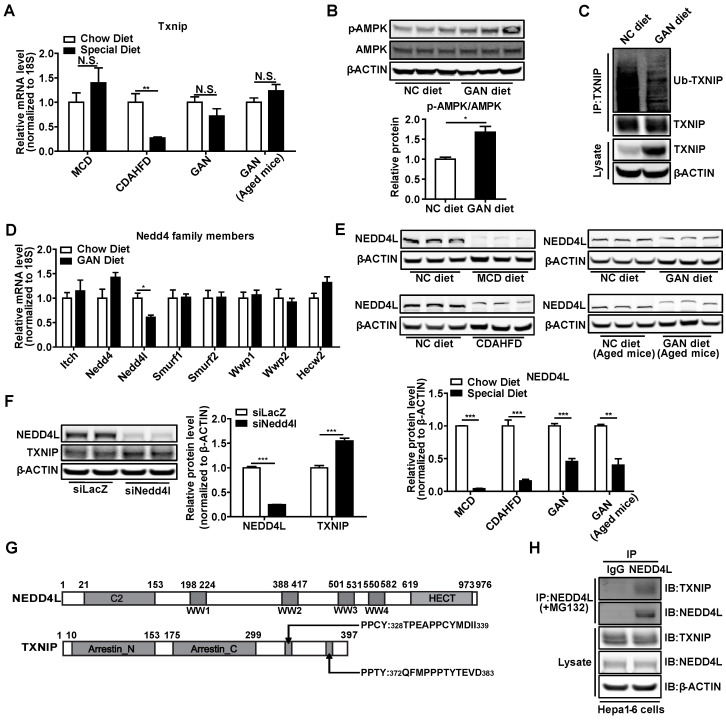
Nonalcoholic steatohepatitis (NASH) is a leading cause of chronic liver diseases worldwide. There is a pressing clinical need to identify potential therapeutic targets for NASH treatment. Thioredoxin interacting protein () is a stress responsive gene that has been implicated in the pathogenesis of NASH, but its exact role is not fully understood. Here, we investigated the liver- and gene-specific role of and its upstream/downstream signaling in the pathogenesis of NASH. Using four independent NASH mouse models, we found that TXNIP protein abnormally accumulated in NASH mouse livers. A decrease in E3 ubiquitin ligase NEDD4L resulted in impaired TXNIP ubiquitination and its accumulation in the liver. TXNIP protein levels were positively correlated with that of CHOP, a major regulator of ER stress-mediated apoptosis, in NASH mouse liver. Moreover, gain- and loss-of-function studies showed that TXNIP increased protein not mRNA levels of both and . Mechanistically, the C-terminus of TXNIP associated with the N-terminus of the α-helix domain of CHOP and decreased CHOP ubiquitination, thus increasing the stability of CHOP protein. Lastly, selective knockdown of by adenovirus-mediated shRNA (not targets antisense lncRNA) delivery in the livers of both young and aged NASH mice suppressed the expression of CHOP and its downstream apoptotic pathway, and ameliorated NASH by reducing hepatic apoptosis, inflammation, and fibrosis. Our study revealed a pathogenic role of hepatic TXNIP in NASH and identified a novel NEDD4L-TXNIP-CHOP axis in the pathogenesis of NASH.
非酒精性脂肪性肝炎(NASH)是全球慢性肝病的主要原因。迫切需要确定 NASH 治疗的潜在治疗靶点。硫氧还蛋白相互作用蛋白(TXNIP)是一种应激反应基因,与 NASH 的发病机制有关,但确切作用尚不完全清楚。在这里,我们研究了 TXNIP 及其在上游/下游信号通路在 NASH 发病机制中的肝脏和基因特异性作用。 使用四个独立的 NASH 小鼠模型,我们发现 TXNIP 蛋白在 NASH 小鼠肝脏中异常积累。E3 泛素连接酶 NEDD4L 的减少导致 TXNIP 的泛素化受损及其在肝脏中的积累。TXNIP 蛋白水平与 NASH 小鼠肝中内质网应激介导凋亡的主要调节因子 CHOP 的水平呈正相关。此外,增益和损耗功能研究表明,TXNIP 增加了 和 的蛋白而不是 的 mRNA 水平。在机制上,TXNIP 的 C 末端与 CHOP 的α-螺旋结构域的 N 末端结合,减少 CHOP 的泛素化,从而增加 CHOP 蛋白的稳定性。最后,通过腺病毒介导的 shRNA(而不是靶向反义 lncRNA)在年轻和老年 NASH 小鼠肝脏中的递送,选择性敲低 ,抑制了 CHOP 及其下游凋亡途径的表达,并通过减少肝凋亡、炎症和纤维化改善了 NASH。 我们的研究揭示了肝 TXNIP 在 NASH 中的致病作用,并确定了 NASH 发病机制中的新型 NEDD4L-TXNIP-CHOP 轴。