Department of Epidemiology and Biostatistics, School of Public Health, Jilin University, Changchun, China.
Department of Biostatistics and Epidemiology, School of Public Health, China Medical University, Shenyang, China.
Epidemiol Health. 2023;45:e2023051. doi: 10.4178/epih.e2023051. Epub 2023 May 4.
One of the underlying mechanisms of aging is chronic inflammation, which has been closely associated with daily diet. Phenotypic age (PhenoAge) has been used as an index to track the aging process before diseases show clinical symptoms. The present study aimed to explore the association between the dietary inflammatory index (DII) and PhenoAge.
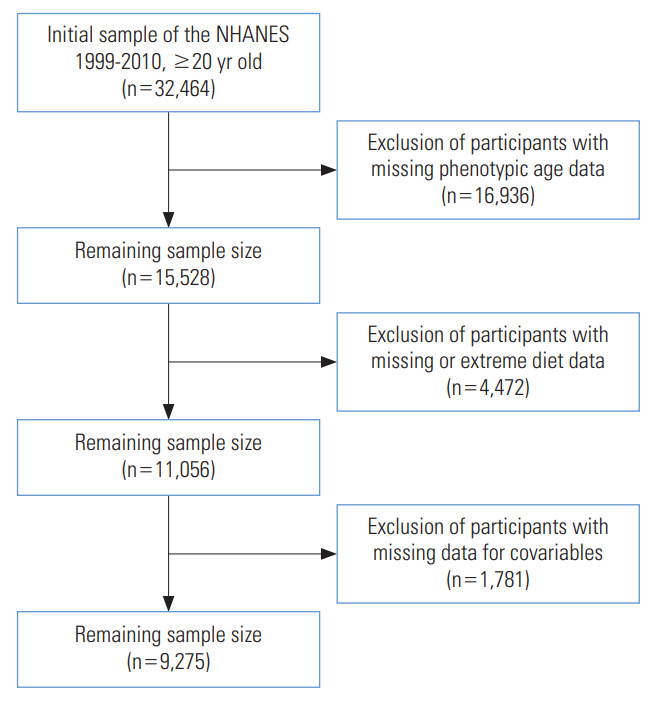
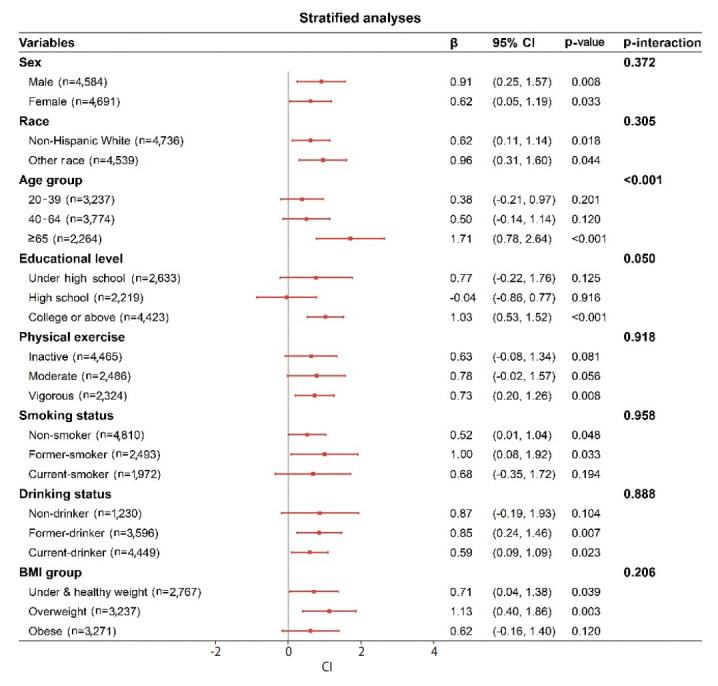
In total, 9,275 adults aged 20 years old and over in the National Health and Nutrition Examination Survey were involved in this study. Dietary patterns were classified as pro-inflammatory or anti-inflammatory according to the DII. PhenoAge was regarded as a continuous variable, and linear regression was used to explore its association with dietary inflammation. Stratified analyses by sex, age, race, physical exercise, smoking status, drinking status, and body mass index were used to test the sensitivity of these associations.
The median value of PhenoAge was 38.60 years and 39.76 years for the participants with anti-inflammatory and pro-inflammatory diets, respectively. A pro-inflammatory diet was positively associated with PhenoAge (β=0.73; 95% confidence interval, 0.31 to 1.14), compared with participants who had an anti-inflammatory diet. There was an interaction between dietary inflammation and age for PhenoAge (pinteraction<0.001). The strength of the association between a pro-inflammatory diet and PhenoAge was stronger as age increased.
A pro-inflammatory diet was associated with a higher PhenoAge, and the association was strongest in the elderly. We recommended reducing dietary inflammation to delay phenotypic aging, especially for the elderly.
衰老的潜在机制之一是慢性炎症,它与日常饮食密切相关。表型年龄(PhenoAge)已被用作在疾病出现临床症状之前跟踪衰老过程的指标。本研究旨在探讨饮食炎症指数(DII)与 PhenoAge 之间的关系。
本研究共纳入了 9275 名年龄在 20 岁及以上的美国国家健康与营养调查参与者。根据 DII 将饮食模式分为促炎或抗炎饮食。将 PhenoAge 视为连续变量,采用线性回归来探讨其与饮食炎症的关系。按性别、年龄、种族、体育锻炼、吸烟状况、饮酒状况和体重指数进行分层分析,以检验这些关联的敏感性。
PhenoAge 的中位数为 38.60 岁,抗炎饮食和促炎饮食组的参与者分别为 39.76 岁。与抗炎饮食组相比,促炎饮食与 PhenoAge 呈正相关(β=0.73;95%置信区间,0.31 至 1.14)。饮食炎症与 PhenoAge 之间存在交互作用(pinteraction<0.001)。随着年龄的增加,促炎饮食与 PhenoAge 之间的关联强度更强。
促炎饮食与更高的 PhenoAge 相关,且这种关联在老年人中最强。我们建议减少饮食炎症以延缓表型衰老,尤其是针对老年人。