Department of Pharmacognosy, Poznan University of Medical Sciences, Rokietnicka 3, 60-806 Poznan, Poland.
Faculty of Mechanical Engineering and Management, Institute of Materials Science and Engineering, Poznan University of Technology, 60-965 Poznan, Poland.
Int J Mol Sci. 2023 Apr 27;24(9):7963. doi: 10.3390/ijms24097963.
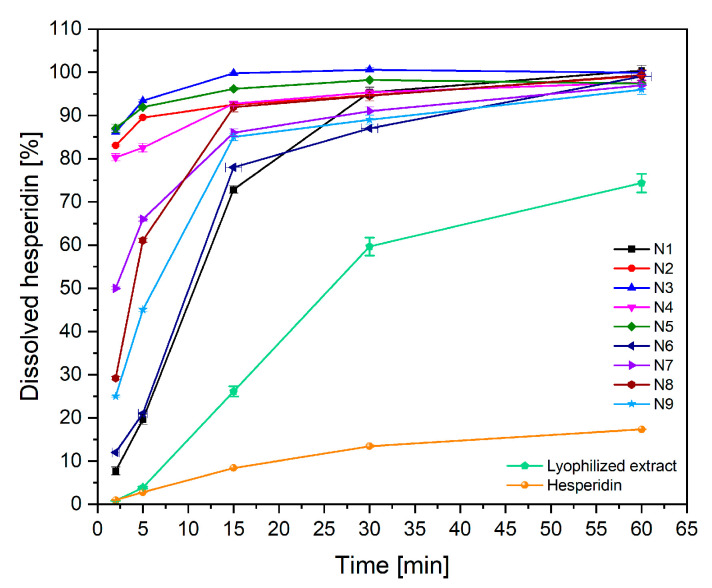
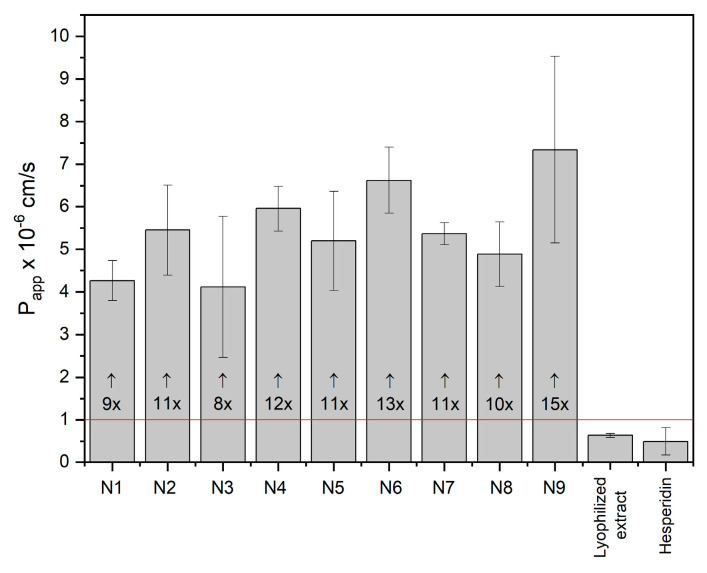
Orange peel, which is a rich source of polyphenolic compounds, including hesperidin, is produced as waste in production. Therefore, optimization of the extraction of hesperidin was performed to obtain its highest content. The influence of process parameters such as the kind of extraction mixture, its temperature and the number of repetitions of the cycles on hesperidin content, the total content of phenolic compounds and antioxidant (DPPH scavenging assay) as well as anti-inflammation activities (inhibition of hyaluronidase activity) was checked. Methanol and temperature were key parameters determining the efficiency of extraction in terms of the possibility of extracting compounds with the highest biological activity. The optimal parameters of the orange peel extraction process were 70% of methanol in the extraction mixture, a temperature of 70 °C and 4 cycles per 20 min. The second part of the work focuses on developing electrospinning technology to synthesize nanofibers of polyvinylpyrrolidone (PVP) and hydroxypropyl-β-cyclodextrin (HPβCD) loaded with hesperidin-rich orange peel extract. This is a response to the circumvention of restrictions in the use of hesperidin due to its poor bioavailability resulting from low solubility and permeability. Dissolution studies showed improved hesperidin solubility (over eight-fold), while the PAMPA-GIT assay confirmed significantly better transmucosal penetration (over nine-fold). A DPPH scavenging assay of antioxidant activity as well as inhibition of hyaluronidase to express anti-inflammation activity was established for hesperidin in prepared electrospun nanofibers, especially those based on HPβCD and PVP. Thus, hesperidin-rich orange peel nanofibers may have potential buccal applications to induce improved systemic effects with pro-health biological activity.
橘皮是多酚化合物的丰富来源,包括橙皮苷,在生产过程中会产生橘皮废弃物。因此,优化了橙皮苷的提取工艺,以获得其最高含量。检查了过程参数(例如提取混合物的种类、温度和循环次数)对橙皮苷含量、总酚类化合物含量和抗氧化活性(DPPH 清除试验)以及抗炎活性(透明质酸酶抑制活性)的影响。甲醇和温度是决定提取效率的关键参数,因为它们决定了提取具有最高生物活性化合物的可能性。橙皮提取过程的最佳参数是提取混合物中 70%的甲醇、70°C 的温度和每 20 分钟 4 个循环。工作的第二部分侧重于开发静电纺丝技术,以合成负载富含橙皮苷的橙皮提取物的聚乙烯吡咯烷酮(PVP)和羟丙基-β-环糊精(HPβCD)纳米纤维。这是对由于低溶解度和渗透性导致橙皮苷生物利用度差而限制其使用的一种回应。溶解研究表明橙皮苷的溶解度提高了(超过八倍),而 PAMPA-GIT 测定证实其跨黏膜渗透能力显著提高(超过九倍)。建立了 DPPH 清除试验来评估抗氧化活性以及抑制透明质酸酶以表达抗炎活性,用于制备的静电纺纳米纤维中的橙皮苷,特别是基于 HPβCD 和 PVP 的纳米纤维。因此,富含橙皮苷的橙皮纳米纤维可能具有口腔应用的潜力,可诱导具有促进健康的生物活性的改善全身作用。