Li Quanxiao, Lu Jun, Li Jinyao, Zhang Baohong, Wu Yanling, Ying Tianlei
Key Laboratory of Medical Molecular Virology (MOE/NHC/CAMS), Shanghai Frontiers Science Center of Pathogenic Microorganisms and Infection, Shanghai Institute of Infectious Disease and Biosecurity, Shanghai Engineering Research Center for Synthetic Immunology, School of Basic Medical Sciences, Shanghai Medical College, Fudan University, Shanghai, China.
Auckland Bioengineering Institute, University of Auckland, Auckland, New Zealand.
Front Oncol. 2023 Apr 27;13:1157345. doi: 10.3389/fonc.2023.1157345. eCollection 2023.
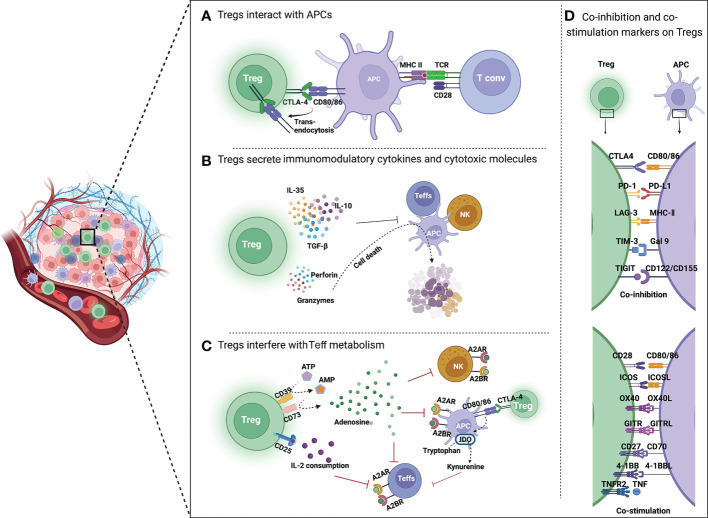
Regulatory T cells (Tregs) are among the most abundant suppressive cells, which infiltrate and accumulate in the tumor microenvironment, leading to tumor escape by inducing anergy and immunosuppression. Their presence has been correlated with tumor progression, invasiveness and metastasis. Targeting tumor-associated Tregs is an effective addition to current immunotherapy approaches, but it may also trigger autoimmune diseases. The major limitation of current therapies targeting Tregs in the tumor microenvironment is the lack of selective targets. Tumor-infiltrating Tregs express high levels of cell surface molecules associated with T-cell activation, such as CTLA4, PD-1, LAG3, TIGIT, ICOS, and TNF receptor superfamily members including 4-1BB, OX40, and GITR. Targeting these molecules often attribute to concurrent depletion of antitumor effector T-cell populations. Therefore, novel approaches need to improve the specificity of targeting Tregs in the tumor microenvironment without affecting peripheral Tregs and effector T cells. In this review, we discuss the immunosuppressive mechanisms of tumor-infiltrating Tregs and the status of antibody-based immunotherapies targeting Tregs.
调节性T细胞(Tregs)是最丰富的抑制性细胞之一,它们浸润并积聚在肿瘤微环境中,通过诱导无反应性和免疫抑制导致肿瘤逃逸。它们的存在与肿瘤进展、侵袭和转移相关。靶向肿瘤相关Tregs是当前免疫治疗方法的有效补充,但也可能引发自身免疫性疾病。当前针对肿瘤微环境中Tregs的治疗方法的主要局限性在于缺乏选择性靶点。肿瘤浸润性Tregs表达高水平的与T细胞活化相关的细胞表面分子,如CTLA4(细胞毒性T淋巴细胞相关蛋白4)、PD-1(程序性死亡受体1)、LAG3(淋巴细胞激活基因3)、TIGIT(T细胞免疫球蛋白和ITIM结构域)、ICOS(可诱导共刺激分子),以及肿瘤坏死因子受体超家族成员,包括4-1BB(CD137)、OX40(肿瘤坏死因子受体超家族成员4)和GITR(糖皮质激素诱导的肿瘤坏死因子受体)。靶向这些分子往往会导致抗肿瘤效应T细胞群体同时耗竭。因此,新的方法需要提高在肿瘤微环境中靶向Tregs的特异性,同时不影响外周Tregs和效应T细胞。在这篇综述中,我们讨论了肿瘤浸润性Tregs的免疫抑制机制以及基于抗体的靶向Tregs免疫疗法的现状。