Department of Biochemistry, Instituto de Química, Universidade de São Paulo, Av. Prof. Lineu Prestes 748, São Paulo, SP, 05508-900, Brazil.
Department of Chemistry, University of Cambridge, Lensfield Road, Cambridge, CB2 1EW, UK.
Sci Rep. 2023 Apr 25;13(1):6738. doi: 10.1038/s41598-023-33333-6.
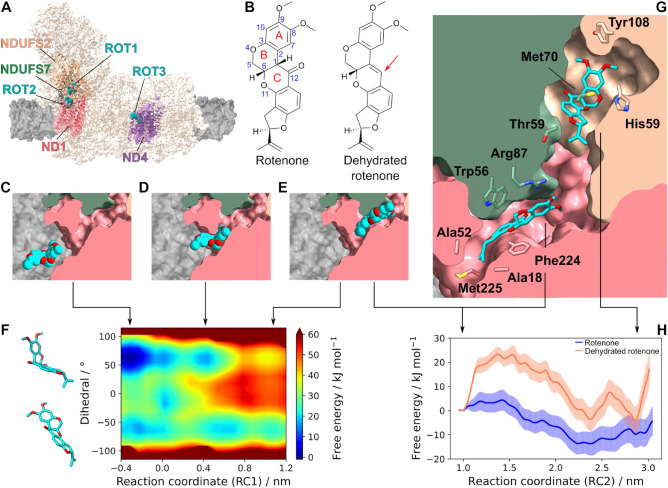
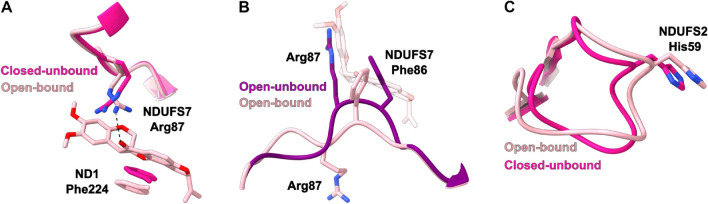
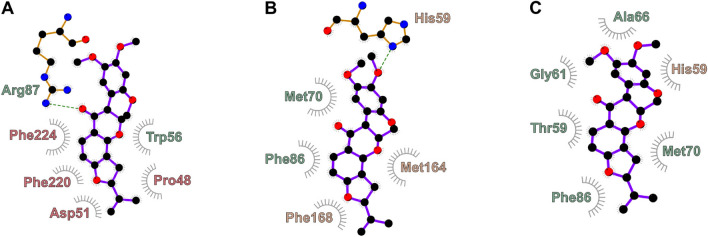
Respiratory complex I is a major cellular energy transducer located in the inner mitochondrial membrane. Its inhibition by rotenone, a natural isoflavonoid, has been used for centuries by indigenous peoples to aid in fishing and, more recently, as a broad-spectrum pesticide or even a possible anticancer therapeutic. Unraveling the molecular mechanism of rotenone action will help to design tuned derivatives and to understand the still mysterious catalytic mechanism of complex I. Although composed of five fused rings, rotenone is a flexible molecule and populates two conformers, bent and straight. Here, a rotenone derivative locked in the straight form was synthesized and found to inhibit complex I with 600-fold less potency than natural rotenone. Large-scale molecular dynamics and free energy simulations of the pathway for ligand binding to complex I show that rotenone is more stable in the bent conformer, either free in the membrane or bound to the redox active site in the substrate-binding Q-channel. However, the straight conformer is necessary for passage from the membrane through the narrow entrance of the channel. The less potent inhibition of the synthesized derivative is therefore due to its lack of internal flexibility, and interconversion between bent and straight forms is required to enable efficient kinetics and high stability for rotenone binding. The ligand also induces reconfiguration of protein loops and side-chains inside the Q-channel similar to structural changes that occur in the open to closed conformational transition of complex I. Detailed understanding of ligand flexibility and interactions that determine rotenone binding may now be exploited to tune the properties of synthetic derivatives for specific applications.
呼吸复合物 I 是一种位于线粒体内膜的主要细胞能量转换器。它的抑制剂鱼藤酮是一种天然异黄酮,几个世纪以来一直被土著人民用来捕鱼,最近还被用作广谱杀虫剂,甚至可能是一种抗癌治疗药物。阐明鱼藤酮的作用机制有助于设计调谐衍生物,并理解复合物 I 仍然神秘的催化机制。尽管鱼藤酮由五个融合环组成,但它是一种灵活的分子,存在两种构象,即弯曲和直线。在这里,合成了一种锁定在直线形式的鱼藤酮衍生物,发现它对复合物 I 的抑制作用比天然鱼藤酮弱 600 倍。对配体与复合物 I 结合途径的大规模分子动力学和自由能模拟表明,鱼藤酮在弯曲构象中更稳定,无论是在膜中自由存在还是结合在底物结合 Q 通道中的氧化还原活性位点。然而,直线构象对于从膜通过通道的狭窄入口是必要的。因此,合成衍生物的抑制作用较弱是由于其缺乏内部灵活性,并且需要弯曲和直线构象之间的转换才能实现鱼藤酮结合的高效动力学和高稳定性。该配体还诱导 Q 通道内蛋白环和侧链的重新配置,类似于复合物 I 从开放构象到关闭构象转变中发生的结构变化。现在可以详细了解决定鱼藤酮结合的配体灵活性和相互作用,以调整合成衍生物的特性,用于特定应用。