de Castro Poncio Lisiane, Apolinário Dos Anjos Filipe, de Oliveira Deborah Aline, de Oliveira da Rosa Aline, Piraccini Silva Bianca, Rebechi Débora, Pedrosa Jorge Márcio, da Costa Franciscato Diego Alan, de Souza Cláudio, Paldi Nitzan
Forrest Brasil Tecnologia Ltda, São José dos Pinhais, PR, Brazil.
Department of Health of Ortigueira, PR, Brazil.
Lancet Reg Health Am. 2023 May 1;21:100498. doi: 10.1016/j.lana.2023.100498. eCollection 2023 May.
Dengue is a global problem that seems to be worsening, as hyper-urbanization associated with climate change has led to a significant increase in the abundance and geographical spread of its principal vector, the mosquito. Currently available solutions have not been able to stop the spread of dengue which shows the urgent need to implement alternative technologies as practical solutions. In a previous pilot trial, we demonstrated the efficacy and safety of the method 'Natural Vector Control' (NVC) in suppressing the vector population and in blocking the occurrence of an outbreak of dengue in the treated areas. Here, we expand the use of the NVC program in a large-scale 20 months intervention period in an entire city in southern Brazil.
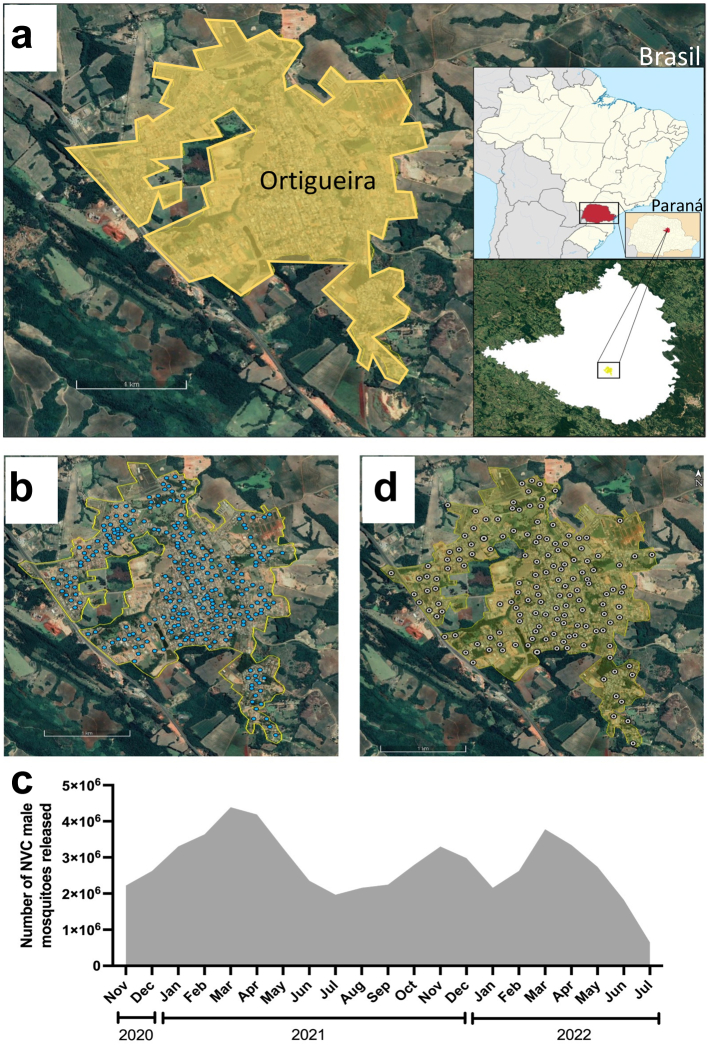
Sterile male mosquitoes were produced from locally sourced mosquitoes by using a treatment that includes double-stranded RNA and thiotepa. Weekly massive releases of sterile male mosquitoes were performed in predefined areas of Ortigueira city from November 2020 to July 2022. Mosquito monitoring was performed by using ovitraps during the entire intervention period. Dengue incidence data was obtained from the Brazilian National Disease Surveillance System.
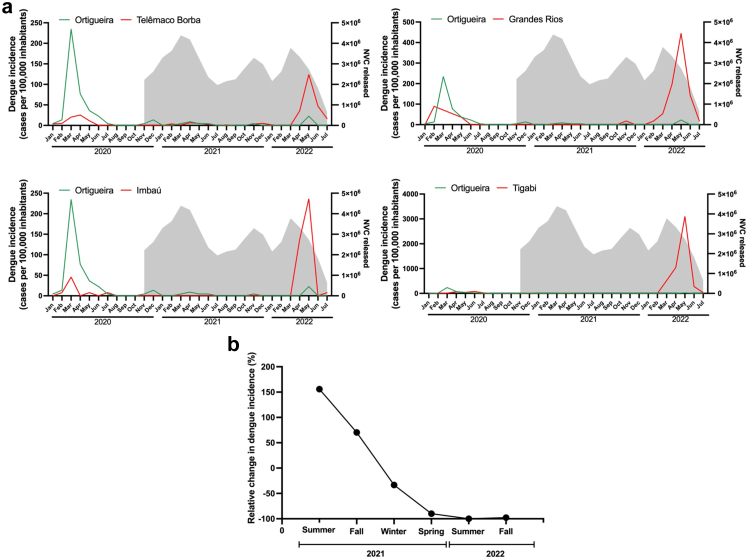
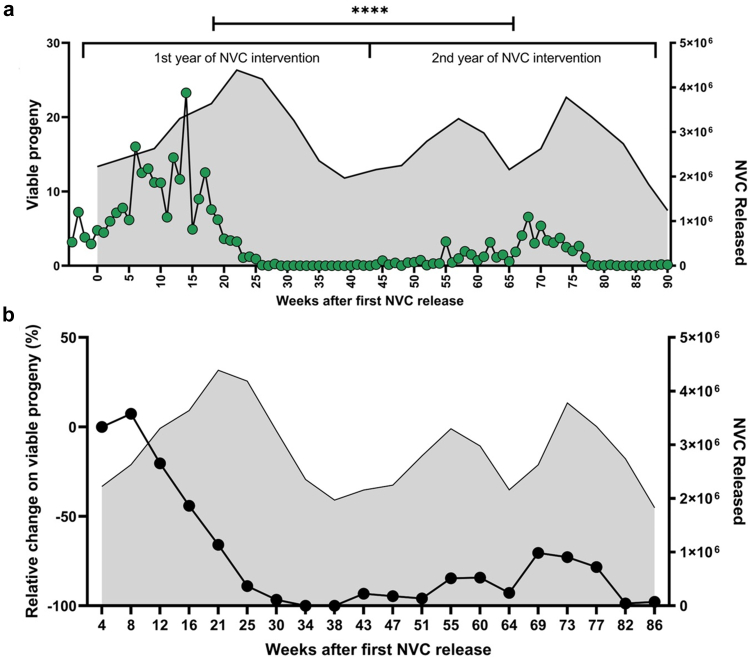
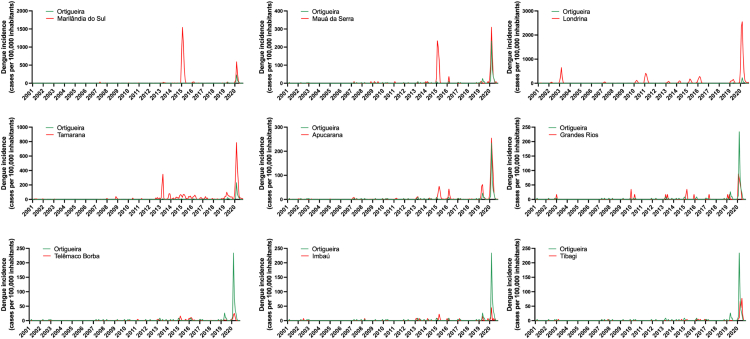
During the two epidemiological seasons, the intervention in Ortigueira resulted in up to 98.7% suppression of live progeny of field mosquitoes recorded over time. More importantly, when comparing the 2020 and 2022 dengue outbreaks that occurred in the region, the post-intervention dengue incidence in Ortigueira was 97% lower compared to the control cities.
The NVC method was confirmed to be a safe and efficient way to suppress field populations and prevent the occurrence of a dengue outbreak. Importantly, it has been shown to be applicable in large-scale, real-world conditions.
This study was funded by Klabin S/A and Forrest Innovations Ltd.
登革热是一个全球性问题,且似乎正在恶化,因为与气候变化相关的过度城市化导致其主要病媒蚊子的数量大幅增加和地理分布范围扩大。目前可用的解决方案未能阻止登革热的传播,这表明迫切需要采用替代技术作为切实可行的解决办法。在之前的一项试点试验中,我们证明了“自然病媒控制”(NVC)方法在抑制病媒种群和阻止登革热疫情在治疗区域发生方面的有效性和安全性。在此,我们在巴西南部一个城市进行了为期20个月的大规模干预期间扩大了NVC计划的应用。
通过使用包括双链RNA和噻替派的处理方法,从当地来源的蚊子中培育出无菌雄蚊。2020年11月至2022年7月,在奥蒂盖拉市的预定义区域每周大量释放无菌雄蚊。在整个干预期间,使用诱蚊产卵器进行蚊子监测。登革热发病率数据来自巴西国家疾病监测系统。
在两个流行季节期间,奥蒂盖拉的干预措施使随时间记录的野外蚊子活后代数量最多减少了98.7%。更重要的是,比较该地区2020年和2022年发生的登革热疫情时,奥蒂盖拉干预后的登革热发病率比对照城市低97%。
NVC方法被证实是抑制野外种群和预防登革热疫情发生的一种安全有效的方法。重要的是,它已被证明适用于大规模的实际情况。
本研究由克拉宾股份公司和福雷斯特创新有限公司资助。