Department of Mechanical Engineering, The University of Hong Kong, Pokfulam Road, Hong Kong (SAR), China.
Advanced Biomedical Instrumentation Centre, Hong Kong Science Park, Shatin, New Territories, Hong Kong (SAR), China.
Nat Commun. 2023 May 16;14(1):2793. doi: 10.1038/s41467-023-38394-9.
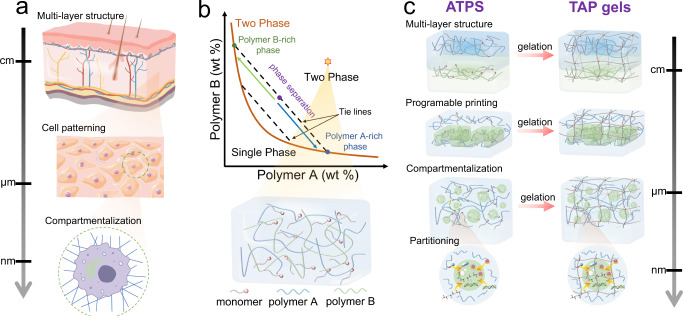
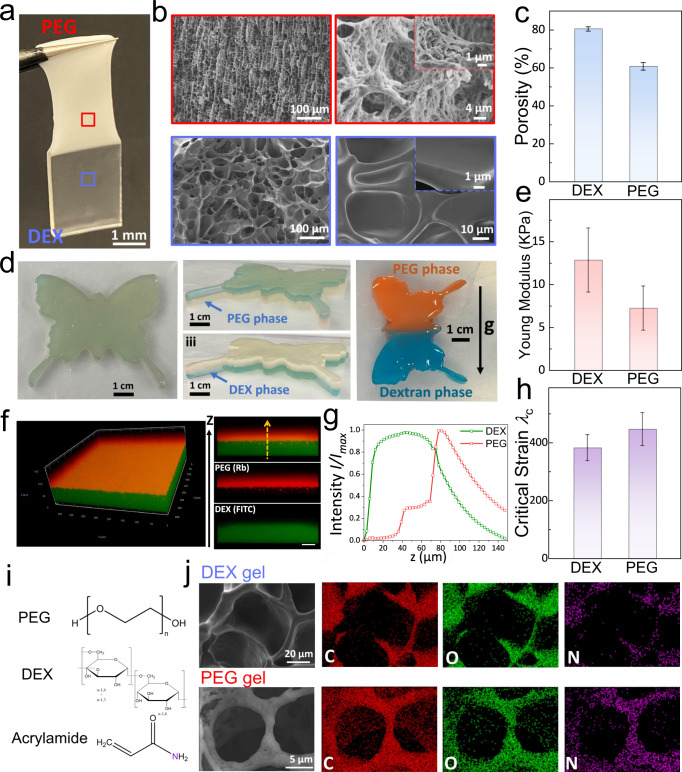
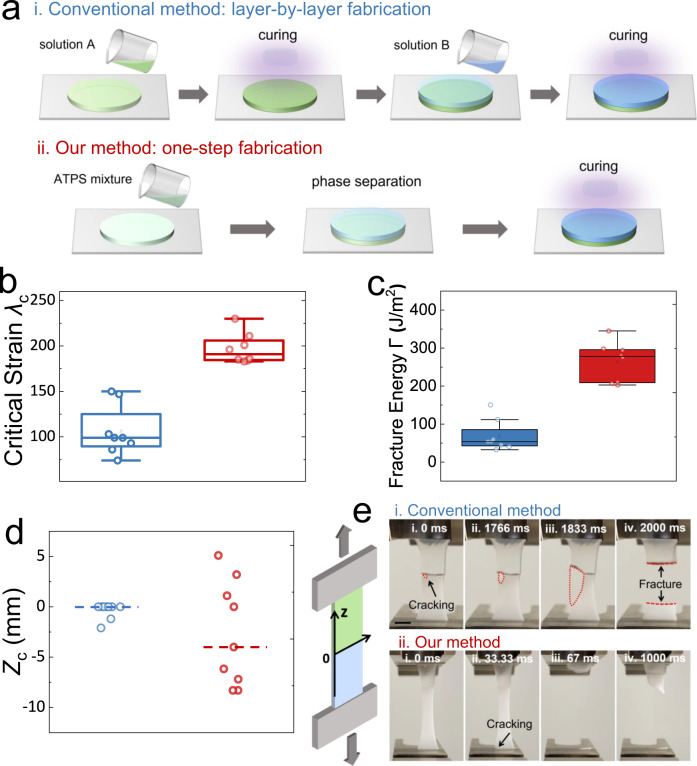
Engineering heterogeneous hydrogels with distinct phases at various lengths, which resemble biological tissues with high complexity, remains challenging by existing fabricating techniques that require complicated procedures and are often only applicable at bulk scales. Here, inspired by ubiquitous phase separation phenomena in biology, we present a one-step fabrication method based on aqueous phase separation to construct two-aqueous-phase gels that comprise multiple phases with distinct physicochemical properties. The gels fabricated by this approach exhibit enhanced interfacial mechanics compared with their counterparts obtained from conventional layer-by-layer methods. Moreover, two-aqueous-phase gels with programmable structures and tunable physicochemical properties can be conveniently constructed by adjusting the polymer constituents, gelation conditions, and combining different fabrication techniques, such as 3D-printing. The versatility of our approach is demonstrated by mimicking the key features of several biological architectures at different lengths: macroscale muscle-tendon connections; mesoscale cell patterning; microscale molecular compartmentalization. The present work advances the fabrication approach for designing heterogeneous multifunctional materials for various technological and biomedical applications.
利用现有制造技术很难在不同长度上构建具有不同相的工程化杂化水凝胶,这些技术通常需要复杂的步骤,而且仅适用于大块规模。在这里,受生物学中普遍存在的相分离现象的启发,我们提出了一种基于水相分离的一步制造方法,用于构建具有不同物理化学性质的多相双水相凝胶。与传统的逐层方法相比,通过这种方法制造的凝胶表现出增强的界面力学性能。此外,通过调整聚合物成分、凝胶化条件以及结合不同的制造技术(如 3D 打印),可以方便地构建具有可编程结构和可调物理化学性质的双水相凝胶。通过模拟不同长度的几种生物结构的关键特征,展示了我们方法的多功能性:宏观尺度的肌肉-肌腱连接;介观尺度的细胞图案化;微观尺度的分子分隔。本工作推进了设计用于各种技术和生物医学应用的杂化多功能材料的制造方法。