School of Life Sciences and Medicine, Shandong University of Technology, 266 Xincun West Road, Zibo, 255000, China.
School of Science and Technology, Georgia Gwinnett College, Lawrenceville, GA, 30043, USA.
Microb Cell Fact. 2023 May 18;22(1):102. doi: 10.1186/s12934-023-02077-3.
Heme is an iron/porphyrin complex compound, widely used in the health care, food, and pharmaceutical industries. It is more advantageous and attractive to develop microbial cell factories to produce heme by fermentation, with lower production costs and environmentally more friendly procedures than those of the traditional extraction based on animal blood. In this study, Bacillus subtilis, a typical industrial model microorganism of food safety grade, was used for the first time as the host to synthesize heme.
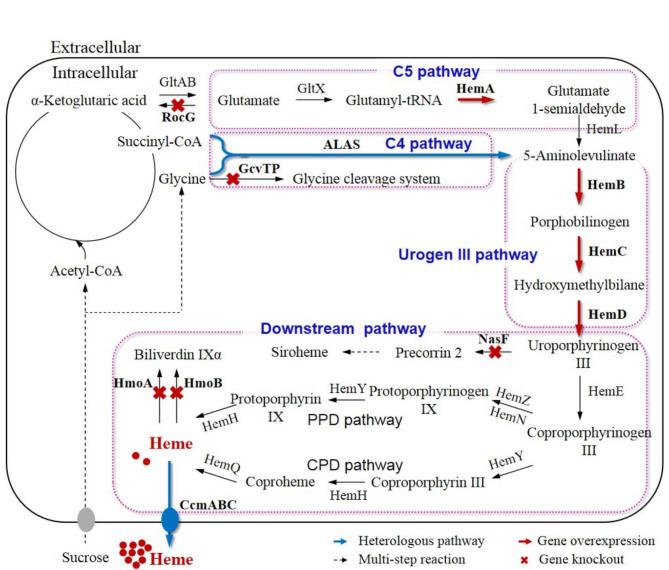
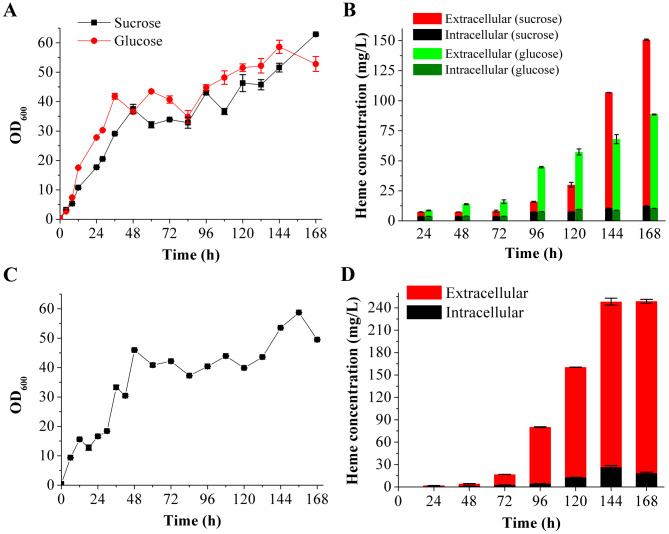
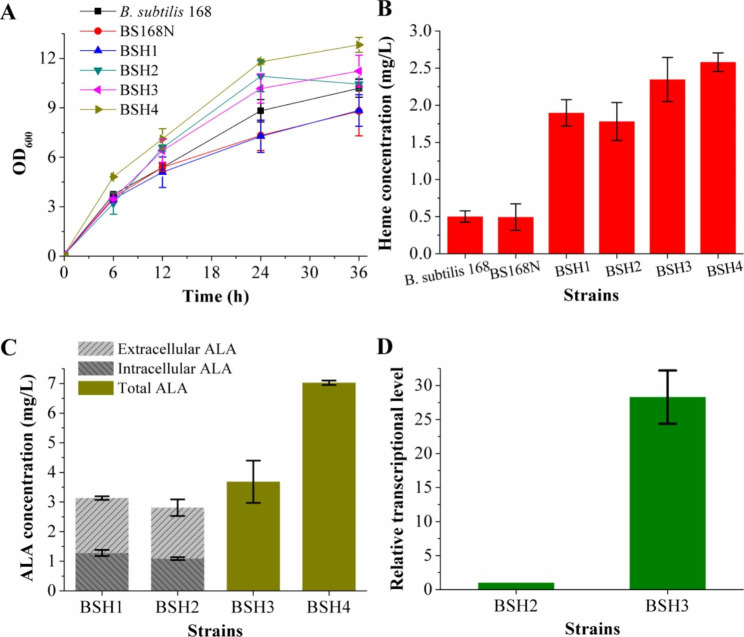
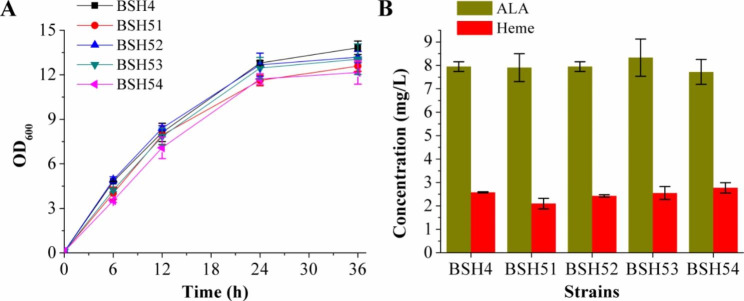
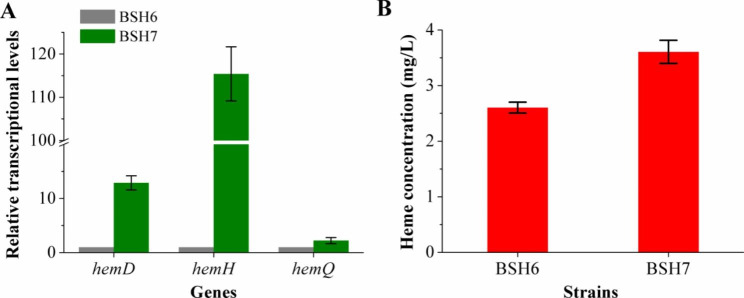
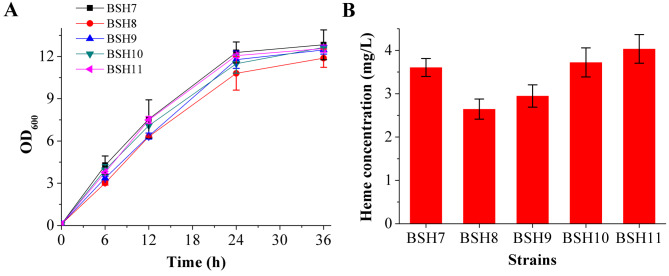
The heme biosynthetic pathway was engineered as four modules, the endogenous C5 pathway, the heterologous C4 pathway, the uroporphyrinogen (urogen) III synthesis pathway, and the downstream synthesis pathway. Knockout of hemX encoding the negative effector of the concentration of HemA, overexpression of hemA encoding glutamyl-tRNA reductase, and knockout of rocG encoding the major glutamate dehydrogenase in the C5 pathway, resulted in an increase of 427% in heme production. Introduction of the heterologous C4 pathway showed a negligible effect on heme biosynthesis. Overexpression of hemCDB, which encoded hydroxymethylbilane synthase, urogen III synthase, and porphobilinogen synthase participating in the urogen III synthesis pathway, increased heme production by 39%. Knockouts of uroporphyrinogen methyltransferase gene nasF and both heme monooxygenase genes hmoA and hmoB in the downstream synthesis pathway increased heme production by 52%. The engineered B. subtilis produced 248.26 ± 6.97 mg/L of total heme with 221.83 ± 4.71 mg/L of extracellular heme during the fed-batch fermentation in 10 L fermenter.
Strengthening endogenous C5 pathway, urogen III synthesis pathway and downstream synthesis pathway promoted the biosynthesis of heme in B. subtilis. The engineered B. subtilis strain has great potential as a microbial cell factory for efficient industrial heme production.
血红素是一种含铁/卟啉的复合物,广泛应用于保健、食品和制药行业。与传统的基于动物血液的提取方法相比,利用发酵工程开发微生物细胞工厂生产血红素具有成本更低、更环保的优势。本研究首次利用枯草芽孢杆菌作为宿主合成血红素。
血红素生物合成途径被构建为四个模块,即内源性 C5 途径、异源 C4 途径、尿卟啉原(urogen)III 合成途径和下游合成途径。敲除编码 HemA 负效应物的 hemX、过表达编码谷氨酰-tRNA 还原酶的 hemA、敲除 C5 途径中主要谷氨酸脱氢酶的 rocG,使血红素产量增加了 427%。引入异源 C4 途径对血红素生物合成几乎没有影响。过表达编码羟甲基胆色素合酶、尿卟啉原 III 合酶和原卟啉原 IV 合酶的 hemCDB,使血红素产量增加了 39%。敲除下游合成途径中的尿卟啉原甲基转移酶基因 nasF 和血红素单加氧酶基因 hmoA 和 hmoB,使血红素产量增加了 52%。在 10 L 发酵罐中进行分批补料发酵时,工程枯草芽孢杆菌产生了 248.26±6.97 mg/L 的总血红素,其中 221.83±4.71 mg/L 为胞外血红素。
增强内源性 C5 途径、尿卟啉原 III 合成途径和下游合成途径促进了枯草芽孢杆菌血红素的生物合成。该工程枯草芽孢杆菌菌株具有作为高效工业血红素生产的微生物细胞工厂的巨大潜力。