College of Health Science, Department of Midwifery, Assosa University, Asosa, Ethiopia.
Inquiry. 2023 Jan-Dec;60:469580231171309. doi: 10.1177/00469580231171309.
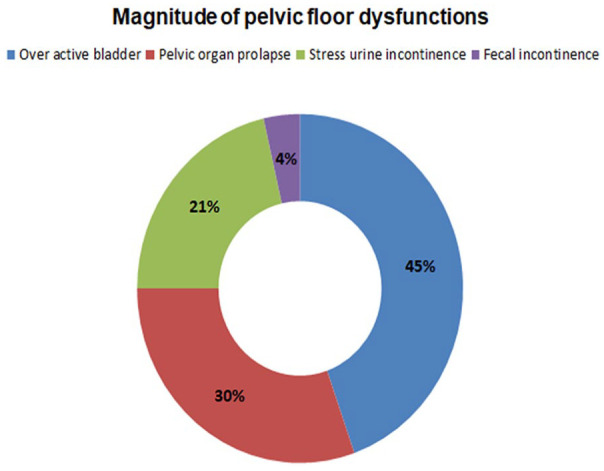
The goal of this research was to determine the extent of pelvic floor dysfunction and the factors that contribute to it. The study design was community-focused and cross-sectional, and participants were chosen using a systematic random sampling technique. For data entry and cleansing, we used EPI data version 3.1 software, and for analysis, we used Statistical Package for the Social Sciences version 26. The 95% confidence interval was predicted, and the factor with a significant level less than 0.05 was chosen for multivariate logistic regression analysis. The overall Magnitude of pelvic floor dysfunction was 37.7% [(95% confidence interval (31.7-42.5)]. The most common type of pelvic floor dysfunction is overactive bladder, which was reported by 135 of all participants. Pelvic organ prolapse accounted for 92 (30.4%) of all cases, and 4 factors were found to be significantly associated with pelvic floor dysfunction. In this study, age 55 years [(AOR = 2.1; 95% CI: (1.52-6.42)], heavy labor work for more than 10 years [(AOR = 3.21; 95% CI: (1.86-5.72) grand-multipara, and being menopause [(AOR = 4.03; 95% CI: (2.20-8.27)] were linked to symptoms of pelvic floor dysfunction. The magnitude of pelvic floor dysfunction in this study was slightly higher than in Ethiopian studies. Pelvic floor dysfunction has been linked to heavy load lifting, low socioeconomic status, recurrent vaginal deliveries, chronic cough, and menopause. Screening and treatment of pelvic floor disorders should be prioritized in collaboration with regional and zonal health departments.
本研究旨在确定盆腔功能障碍的程度以及导致其发生的因素。研究设计采用社区为基础的横断研究方法,采用系统随机抽样技术选择参与者。我们使用 EPI data 版本 3.1 软件进行数据录入和清理,使用 Statistical Package for the Social Sciences 版本 26 进行分析。我们预测了 95%置信区间,并选择了显著性水平小于 0.05 的因素进行多变量逻辑回归分析。盆腔功能障碍的总体严重程度为 37.7%[(95%置信区间(31.7-42.5)]。最常见的盆腔功能障碍类型是膀胱过度活动症,所有参与者中有 135 人报告了这种情况。盆腔器官脱垂占所有病例的 92(30.4%),有 4 个因素与盆腔功能障碍显著相关。在这项研究中,年龄 55 岁[(AOR=2.1;95%CI:(1.52-6.42)]、从事超过 10 年的重体力劳动[(AOR=3.21;95%CI:(1.86-5.72)]、多胎次产妇和绝经[(AOR=4.03;95%CI:(2.20-8.27)]与盆腔功能障碍症状相关。本研究中盆腔功能障碍的严重程度略高于埃塞俄比亚的研究。盆腔功能障碍与举重、社会经济地位低、多次阴道分娩、慢性咳嗽和绝经有关。应与地区和区域卫生部门合作,优先筛查和治疗盆腔功能障碍。