Surgery and Oral Medicine Department, Oral and Dental Research Institute, National Research Centre, 33 El Buhouth St., Dokki, Giza, 12622, Egypt.
Department of Surgery, Anesthesiology and Radiology, Faculty of Veterinary Medicine, Cairo University, Giza, 12211, Egypt.
J Mater Sci Mater Med. 2023 May 19;34(6):27. doi: 10.1007/s10856-023-06731-5.
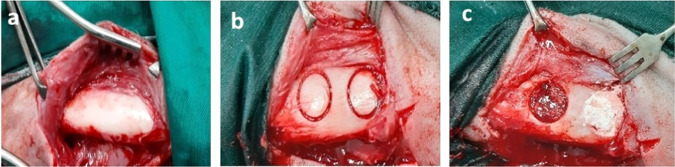
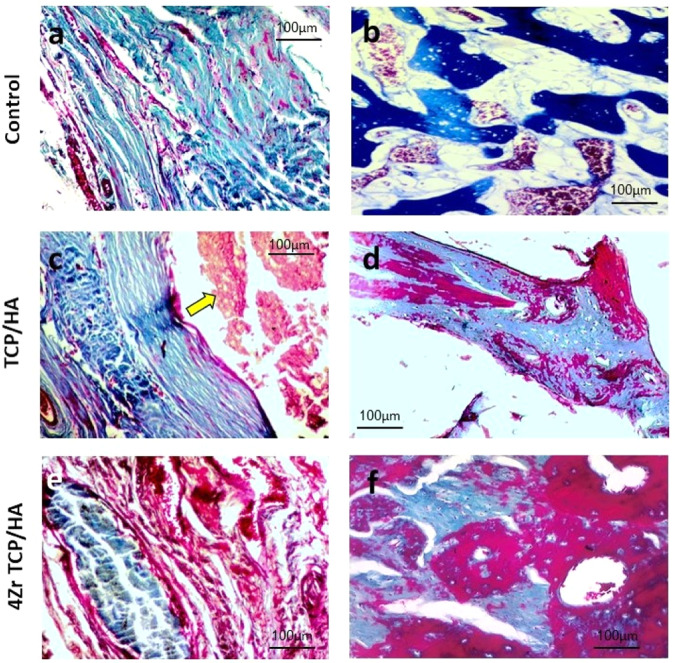
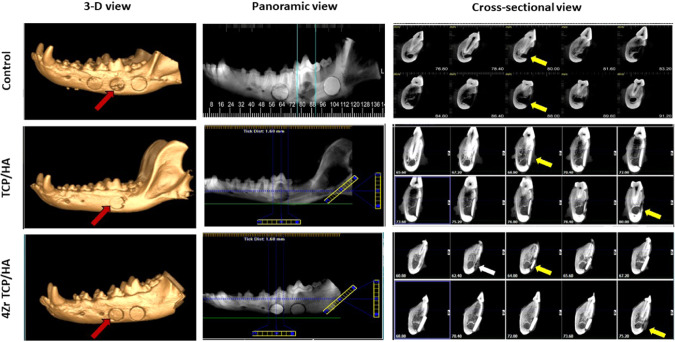
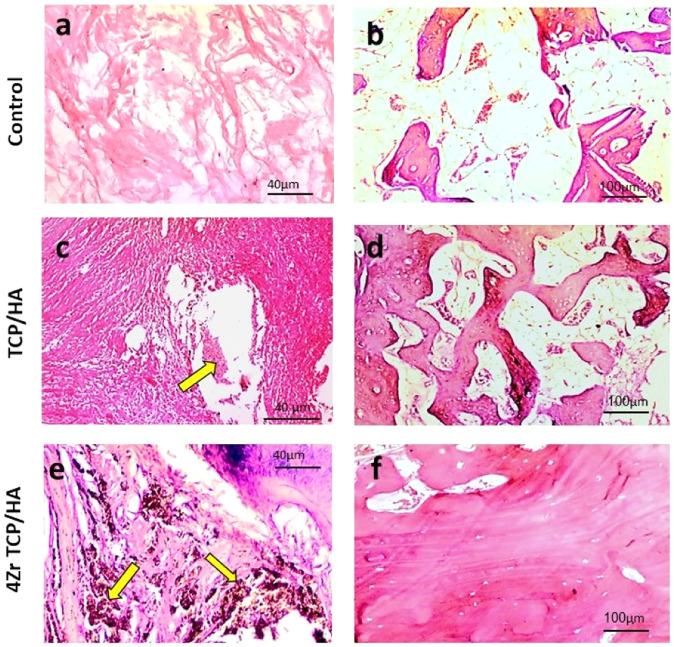
The present study aimed to evaluate osteogenic potential and biocompatibility of combining biphasic calcium phosphate with zirconia nanoparticles (4Zr TCP/HA) compared to biphasic calcium phosphate (TCP/HA) for reconstruction of induced mandibular defects in dog model. TCP/HA and 4Zr TCP/HA scaffolds were prepared. Morphological, physicochemical, antibacterial, cytocompatibility characterization were tested. In vivo application was performed in 12 dogs where three critical-sized mandibular defects were created in each dog. Bone defects were randomly allocated into: control, TCP/HA, and 4Zr TCP/HA groups. Bone density and bone area percentage were evaluated at 12 weeks using cone-beam computed tomographic, histopathologic, histomorphometric examination. Bone area density was statistically increased (p < 0.001) in TCP/HA and 4Zr TCP/HA groups compared to control group both in sagittal and coronal views. Comparing TCP/HA and 4Zr TCP/HA groups, the increase in bone area density was statistically significant in coronal view (p = 0.002) and sagittal view (p = 0.05). Histopathologic sections of TCP/HA group demonstrated incomplete filling of the defect with osteoid tissue. Doping with zirconia (4Zr TCP/HA group), resulted in statistically significant increase (p < 0.001) in bone formation (as indicated by bone area percentage) and maturation (as confirmed by Masson trichrome staining) compared to TCP/HA group. The newly formed bone was mature and organized with more trabecular thickness and less trabecular space in between. Physicochemical, morphological and bactericidal properties of combining zirconia and TCP/HA were improved. Combining zirconia and TCP/HA resulted in synergistic action with effective osteoinduction, osteoconduction and osteointegration suggesting its suitability to restore damaged bone in clinical practice.
本研究旨在评估双相磷酸钙与氧化锆纳米粒子(4Zr TCP/HA)结合的成骨潜力和生物相容性,并与双相磷酸钙(TCP/HA)进行比较,用于犬模型下颌诱导缺损的重建。制备了 TCP/HA 和 4Zr TCP/HA 支架。测试了形态、物理化学、抗菌、细胞相容性特征。在 12 只狗中进行了体内应用,每只狗的下颌骨都有三个临界尺寸的缺损。将骨缺损随机分配到:对照组、TCP/HA 组和 4Zr TCP/HA 组。使用锥形束计算机断层扫描、组织病理学、组织形态计量学检查在 12 周时评估骨密度和骨面积百分比。与对照组相比,TCP/HA 和 4Zr TCP/HA 组的骨密度和骨面积百分比均有统计学增加(p<0.001),在矢状面和冠状面均有统计学意义。与 TCP/HA 组相比,4Zr TCP/HA 组的骨面积密度增加有统计学意义(p=0.002)和冠状面(p=0.05)。TCP/HA 组的组织病理学切片显示骨样组织不完全填充缺损。掺杂氧化锆(4Zr TCP/HA 组)可显著增加骨形成(如骨面积百分比所示)和成熟度(如 Masson 三色染色证实)(p<0.001)与 TCP/HA 组相比。新形成的骨成熟且有组织,骨小梁厚度增加,骨小梁之间的空间减少。氧化锆和 TCP/HA 的物理化学、形态和杀菌性能得到改善。氧化锆和 TCP/HA 的结合具有协同作用,具有有效的骨诱导、骨传导和骨整合作用,表明其适合在临床实践中修复受损的骨骼。