Department of Medical and Surgical Sciences (DIMEC), Institute of Hematology 'Seràgnoli', University of Bologna, Bologna, Italy.
Department of Chemistry, Biology and Biotechnology, Biochemistry and Molecular Biology Section, University of Perugia, Perugia, Italy.
Front Immunol. 2023 May 3;14:1085610. doi: 10.3389/fimmu.2023.1085610. eCollection 2023.
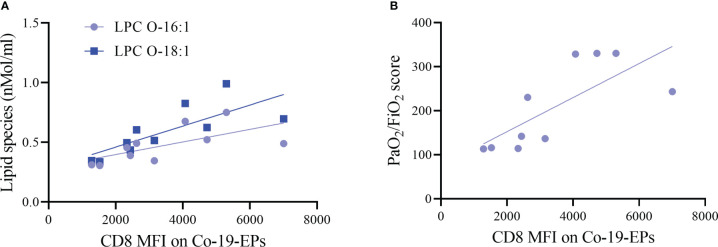
Extracellular vesicles (EVs) and particles (EPs) represent reliable biomarkers for disease detection. Their role in the inflammatory microenvironment of severe COVID-19 patients is not well determined. Here, we characterized the immunophenotype, the lipidomic cargo and the functional activity of circulating EPs from severe COVID-19 patients (Co-19-EPs) and healthy controls (HC-EPs) correlating the data with the clinical parameters including the partial pressure of oxygen to fraction of inspired oxygen ratio (PaO2/FiO2) and the sequential organ failure assessment (SOFA) score.
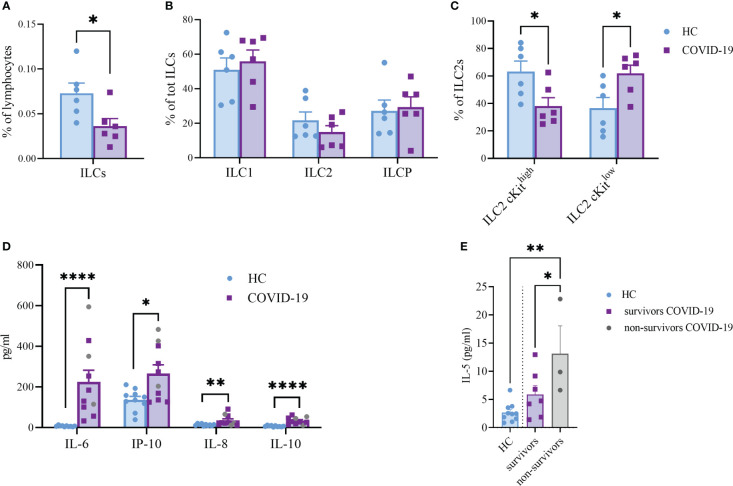
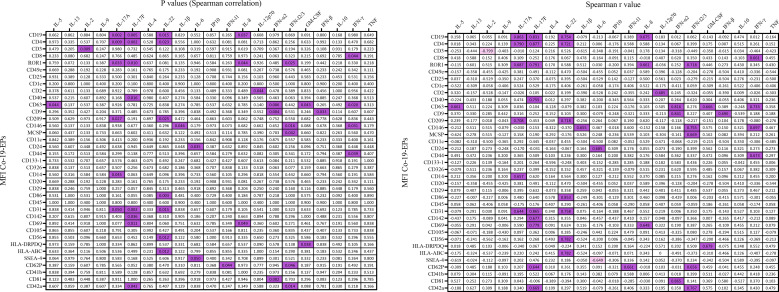
Peripheral blood (PB) was collected from COVID-19 patients (n=10) and HC (n=10). EPs were purified from platelet-poor plasma by size exclusion chromatography (SEC) and ultrafiltration. Plasma cytokines and EPs were characterized by multiplex bead-based assay. Quantitative lipidomic profiling of EPs was performed by liquid chromatography/mass spectrometry combined with quadrupole time-of-flight (LC/MS Q-TOF). Innate lymphoid cells (ILC) were characterized by flow cytometry after co-cultures with HC-EPs or Co-19-EPs.
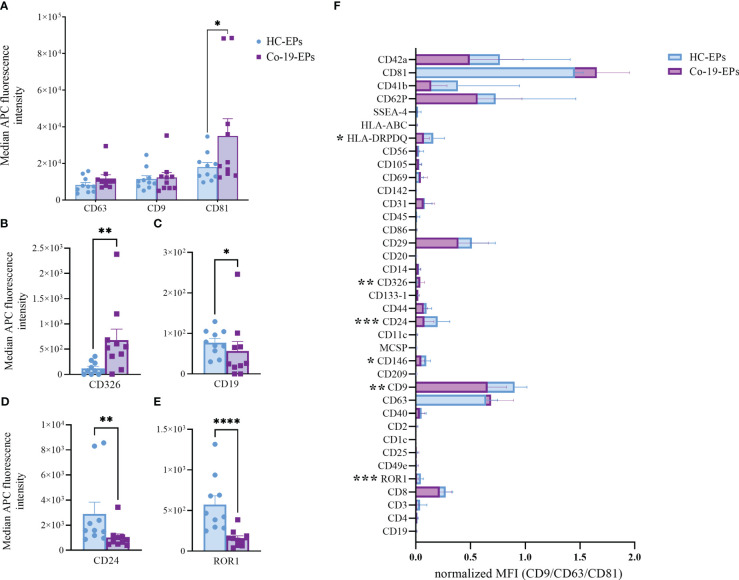
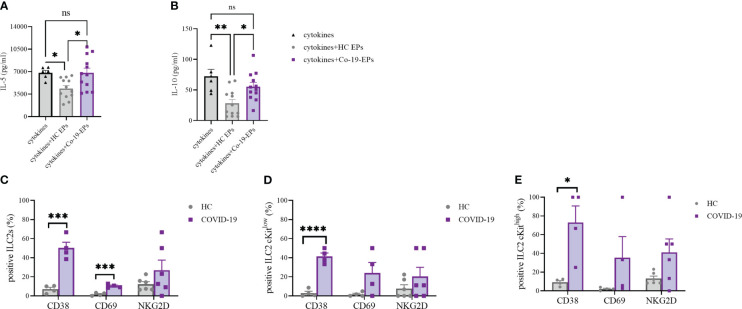
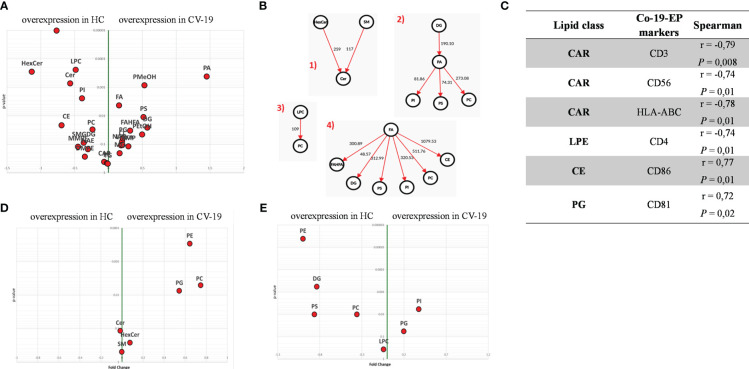
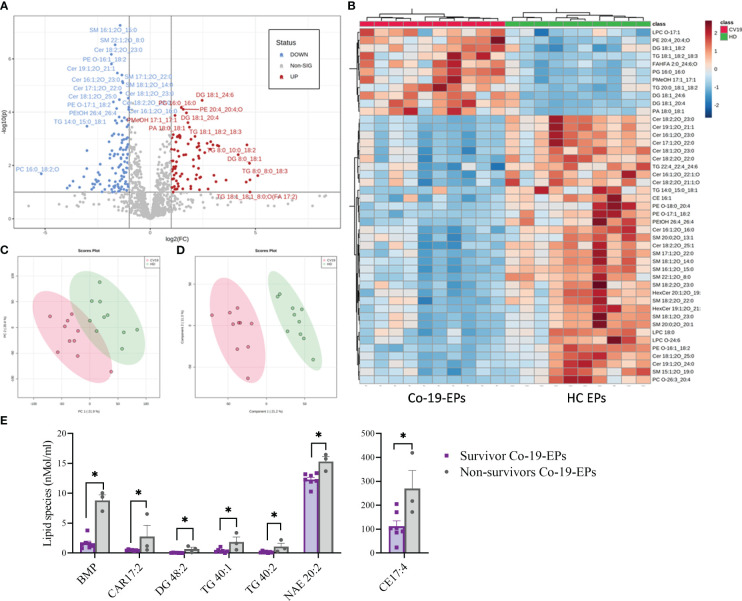
We observed that EPs from severe COVID-19 patients: 1) display an altered surface signature as assessed by multiplex protein analysis; 2) are characterized by distinct lipidomic profiling; 3) show correlations between lipidomic profiling and disease aggressiveness scores; 4) fail to dampen type 2 innate lymphoid cells (ILC2) cytokine secretion. As a consequence, ILC2 from severe COVID-19 patients show a more activated phenotype due to the presence of Co-19-EPs.
In summary, these data highlight that abnormal circulating EPs promote ILC2-driven inflammatory signals in severe COVID-19 patients and support further exploration to unravel the role of EPs (and EVs) in COVID-19 pathogenesis.
细胞外囊泡(EVs)和颗粒(EPs)是疾病检测的可靠生物标志物。它们在重症 COVID-19 患者炎症微环境中的作用尚未明确。在这里,我们对来自重症 COVID-19 患者(Co-19-EPs)和健康对照(HC-EPs)的循环 EPs 的免疫表型、脂质组货物和功能活性进行了表征,并将数据与包括氧分压与吸入氧分数比(PaO2/FiO2)和序贯器官衰竭评估(SOFA)评分在内的临床参数相关联。
从 COVID-19 患者(n=10)和 HC(n=10)中采集外周血(PB)。通过尺寸排阻色谱(SEC)和超滤从血小板贫乏的血浆中纯化 EPs。通过多指标珠粒基检测法对血浆细胞因子和 EPs 进行表征。通过液相色谱/质谱联用四极杆飞行时间(LC/MS Q-TOF)对 EPs 的定量脂质组学进行分析。在与 HC-EPs 或 Co-19-EPs 共培养后,通过流式细胞术对先天淋巴细胞(ILC)进行表征。
我们观察到,来自重症 COVID-19 患者的 EPs:1)通过多指标蛋白分析评估,其表面特征发生改变;2)具有独特的脂质组学特征;3)表现出脂质组学特征与疾病侵袭性评分之间的相关性;4)无法抑制 2 型先天淋巴细胞(ILC2)细胞因子的分泌。因此,由于存在 Co-19-EPs,重症 COVID-19 患者的 ILC2 表现出更活跃的表型。
总之,这些数据强调了异常循环 EPs 在重症 COVID-19 患者中促进 ILC2 驱动的炎症信号,并支持进一步探索以揭示 EPs(和 EVs)在 COVID-19 发病机制中的作用。