Malawi Liverpool Wellcome Research Programme, Kamuzu University of Health Sciences, Blantyre, Malawi; Department of Clinical Sciences, Liverpool School of Tropical Medicine, Liverpool, UK.
Centre for Water, Sanitation, Health and Appropriate Technology Development, Malawi University of Business and Applied Sciences, Blantyre, Malawi; Department of Civil and Environmental Engineering, University of Strathclyde, Glasgow, UK.
Lancet Microbe. 2023 Jul;4(7):e534-e543. doi: 10.1016/S2666-5247(23)00062-9. Epub 2023 May 16.
Low-income countries have high morbidity and mortality from drug-resistant infections, especially from enteric bacteria such as Escherichia coli. In these settings, sanitation infrastructure is of variable and often inadequate quality, creating risks of extended-spectrum β-lactamase (ESBL)-producing Enterobacterales transmission. We aimed to describe the prevalence, distribution, and risks of ESBL-producing Enterobacterales colonisation in sub-Saharan Africa using a One Health approach.
Between April 29, 2019, and Dec 3, 2020, we recruited 300 households in Malawi for this longitudinal cohort study: 100 each in urban, peri-urban, and rural settings. All households underwent a baseline visit and 195 were selected for longitudinal follow-up, comprising up to three additional visits over a 6 month period. Data on human health, antibiotic usage, health-seeking behaviours, structural and behavioural environmental health practices, and animal husbandry were captured alongside human, animal, and environmental samples. Microbiological processing determined the presence of ESBL-producing E coli and Klebsiella pneumoniae, and hierarchical logistic regression was performed to evaluate the risks of human ESBL-producing Enterobacterales colonisation.
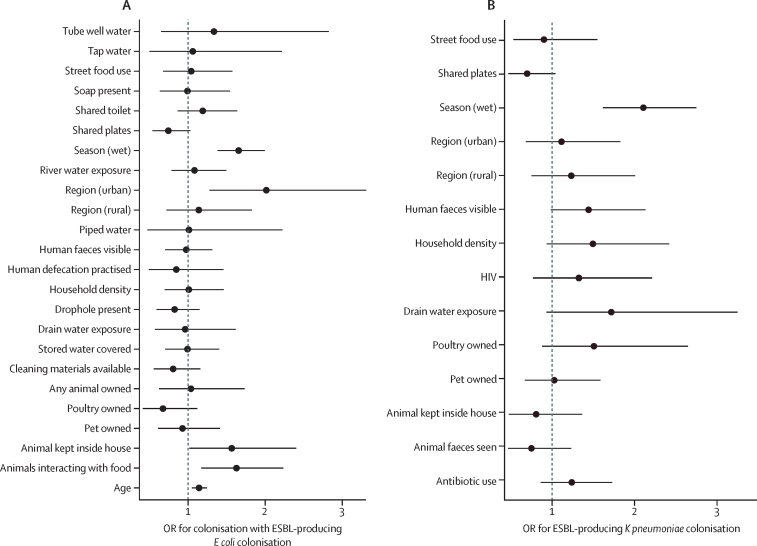
A paucity of environmental health infrastructure and materials for safe sanitation was identified across all sites. A total of 11 975 samples were cultured, and ESBL-producing Enterobacterales were isolated from 1190 (41·8%) of 2845 samples of human stool, 290 (29·8%) of 973 samples of animal stool, 339 (66·2%) of 512 samples of river water, and 138 (46·0%) of 300 samples of drain water. Multivariable models illustrated that human ESBL-producing E coli colonisation was associated with the wet season (adjusted odds ratio 1·66, 95% credible interval 1·38-2·00), living in urban areas (2·01, 1·26-3·24), advanced age (1·14, 1·05-1·25), and living in households where animals were observed interacting with food (1·62, 1·17-2·28) or kept inside (1·58, 1·00-2·43). Human ESBL-producing K pneumoniae colonisation was associated with the wet season (2·12, 1·63-2·76).
There are extremely high levels of ESBL-producing Enterobacterales colonisation in humans and animals and extensive contamination of the wider environment in southern Malawi. Urbanisation and seasonality are key risks for ESBL-producing Enterobacterales colonisation, probably reflecting environmental drivers. Without adequate efforts to improve environmental health, ESBL-producing Enterobacterales transmission is likely to persist in this setting.
Medical Research Council, National Institute for Health and Care Research, and Wellcome Trust.
For the Chichewa translation of the abstract see Supplementary Materials section.
低收入国家的耐药感染发病率和死亡率较高,尤其是肠细菌(如大肠杆菌)。在这些环境中,卫生基础设施质量参差不齐,且往往不足,这增加了产生超广谱β-内酰胺酶(ESBL)的肠杆菌传播的风险。我们旨在采用“同一健康”方法描述撒哈拉以南非洲地区产 ESBL 肠杆菌定植的流行率、分布和风险。
2019 年 4 月 29 日至 2020 年 12 月 3 日,我们在马拉维招募了 300 户家庭进行这项纵向队列研究:城市、城乡结合部和农村地区各 100 户。所有家庭都接受了基线访问,其中 195 户被选为纵向随访,在 6 个月的时间内最多进行了 3 次额外的访问。在采集人类、动物和环境样本的同时,还记录了人类健康、抗生素使用、求医行为、结构和行为环境卫生实践以及畜牧业的数据。微生物处理确定了 ESBL 产生的大肠杆菌和肺炎克雷伯菌的存在,并进行了分层逻辑回归以评估人类产 ESBL 肠杆菌定植的风险。
所有地点都发现环境卫生基础设施和安全卫生设施材料严重缺乏。共培养了 11975 个样本,从 2845 个人类粪便样本中分离出 1190 个(41.8%)产 ESBL 肠杆菌,从 973 个动物粪便样本中分离出 290 个(29.8%),从 512 个河水样本中分离出 339 个(66.2%),从 300 个污水样本中分离出 138 个(46.0%)。多变量模型表明,人类产 ESBL 大肠杆菌定植与雨季(调整后的优势比 1.66,95%置信区间 1.38-2.00)、居住在城市地区(2.01,1.26-3.24)、年龄较大(1.14,1.05-1.25)以及观察到动物与食物接触(1.62,1.17-2.28)或被关在室内(1.58,1.00-2.43)的家庭有关。人类产 ESBL 肺炎克雷伯菌定植与雨季有关(2.12,1.63-2.76)。
在马拉维南部,人类和动物中 ESBL 产生肠杆菌的定植率极高,且周围环境的广泛污染极为严重。城市化和季节性是 ESBL 产生肠杆菌定植的关键风险因素,可能反映了环境驱动因素。如果不采取充分措施改善环境卫生,ESBL 产生肠杆菌的传播很可能在这一环境中持续存在。
医学研究委员会、英国国家卫生与保健研究院和惠康基金会。