Booton Ross D, Meeyai Aronrag, Alhusein Nour, Buller Henry, Feil Edward, Lambert Helen, Mongkolsuk Skorn, Pitchforth Emma, Reyher Kristen K, Sakcamduang Walasinee, Satayavivad Jutamaad, Singer Andrew C, Sringernyuang Luechai, Thamlikitkul Visanu, Vass Lucy, Avison Matthew B, Turner Katherine M E
Bristol Veterinary School, University of Bristol, Bristol, UK.
Department of Epidemiology, Mahidol University, Bangkok, Thailand.
One Health. 2021 Jan 26;12:100220. doi: 10.1016/j.onehlt.2021.100220. eCollection 2021 Jun.
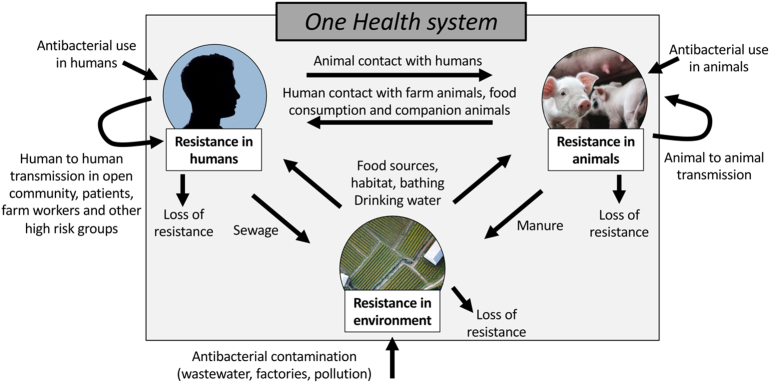
Antibacterial resistance (ABR) is a major global health security threat, with a disproportionate burden on lower-and middle-income countries (LMICs). It is not understood how 'One Health', where human health is co-dependent on animal health and the environment, might impact the burden of ABR in LMICs. Thailand's 2017 "National Strategic Plan on Antimicrobial Resistance" (NSP-AMR) aims to reduce AMR morbidity by 50% through 20% reductions in human and 30% in animal antibacterial use (ABU). There is a need to understand the implications of such a plan within a One Health perspective.
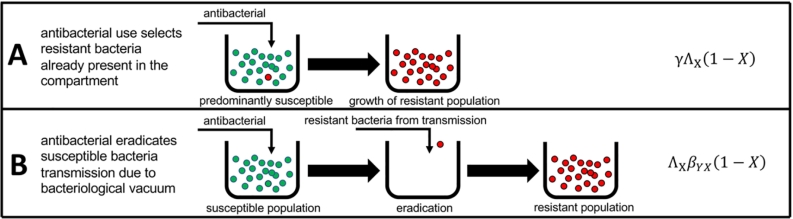
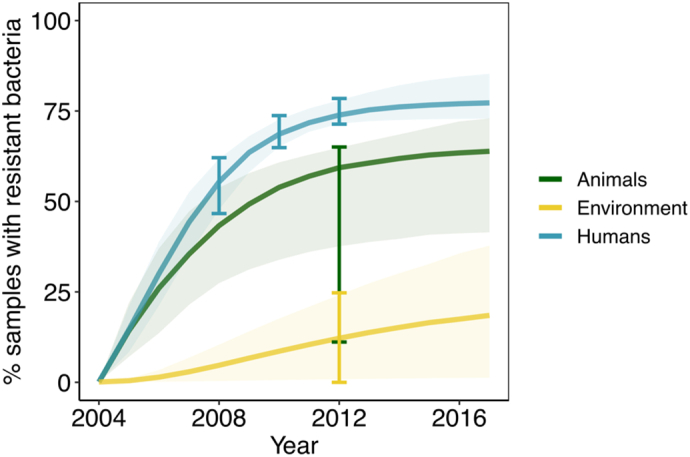
A model of ABU, gut colonisation with extended-spectrum beta-lactamase (ESBL)-producing bacteria and transmission was calibrated using estimates of the prevalence of ESBL-producing bacteria in Thailand. This model was used to project the reduction in human ABR over 20 years (2020-2040) for each One Health driver, including individual transmission rates between humans, animals and the environment, and to estimate the long-term impact of the NSP-AMR intervention.
The model predicts that human ABU was the most important factor in reducing the colonisation of humans with resistant bacteria (maximum 65.7-99.7% reduction). The NSP-AMR is projected to reduce human colonisation by 6.0-18.8%, with more ambitious targets (30% reductions in human ABU) increasing this to 8.5-24.9%.
Our model provides a simple framework to explain the mechanisms underpinning ABR, suggesting that future interventions targeting the simultaneous reduction of transmission and ABU would help to control ABR more effectively in Thailand.
抗菌药物耐药性(ABR)是全球主要的卫生安全威胁,对低收入和中等收入国家(LMICs)造成的负担尤为沉重。目前尚不清楚“同一健康”(即人类健康与动物健康和环境相互依存)如何影响低收入和中等收入国家的抗菌药物耐药性负担。泰国2017年的“国家抗菌药物耐药性战略计划”(NSP-AMR)旨在到2020年将抗菌药物耐药性发病率降低50%,其中人类抗菌药物使用量减少20%,动物抗菌药物使用量减少30%。有必要从“同一健康”的角度了解该计划的影响。
利用泰国产超广谱β-内酰胺酶(ESBL)细菌的流行率估计值,校准了抗菌药物使用、产ESBL细菌的肠道定植和传播模型。该模型用于预测20年(2020年至2040年)内每个“同一健康”驱动因素导致的人类抗菌药物耐药性降低情况,包括人类、动物和环境之间的个体传播率,并估计NSP-AMR干预措施的长期影响。
该模型预测,人类抗菌药物使用是减少人类对耐药菌定植的最重要因素(最大减少65.7%-99.7%)。预计NSP-AMR将使人类定植减少6.0%-18.8%,更宏伟的目标(人类抗菌药物使用量减少30%)将使其增加到8.5%-24.9%。
我们的模型提供了一个简单的框架来解释抗菌药物耐药性的潜在机制,表明未来同时针对减少传播和抗菌药物使用的干预措施将有助于在泰国更有效地控制抗菌药物耐药性。