Department of Medicine and Clinical Science, Graduate School of Medical Sciences, Kyushu University, Maidashi 3-1-1, Higashi-Ku, Fukuoka, 812-8582, Japan.
Diabetes Center, Hakujyuji Hospital, Fukuoka, Japan.
Biol Sex Differ. 2023 May 22;14(1):32. doi: 10.1186/s13293-023-00517-8.
The excess risk of cardiovascular diseases associated with diabetes is greater in women than in men. The present study aimed to examine sex differences in the control of cardiovascular risk factors, as well as lifestyle and psychological factors, in patients with type 2 diabetes.
A total of 4923 Japanese patients with type 2 diabetes were included in this cross-sectional study. Female/male differences in cardiovascular risk factor levels, and corresponding odds ratios for achieving recommended ranges for preventing cardiovascular diseases and having unhealthy lifestyle and psychological factors were computed by linear and logistic regression models.
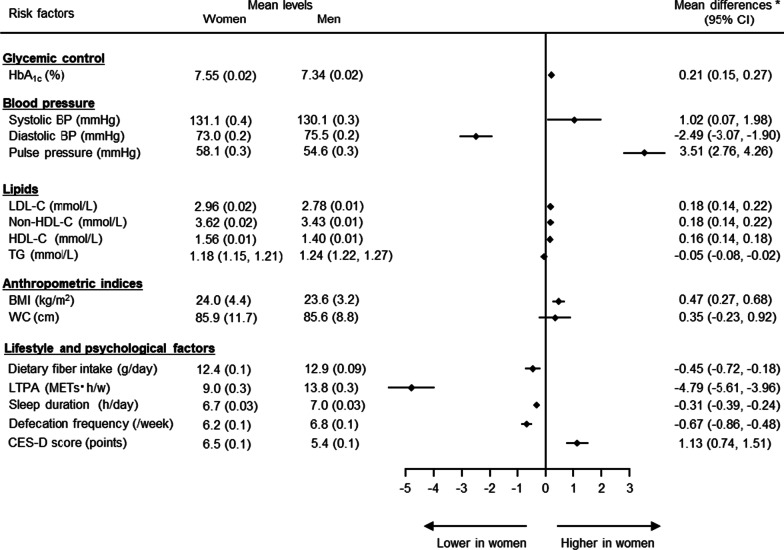
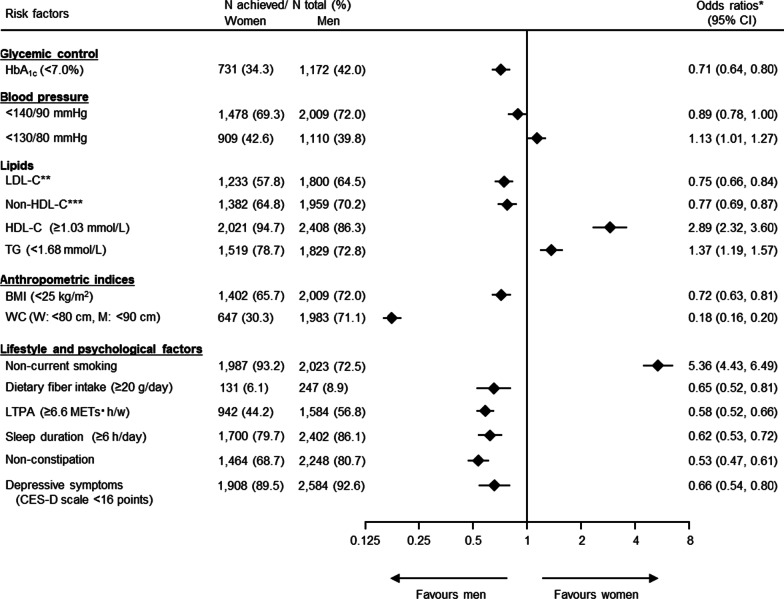
Women were less likely than men to achieve recommended ranges for glycated hemoglobin, low-density lipoprotein cholesterol, non-high-density lipoprotein cholesterol, and obesity-related anthropometric indices such as body mass index and waist circumference, but were more likely than men to be on target for high-density lipoprotein cholesterol and triglycerides. Women were also more likely than men to have an unhealthy lifestyle and psychological factors, including less dietary fiber intake, less leisure-time physical activity, shorter sleep duration, more constipation, and more depressive symptoms. Similar findings were observed when the participants were subgrouped by age (< 65 and ≥ 65 years) and past history of cardiovascular disease.
We observed significant sex differences for a range of cardiovascular risk factors, as well as lifestyle and psychological factors, suggesting the importance of adopting a sex-specific approach for the daily clinical management of diabetes.
与糖尿病相关的心血管疾病风险在女性中比男性更高。本研究旨在探讨 2 型糖尿病患者在控制心血管危险因素以及生活方式和心理因素方面的性别差异。
本横断面研究共纳入 4923 例日本 2 型糖尿病患者。通过线性和逻辑回归模型计算心血管疾病预防推荐范围内的心血管危险因素水平以及达到相应水平的比值比,同时还计算了不健康的生活方式和心理因素的比值比。
与男性相比,女性更难以达到糖化血红蛋白、低密度脂蛋白胆固醇、非高密度脂蛋白胆固醇和肥胖相关的人体测量学指标(如体重指数和腰围)的推荐范围,但更有可能达到高密度脂蛋白胆固醇和甘油三酯的目标值。女性也更有可能存在不健康的生活方式和心理因素,包括膳食纤维摄入量较少、休闲时间体力活动较少、睡眠时间较短、便秘较多和抑郁症状较多。当参与者按年龄(<65 岁和≥65 岁)和心血管疾病既往史进行亚组分析时,也观察到了类似的结果。
我们观察到了一系列心血管危险因素以及生活方式和心理因素方面的显著性别差异,这表明在日常的糖尿病临床管理中采用性别特异性方法非常重要。