Department of Otolaryngology Head and Neck Surgery, Dankook University Hospital, College of Medicine, Dankook University, Cheonan, South Korea.
Multi-modality Treatment Research Center for Auditory/Vestibular Disease, College of Medicine, Dankook University, Cheonan, South Korea.
PLoS One. 2023 May 22;18(5):e0284626. doi: 10.1371/journal.pone.0284626. eCollection 2023.
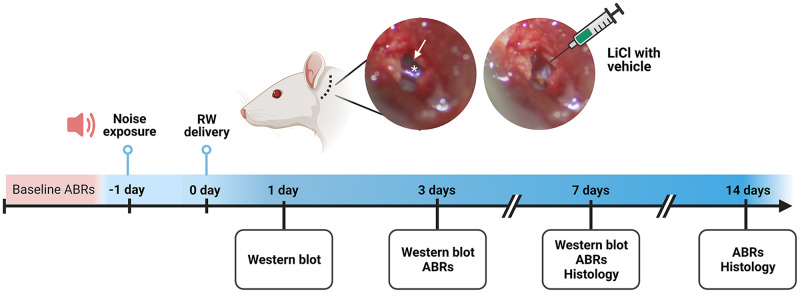
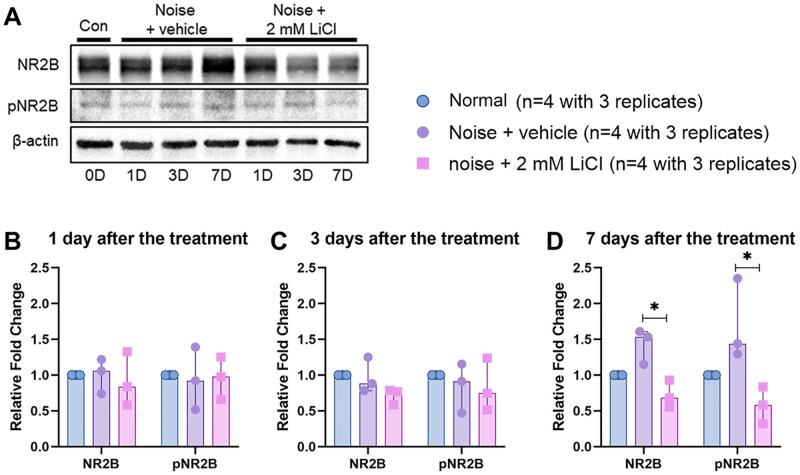
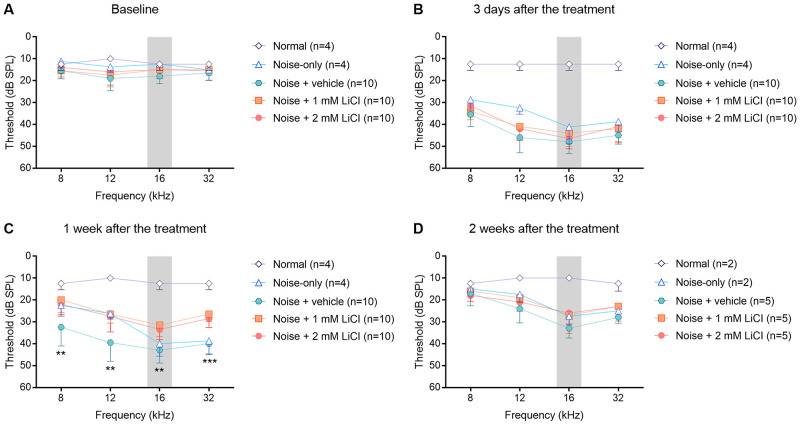
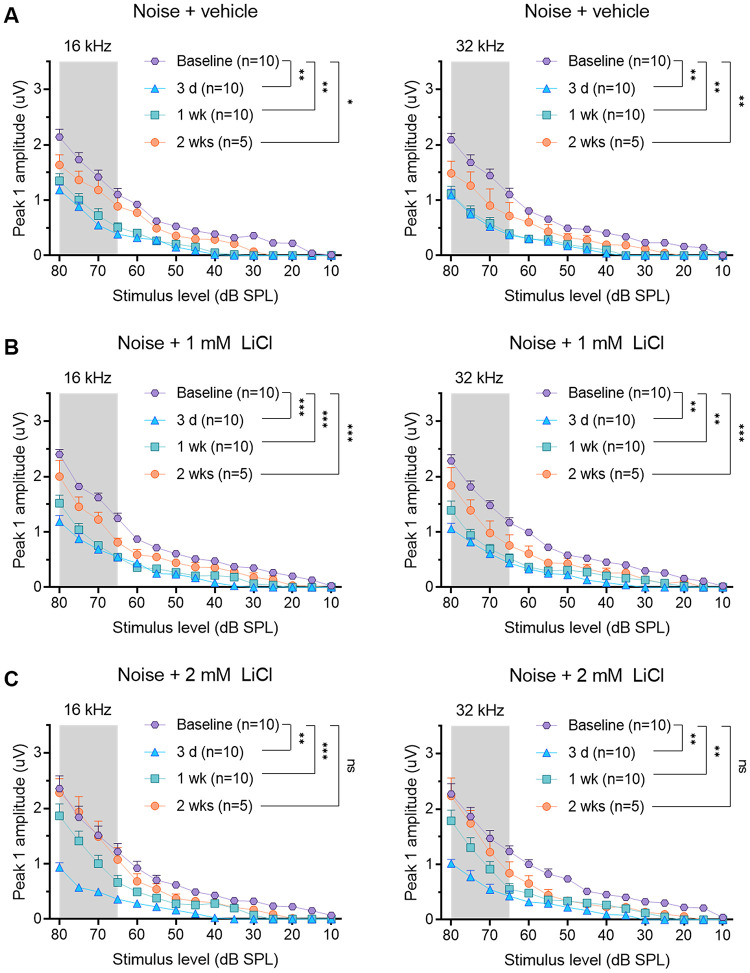
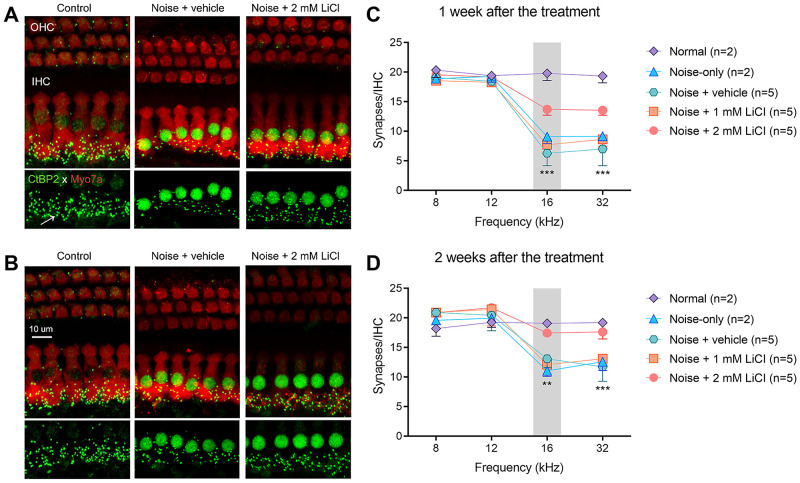
Noise exposure can destroy the synaptic connections between hair cells and auditory nerve fibers without damaging the hair cells, and this synaptic loss could contribute to difficult hearing in noisy environments. In this study, we investigated whether delivering lithium chloride to the round-window can regenerate synaptic loss of cochlea after acoustic overexposure. Our rat animal model of noise-induced cochlear synaptopathy caused about 50% loss of synapses in the cochlear basal region without damaging hair cells. We locally delivered a single treatment of poloxamer 407 (vehicle) containing lithium chloride (either 1 mM or 2 mM) to the round-window niche 24 hours after noise exposure. Controls included animals exposed to noise who received only the vehicle. Auditory brainstem responses were measured 3 days, 1 week, and 2 weeks post-exposure treatment, and cochleas were harvested 1 week and 2 weeks post-exposure treatment for histological analysis. As documented by confocal microscopy of immunostained ribbon synapses, local delivery of 2 mM lithium chloride produced synaptic regeneration coupled with corresponding functional recovery, as seen in the suprathreshold amplitude of auditory brainstem response wave 1. Western blot analyses revealed that 2 mM lithium chloride suppressed N-methyl-D-aspartate (NMDA) receptor expression 7 days after noise-exposure. Thus, round-window delivery of lithium chloride using poloxamer 407 reduces cochlear synaptic loss after acoustic overexposure by inhibiting NMDA receptor activity in rat model.
噪声暴露可在不损伤毛细胞的情况下破坏毛细胞和听神经纤维之间的突触连接,这种突触丢失可能导致在嘈杂环境中听力困难。在这项研究中,我们研究了向圆窗内局部给予氯化锂是否可以再生声过载后耳蜗的突触丢失。我们的噪声诱导耳蜗突触病大鼠动物模型导致耳蜗基底区约 50%的突触丢失,而毛细胞未受损。我们在噪声暴露后 24 小时向圆窗窝内局部给予单次含有氯化锂(1 mM 或 2 mM)的泊洛沙姆 407(载体)处理。对照组包括仅接受载体的暴露于噪声的动物。在暴露后处理 3 天、1 周和 2 周时测量听觉脑干反应,在暴露后处理 1 周和 2 周时收获耳蜗进行组织学分析。通过免疫染色带突触的共聚焦显微镜记录,局部给予 2 mM 氯化锂产生了突触再生,并伴有相应的功能恢复,如听觉脑干反应波 1 的超阈值幅度所示。Western blot 分析显示,2 mM 氯化锂在噪声暴露后 7 天抑制 N-甲基-D-天冬氨酸(NMDA)受体表达。因此,用泊洛沙姆 407 通过圆窗内给予氯化锂可通过抑制 NMDA 受体活性减少大鼠模型中声过载后的耳蜗突触丢失。