Arfijanto Muhammad Vitanata, Asmarawati Tri Pudy, Bramantono Bramantono, Rusli Musofa, Rachman Brian Eka, Mahdi Bagus Aulia, Nasronudin Nasronudin, Hadi Usman
Department of Internal Medicine, Faculty of Medicine, Airlangga University, Surabaya 60132, Indonesia.
Universitas Airlangga Hospital, Airlangga University, Surabaya 60115, Indonesia.
Pathophysiology. 2023 May 4;30(2):186-198. doi: 10.3390/pathophysiology30020016.
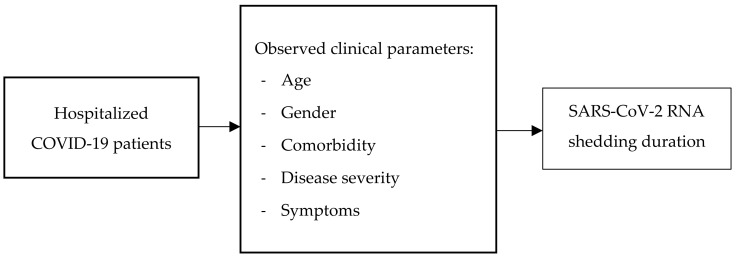
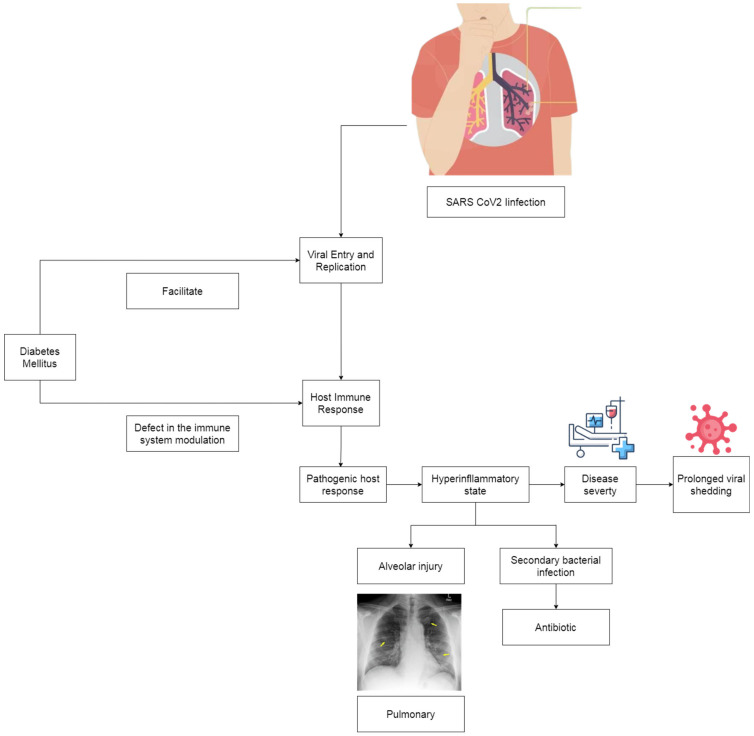
Severe acute respiratory syndrome coronavirus type 2 (SARS-CoV-2) ribonucleic acid (RNA) shedding is an important parameter for determining the optimal length of isolation period required for coronavirus disease 2019 (COVID-19) patients. However, the clinical (i.e., patient and disease) characteristics that could influence this parameter have yet to be determined. In this study, we aim to explore the potential associations between several clinical features and the duration of SARS-CoV-2 RNA shedding in patients hospitalized with COVID-19. A retrospective cohort study involving 162 patients hospitalized for COVID-19 in a tertiary referral teaching hospital in Indonesia was performed from June to December 2021. Patients were grouped based on the mean duration of viral shedding and were compared based on several clinical characteristics (e.g., age, sex, comorbidities, COVID-19 symptoms, severity, and therapies). Subsequently, clinical factors potentially associated with the duration of SARS-CoV-2 RNA shedding were further assessed using multivariate logistic regression analysis. As a result, the mean duration of SARS-CoV-2 RNA shedding was found to be 13 ± 8.44 days. In patients with diabetes mellitus (without chronic complications) or hypertension, the duration of viral shedding was significantly prolonged (≥13 days; = 0.001 and = 0.029, respectively). Furthermore, patients with dyspnea displayed viral shedding for longer durations ( = 0.011). The multivariate logistic regression analysis reveals that independent risk factors associated with the duration of SARS-CoV-2 RNA shedding include disease severity (adjusted odds ratio [aOR] = 2.94; 95% CI = 1.36-6.44), bilateral lung infiltrates (aOR = 2.79; 95% CI = 1.14-6.84), diabetes mellitus (aOR = 2.17; 95% CI = 1.02-4.63), and antibiotic treatment (aOR = 3.66; 95% CI = 1.74-7.71). In summary, several clinical factors are linked with the duration of SARS-CoV-2 RNA shedding. Disease severity is positively associated with the duration of viral shedding, while bilateral lung infiltrates, diabetes mellitus, and antibiotic treatment are negatively linked with the duration of viral shedding. Overall, our findings suggest the need to consider different isolation period estimations for specific clinical characteristics of patients with COVID-19 that affect the duration of SARS-CoV-2 RNA shedding.
严重急性呼吸综合征冠状病毒2型(SARS-CoV-2)核糖核酸(RNA)脱落是确定2019冠状病毒病(COVID-19)患者所需最佳隔离期长度的一个重要参数。然而,可能影响该参数的临床(即患者和疾病)特征尚未确定。在本研究中,我们旨在探讨COVID-19住院患者的几种临床特征与SARS-CoV-2 RNA脱落持续时间之间的潜在关联。2021年6月至12月,在印度尼西亚一家三级转诊教学医院对162例因COVID-19住院的患者进行了一项回顾性队列研究。患者根据病毒脱落的平均持续时间分组,并根据几种临床特征(如年龄、性别、合并症、COVID-19症状、严重程度和治疗方法)进行比较。随后,使用多因素逻辑回归分析进一步评估可能与SARS-CoV-2 RNA脱落持续时间相关的临床因素。结果发现,SARS-CoV-2 RNA脱落的平均持续时间为13±8.44天。在患有糖尿病(无慢性并发症)或高血压的患者中,病毒脱落持续时间显著延长(≥13天;分别为P = 0.001和P = 0.029)。此外,出现呼吸困难的患者病毒脱落持续时间更长(P = 0.011)。多因素逻辑回归分析显示,与SARS-CoV-2 RNA脱落持续时间相关的独立危险因素包括疾病严重程度(调整后的优势比[aOR]=2.94;95%置信区间[CI]=1.36 - 6.44)、双侧肺部浸润(aOR = 2.79;95%CI = 1.14 - 6.84)、糖尿病(aOR = 2.17;95%CI = 1.02 - 4.63)和抗生素治疗(aOR = 3.66;95%CI = 1.74 - 7.71)。总之,几种临床因素与SARS-CoV-2 RNA脱落持续时间有关。疾病严重程度与病毒脱落持续时间呈正相关,而双侧肺部浸润、糖尿病和抗生素治疗与病毒脱落持续时间呈负相关。总体而言,我们的研究结果表明,对于影响SARS-CoV-2 RNA脱落持续时间的COVID-19患者的特定临床特征,需要考虑不同的隔离期估计。