Rehabilitation Sciences, Ghent University, Ghent, Belgium.
Rheumatology, University Hospital Ghent, Ghent, Belgium.
RMD Open. 2023 May;9(2). doi: 10.1136/rmdopen-2022-002945.
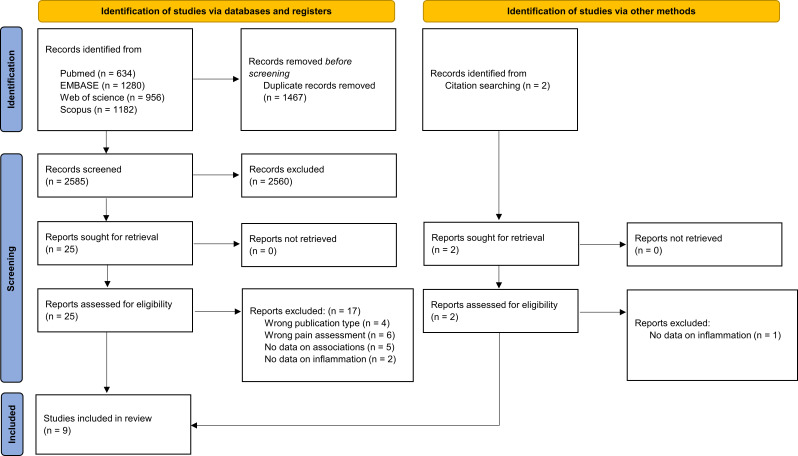
To provide an extensive review on the associations between knee inflammation and altered pain perception mechanisms in people with knee osteoarthritis (OA). MEDLINE, Web of Science, EMBASE and Scopus were searched up to 13 December 2022. We included articles reporting associations between knee inflammation (measured by effusion, synovitis, bone marrow lesions (BMLs) and cytokines) and signs of altered pain processing (assessed by quantitative sensory testing and/or questionnaire for neuropathic-like pain) in people with knee OA. Methodological quality was evaluated using the National Heart, Lung and Blood Institute Study Quality Assessment Tool. Level of evidence and strength of conclusion were determined using the Evidence-Based Guideline Development method. Nine studies were included, comprising of 1889 people with knee OA. Signs of greater effusion/synovitis may be positively associated with lower knee pain pressure threshold (PPT) and neuropathic-like pain. Current evidence could not establish an association between BMLs and pain sensitivity. Evidence on associations between inflammatory cytokines and pain sensitivity or neuropathic-like pain was conflicting. There are indications of a positive association between higher serum C reactive protein (CRP) levels and lower PPT and presence of temporal summation. Methodological quality varied from level C to A2. Signs of effusion/synovitis may be positively associated with neuropathic-like pain and pain sensitivity. There are indications of a possible positive association between serum CRP levels and pain sensitivity. Given the quality and the small amount of included studies, uncertainty remains. Future studies with adequate sample size and follow-up are needed to strengthen the level of evidence.PROSPERO registration number: CRD42022329245.
提供一篇关于膝关节炎症与膝关节骨关节炎(OA)患者疼痛感知机制改变之间关联的广泛综述。截至 2022 年 12 月 13 日,我们检索了 MEDLINE、Web of Science、EMBASE 和 Scopus。我们纳入了报告膝关节炎症(通过积液、滑膜炎、骨髓病变(BML)和细胞因子测量)与膝关节 OA 患者疼痛处理改变迹象(通过定量感觉测试和/或神经病理性疼痛问卷评估)之间关联的文章。使用美国国立心肺血液研究所研究质量评估工具评估方法学质量。使用循证指南制定方法确定证据水平和结论强度。共纳入 9 项研究,包括 1889 例膝关节 OA 患者。积液/滑膜炎程度较高可能与膝关节疼痛压力阈值(PPT)和神经病理性疼痛降低呈正相关。目前的证据尚不能确定 BML 与疼痛敏感性之间的关联。炎症细胞因子与疼痛敏感性或神经病理性疼痛之间关联的证据相互矛盾。血清 C 反应蛋白(CRP)水平较高与 PPT 降低和时间总和存在呈正相关的迹象。方法学质量从 C 级到 A2 级不等。积液/滑膜炎程度较高可能与神经病理性疼痛和疼痛敏感性呈正相关。血清 CRP 水平与疼痛敏感性之间可能存在正相关。鉴于研究质量和纳入研究数量较少,仍存在不确定性。需要进行具有足够样本量和随访的未来研究,以加强证据水平。PROSPERO 注册号:CRD42022329245。