School of Healthcare Sciences, Cardiff University, Cardiff, United Kingdom.
School of Medicine, Cardiff University, Cardiff, United Kingdom.
PLoS One. 2023 May 25;18(5):e0285763. doi: 10.1371/journal.pone.0285763. eCollection 2023.
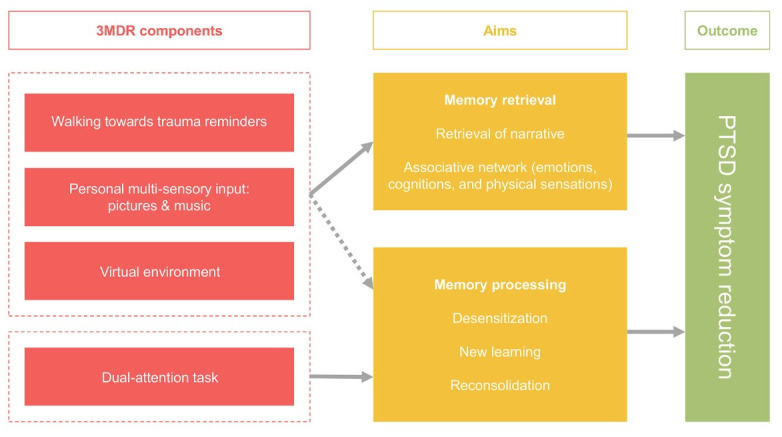
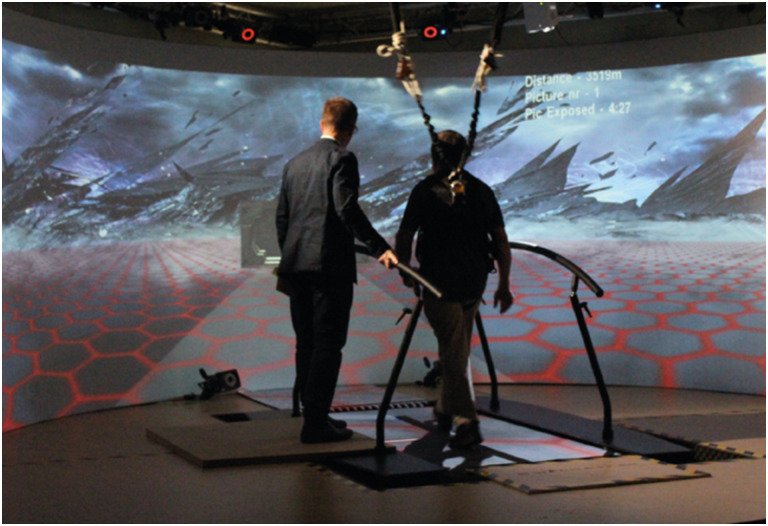
Multi-modular motion-assisted memory desensitization and reconsolidation therapy (3MDR) is a new psychological intervention for people with post-traumatic stress disorder (PTSD). 3MDR is immersive, delivered in a virtual reality environment, and emphasises engagement, recollection and reprocessing.
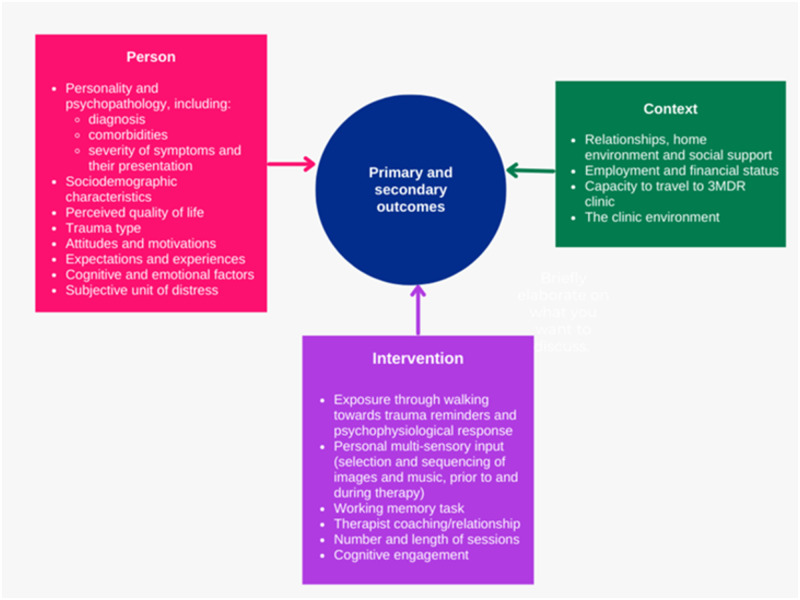
Through a theory-driven examination of data relating to 10 out of 42 UK military veterans taking part in a trial of 3MDR, the principal objective was to explore the complex interrelationships between people, interventions and context and to investigate how factors within these domains interacted in specific outcome typologies.
Quantitative and qualitative data relating to 10 trial participants were derived from: researcher-assessed and self-report clinical measures; interviews; physiological recordings; words describing thoughts and feelings during therapy; and subjective unit of distress scores. Using a convergent mixed methods approach, data were tabulated using a person, intervention and context model. Participant summaries were grouped into outcome typologies, followed by an analysis of data convergence and divergence within each and an interpretation of identified patterns.
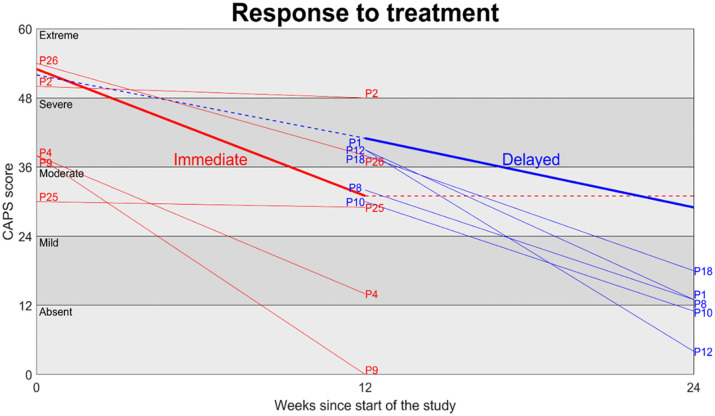
Three outcome response typologies were identified: dramatic improvement, moderate improvement and minimal improvement. Within the person domain, factors associated with outcomes included walking capacity, commitment and ability to complete therapy, and levels of subjective distress. Within the intervention domain, factors associated with outcomes related to image selection and use, therapeutic alliance and orientations towards the tailoring of sessions. Within the context domain, factors associated with outcomes included reactions to the therapy environment. The patterning of secondary outcomes broadly corresponded with primary outcomes within each typology. Alongside patterned data differentiating aspects of the person, intervention and context domains, within the three response typologies data also existed where no obvious patterning was detected.
The model developed here may have novel value in evaluating a range of personalised interventions, but further work is needed before confident assertions can be made of who is likely to benefit from 3MDR specifically.
多模块运动辅助记忆脱敏和再巩固治疗(3MDR)是一种针对创伤后应激障碍(PTSD)患者的新心理干预方法。3MDR 是沉浸式的,在虚拟现实环境中进行,强调参与、回忆和再处理。
通过对参与 3MDR 试验的 42 名英国退伍军人中的 10 人进行的一项基于理论的数据分析,主要目的是探索人与干预措施和环境之间的复杂相互关系,并研究这些领域中的因素如何在特定的结果类型中相互作用。
从 10 名试验参与者中获得了与研究相关的定量和定性数据:研究人员评估和自我报告的临床测量;访谈;生理记录;描述治疗期间想法和感受的词语;以及主观不适单位评分。使用收敛混合方法,使用人与干预和环境模型对数据进行制表。参与者摘要分为结果类型,然后对每种类型中的数据收敛和发散进行分析,并对确定的模式进行解释。
确定了三种结果反应类型:显著改善、中度改善和轻度改善。在个人领域,与结果相关的因素包括步行能力、承诺和完成治疗的能力以及主观不适水平。在干预领域,与结果相关的因素与图像选择和使用、治疗联盟以及对课程定制的态度有关。在环境领域,与结果相关的因素包括对治疗环境的反应。每个类型中,次要结果的模式大致与主要结果相对应。除了在区分人与干预和环境领域方面具有模式化数据外,在三个反应类型中,还存在一些数据没有明显的模式。
这里开发的模型在评估一系列个性化干预措施方面可能具有新颖的价值,但在能够自信地确定谁可能特别受益于 3MDR 之前,还需要进一步的工作。