Jones Chelsea, Smith-MacDonald Lorraine, Miguel-Cruz Antonio, Pike Ashley, van Gelderen Marieke, Lentz Liana, Shiu Maria Y, Tang Emily, Sawalha Jeffrey, Greenshaw Andrew, Rhind Shawn G, Fang Xin, Norbash Adrian, Jetly Rakesh, Vermetten Eric, Brémault-Phillips Suzette
Heroes in Mind, Advocacy and Research Consortium, Faculty of Rehabilitation, University of Alberta, Edmonton, AB, Canada.
Department of Occupational Therapy, Faculty of Rehabilitation, University of Alberta, Edmonton, AB, Canada.
JMIR Res Protoc. 2020 Oct 29;9(10):e20620. doi: 10.2196/20620.
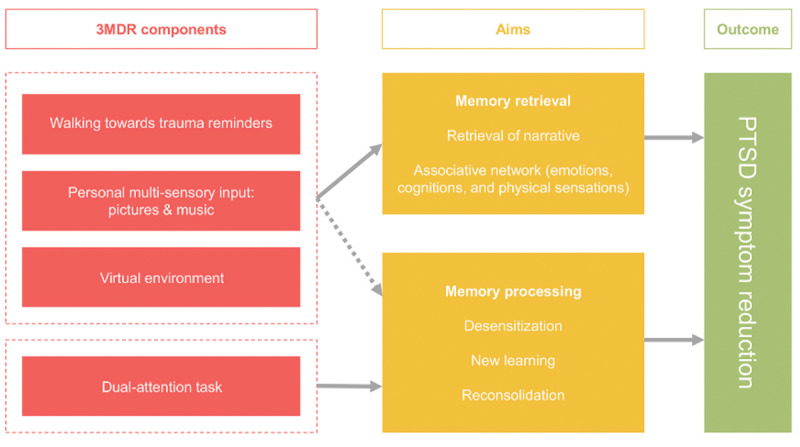
Military members are at elevated risk of operational stress injuries, including posttraumatic stress disorder (PTSD) and moral injury. Although psychotherapy can reduce symptoms, some military members may experience treatment-resistant PTSD. Multimodular motion-assisted memory desensitization and reconsolidation (3MDR) has been introduced as a virtual reality (VR) intervention for military members with PTSD related to military service. The 3MDR intervention incorporates exposure therapy, psychotherapy, eye movement desensitization and reconsolidation, VR, supportive counselling, and treadmill walking.
The objective of this study is to investigate whether 3MDR reduces PTSD symptoms among military members with combat-related treatment-resistant PTSD (TR-PTSD); examine the technology acceptance and usability of the Computer Assisted Rehabilitation ENvironment (CAREN) and 3MDR interventions by Canadian Armed Forces service members (CAF-SMs), veterans, 3MDR clinicians, and operators; and evaluate the impact on clinicians and operators of delivering 3MDR.
This is a mixed-methods waitlist controlled crossover design randomized controlled trial. Participants include both CAF-SMs and veterans (N=40) aged 18-60 years with combat-related TR-PTSD (unsuccessful experience of at least 2 evidence-based trauma treatments). Participants will also include clinicians and operators (N=12) who have been trained in 3MDR and subsequently utilized this intervention with patients. CAF-SMs and veterans will receive 6 weekly 90-minute 3MDR sessions. Quantitative and qualitative data will be collected at baseline and at 1, 3, and 6 months postintervention. Quantitative data collection will include multiomic biomarkers (ie, blood and salivary proteomic and genomic profiles of neuroendocrine, immune-inflammatory mediators, and microRNA), eye tracking, electroencephalography, and physiological data. Data from outcome measures will capture self-reported symptoms of PTSD, moral injury, resilience, and technology acceptance and usability. Qualitative data will be collected from audiovisual recordings of 3MDR sessions and semistructured interviews. Data analysis will include univariate and multivariate approaches, and thematic analysis of treatment sessions and interviews. Machine learning analysis will be included to develop models for the prediction of diagnosis, symptom severity, and treatment outcomes.
This study commenced in April 2019 and is planned to conclude in April 2021. Study results will guide the further evolution and utilization of 3MDR for military members with TR-PTSD and will have utility in treating other trauma-affected populations.
The goal of this study is to utilize qualitative and quantitative primary and secondary outcomes to provide evidence for the effectiveness and feasibility of 3MDR for treating CAF-SMs and veterans with combat-related TR-PTSD. The results will inform a full-scale clinical trial and stimulate development and adaptation of the protocol to mobile VR apps in supervised clinical settings. This study will add to knowledge of the clinical effectiveness of 3MDR, and provide the first comprehensive analysis of biomarkers, technology acceptance and usability, moral injury, resilience, and the experience of clinicians and operators delivering 3MDR.
ISRCTN Registry 11264368; http://www.isrctn.com/ISRCTN11264368.
INTERNATIONAL REGISTERED REPORT IDENTIFIER (IRRID): DERR1-10.2196/20620.
军事人员面临行动应激损伤的风险较高,包括创伤后应激障碍(PTSD)和道德损伤。尽管心理治疗可以减轻症状,但一些军事人员可能会经历难治性PTSD。多模块运动辅助记忆脱敏与再巩固疗法(3MDR)已被引入,作为一种针对与军事服役相关的PTSD军事人员的虚拟现实(VR)干预措施。3MDR干预结合了暴露疗法、心理治疗、眼动脱敏与再巩固疗法、VR、支持性咨询和跑步机行走。
本研究的目的是调查3MDR是否能减轻患有与战斗相关的难治性PTSD(TR-PTSD)的军事人员的PTSD症状;检查加拿大武装部队军人(CAF-SMs)、退伍军人、3MDR临床医生和操作人员对计算机辅助康复环境(CAREN)和3MDR干预措施的技术接受度和可用性;并评估提供3MDR对临床医生和操作人员的影响。
这是一项混合方法的等候名单对照交叉设计随机对照试验。参与者包括年龄在18至60岁之间、患有与战斗相关的TR-PTSD(至少2种循证创伤治疗方法治疗失败)的CAF-SMs和退伍军人(N = 40)。参与者还将包括已接受3MDR培训并随后将此干预措施用于患者的临床医生和操作人员(N = 12)。CAF-SMs和退伍军人将接受为期6周、每周90分钟的3MDR治疗。将在基线以及干预后1、3和6个月收集定量和定性数据。定量数据收集将包括多组学生物标志物(即神经内分泌、免疫炎症介质和微小RNA的血液和唾液蛋白质组学和基因组图谱)、眼动追踪、脑电图和生理数据。来自结局指标的数据将获取PTSD、道德损伤、复原力以及技术接受度和可用性的自我报告症状。定性数据将从3MDR治疗的视听记录和半结构化访谈中收集。数据分析将包括单变量和多变量方法,以及对治疗过程和访谈的主题分析。将纳入机器学习分析以开发用于预测诊断、症状严重程度和治疗结果的模型。
本研究于2019年4月开始,计划于2021年4月结束。研究结果将指导3MDR在患有TR-PTSD的军事人员中的进一步发展和应用,并将有助于治疗其他受创伤影响的人群。
本研究的目标是利用定性和定量的主要及次要结局指标,为3MDR治疗患有与战斗相关的TR-PTSD的CAF-SMs和退伍军人的有效性和可行性提供证据。结果将为全面的临床试验提供信息,并促进该方案在受监督的临床环境中向移动VR应用程序的开发和调整。本研究将增加对3MDR临床有效性的了解,并首次对生物标志物、技术接受度和可用性、道德损伤、复原力以及提供3MDR的临床医生和操作人员的体验进行全面分析。
ISRCTN注册库11264368;http://www.isrctn.com/ISRCTN11264368。
国际注册报告识别号(IRRID):DERR1-10.2196/20620。