Peyrachon Romane, Rébillard Amélie
Movement, Sport and Heath Sciences laboratory M2S-EA7470, University of Rennes 2, Rennes, France.
Institut Universitaire de France, Paris, France.
JMIR Cancer. 2023 May 26;9:e45037. doi: 10.2196/45037.
Physical activity (PA) is now considered an adjuvant therapy in cancer treatment; nevertheless, multiple barriers could reduce PA engagement during treatment. Active video games (AVGs) lead to the achievement of mild- to moderate-intensity PA and represent a promising tool for regular movement and exercise.
This paper aims to review the current literature and provide updated content on the physiological and psychological effects of AVG-based interventions in patients with cancer undergoing treatment.
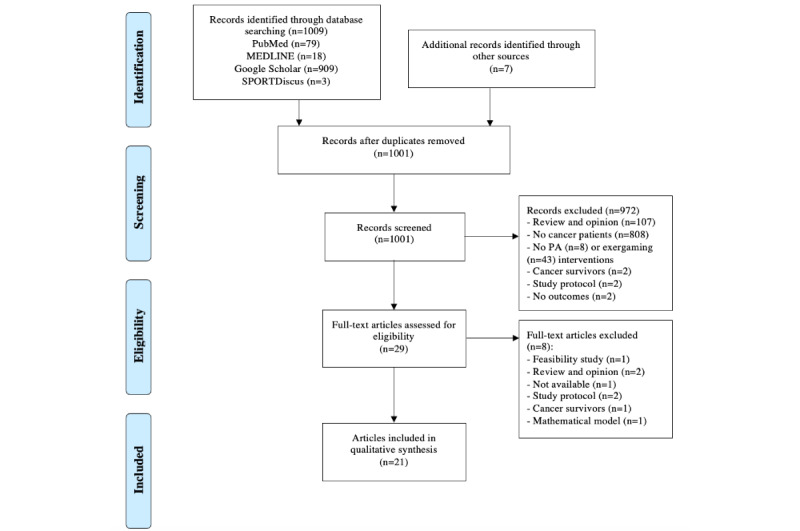
Four electronic databases were investigated. Studies reporting on AVG interventions delivered to patients undergoing treatment were included. A total of 21 articles (17 interventions) were identified for data extraction and quality assessment.
A total of 362 patients with cancer participated in the studies (number of participants 3-70). The majority underwent treatment for breast, lung, prostate, hematologic, or oral or laryngeal cancer. The types and stages of cancer varied in all studies. Participants ranged in age from 3 to 93 years. Four studies included patients with pediatric cancer. The duration of interventions ranged from 2 to 16 weeks, with a minimum of 2 sessions per week and a maximum of 1 daily session. Sessions were supervised in 10 studies, and 7 included home-based interventions. AVG interventions improved endurance, quality of life, cancer-related fatigue, and self-efficacy. Effects were mixed on strength, physical function, and depression. AVGs did not affect activity level, body composition, or anxiety. Compared with standard physiotherapy, physiological effects were lower or similar, and psychological effects were higher or similar.
Overall, our results suggest that AVGs can be recommended to patients undergoing cancer treatment, given the physiological and psychological benefits. When AVGs are proposed, supervision of the sessions should be considered as it can limit dropouts. In the future, it is important to develop AVGs that combine endurance and muscle strengthening, with the possibility of achieving moderate to high exercise intensity, depending on the physical abilities of the patients, as indicated in the World Health Organization's recommendations.
体育活动(PA)如今被视为癌症治疗中的一种辅助疗法;然而,多种障碍可能会减少治疗期间的体育活动参与度。主动式电子游戏(AVG)能带来轻度至中度强度的体育活动,是促进规律运动和锻炼的一种有前景的工具。
本文旨在综述当前文献,并提供关于基于主动式电子游戏的干预措施对正在接受治疗的癌症患者生理和心理影响的最新内容。
对四个电子数据库进行了调查。纳入了报告对正在接受治疗的患者实施主动式电子游戏干预措施的研究。共确定了21篇文章(17项干预措施)用于数据提取和质量评估。
共有362名癌症患者参与了研究(参与者人数为3至70人)。大多数患者接受乳腺癌、肺癌、前列腺癌、血液系统癌症或口腔或喉癌的治疗。所有研究中癌症的类型和阶段各不相同。参与者年龄在3岁至93岁之间。四项研究纳入了儿童癌症患者。干预措施的持续时间为2至16周,每周最少2次,最多每天1次。10项研究中的干预措施有监督,7项包括家庭干预。主动式电子游戏干预措施改善了耐力、生活质量、癌症相关疲劳和自我效能感。对力量、身体功能和抑郁的影响不一。主动式电子游戏对活动水平、身体成分或焦虑没有影响。与标准物理治疗相比,生理影响较低或相似,心理影响较高或相似。
总体而言,我们的结果表明,鉴于主动式电子游戏对生理和心理有益,可推荐给正在接受癌症治疗的患者。当推荐主动式电子游戏时,应考虑对干预措施进行监督,因为这可以减少退出情况。未来,根据世界卫生组织的建议,开发结合耐力和肌肉强化且能根据患者身体能力实现中度至高运动强度的主动式电子游戏很重要。