Sumner Kelsey M, Duca Lindsey M, Arriola Carmen Sofia, Neyra Joan, Soto Giselle, Romero Candice, Tinoco Yeny, Nogareda Francisco, Matos Eduardo, Chavez Victor, Castillo Maria, Bravo Eduar, Castro Juan, Thompson Mark, Azziz-Baumgartner Eduardo
Influenza Division, Centers for Disease Control and Prevention, Atlanta, GA, USA.
Epidemic Intelligence Service, Centers for Disease Control and Prevention, Atlanta, GA, USA.
Vaccine X. 2023 May 12;14:100314. doi: 10.1016/j.jvacx.2023.100314. eCollection 2023 Aug.
Despite a government-subsidized vaccination program, healthcare personnel (HCP) influenza vaccination uptake remains low in Peru. Using three years of cross-sectional surveys and an additional five years of prior vaccination history of HCP in Peru, we explored HCP knowledge, attitudes, and practices (KAP) of influenza illness and its impact on vaccination frequency.
In 2016, the Estudio Vacuna de Influenza Peru (VIP) cohort was initiated in Lima, Peru, which collected information about HCP KAP and influenza vaccination history from 2011─2018. HCP were classified by their 8-year influenza vaccination history as never (0 years), infrequently (1─4 years), or frequently (5─8 years) vaccinated. Logistic regression models were used to describe KAP associated with frequent compared to infrequent influenza vaccination, adjusted for each HCP's healthcare workplace, age, sex, preexisting medical conditions, occupation, and length of time providing direct patient care.
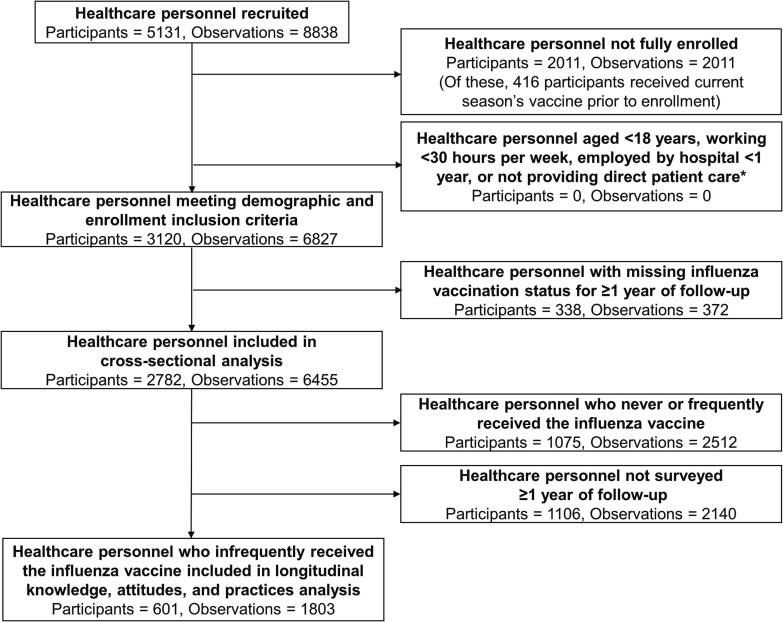
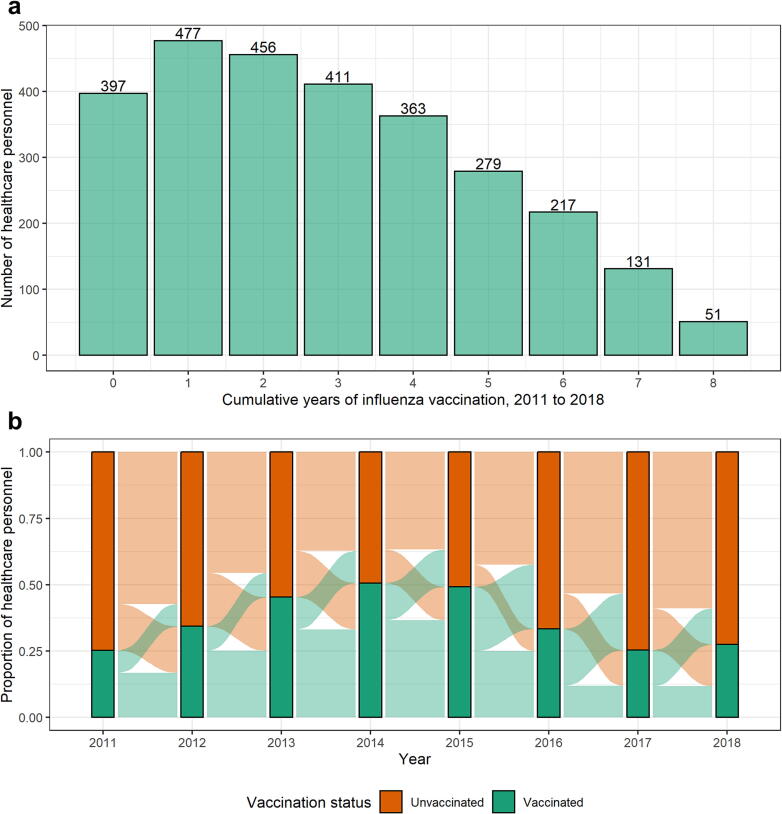
From 2016─2018, 5131 HCP were recruited and 3120 fully enrolled in VIP; 2782 consistently reported influenza vaccination status and became our analytic sample. From 2011─2018, 14.3% of HCP never, 61.4% infrequently, and 24.4% frequently received influenza vaccines. Compared to HCP who were infrequently vaccinated, frequently vaccinated HCP were more likely to believe they were susceptible to influenza (adjusted odds ratio [aOR]:1.49, 95% confidence interval [CI]:1.22─1.82), perceived vaccination to be effective (aOR:1.92, 95%CI:1.59─2.32), were knowledgeable about influenza and vaccination (aOR:1.37, 95%CI:1.06─1.77), and believed vaccination had emotional benefits like reduced regret or anger if they became ill with influenza (aOR:1.96, 95%CI:1.60─2.42). HCP who reported vaccination barriers like not having time or a convenient place to receive vaccines had reduced odds of frequent vaccination (aOR:0.74, 95%CI:0.61─0.89) compared to those without reported barriers.
Few HCP frequently received influenza vaccines during an eight-year period. To increase HCP influenza vaccination in middle-income settings like Peru, campaigns could strengthen influenza risk perception, vaccine knowledge, and accessibility.
尽管秘鲁有政府补贴的疫苗接种计划,但医疗保健人员(HCP)的流感疫苗接种率仍然很低。利用三年的横断面调查以及秘鲁HCP另外五年的既往疫苗接种史,我们探讨了HCP对流感疾病的知识、态度和行为(KAP)及其对疫苗接种频率的影响。
2016年,秘鲁流感疫苗研究(VIP)队列在秘鲁利马启动,该队列收集了2011年至2018年期间HCP的KAP和流感疫苗接种史信息。HCP根据其8年的流感疫苗接种史分为从未接种(0年)、偶尔接种(1至4年)或经常接种(5至8年)。使用逻辑回归模型来描述与偶尔接种流感疫苗相比,经常接种流感疫苗相关的KAP,并根据每个HCP的医疗工作场所、年龄、性别、既往病史、职业以及提供直接患者护理的时间长度进行调整。
2016年至2018年期间,招募了5131名HCP,其中3120名完全纳入VIP;2782人持续报告了流感疫苗接种状况并成为我们的分析样本。2011年至2018年期间,14.3%的HCP从未接种过流感疫苗,61.4%的HCP偶尔接种,24.4%的HCP经常接种。与偶尔接种疫苗的HCP相比,经常接种疫苗的HCP更有可能认为自己易感染流感(调整后的优势比[aOR]:1.49,95%置信区间[CI]:1.22至1.82),认为接种疫苗有效(aOR:1.92,95%CI:1.59至2.32),对流感和疫苗接种有了解(aOR:1.37,95%CI:1.06至1.77),并且认为接种疫苗有情感益处,比如如果感染流感会减少遗憾或愤怒(aOR:1.96,95%CI:1.60至2.42)。与没有报告接种障碍的HCP相比,报告有接种障碍(如没有时间或没有方便的接种地点)的HCP经常接种疫苗的几率降低(aOR:0.74,95%CI:0.61至0.89)。
在八年期间,很少有HCP经常接种流感疫苗。为了在秘鲁这样的中等收入环境中提高HCP的流感疫苗接种率,相关活动可以加强对流感风险的认知、疫苗知识以及可及性。