Liu Mingsu, Jiang Jian, Feng Yu, Cai Yang, Ding Jing, Wang Xin
Department of Neurology, Zhongshan Hospital, Fudan University, Shanghai 200032, China.
Institute of Neuroscience, Key Laboratory of Primate Neurobiology, CAS Center for Excellence in Brain Science and Intelligence Technology, Chinese Academy of Sciences, Shanghai 200050, China.
Brain Sci. 2023 May 19;13(5):823. doi: 10.3390/brainsci13050823.
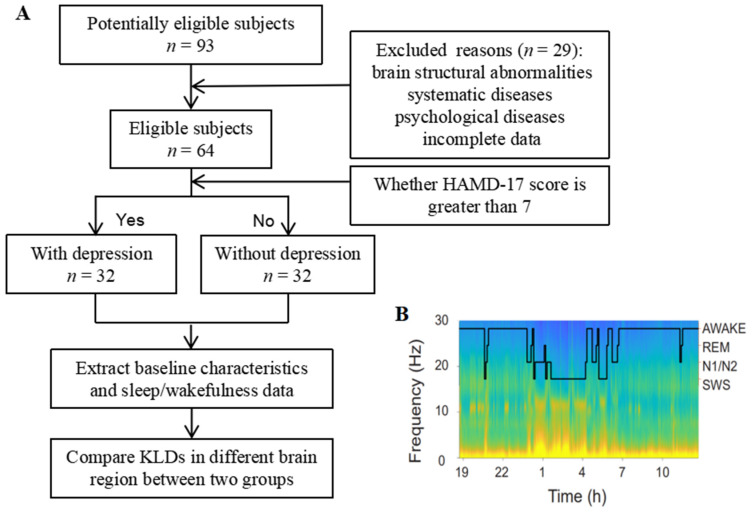
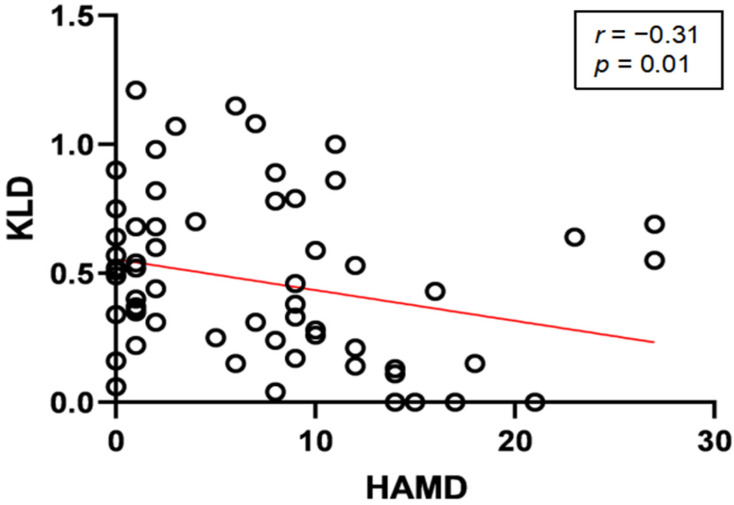
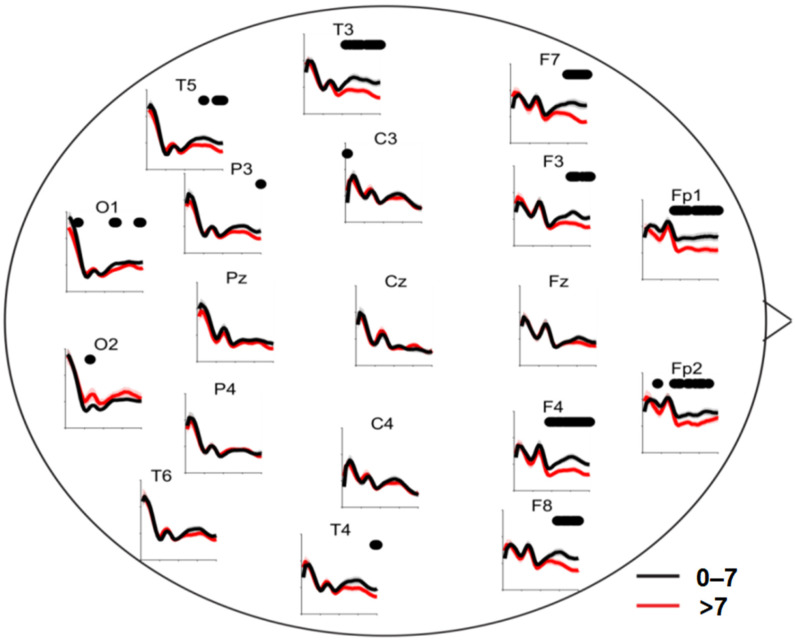
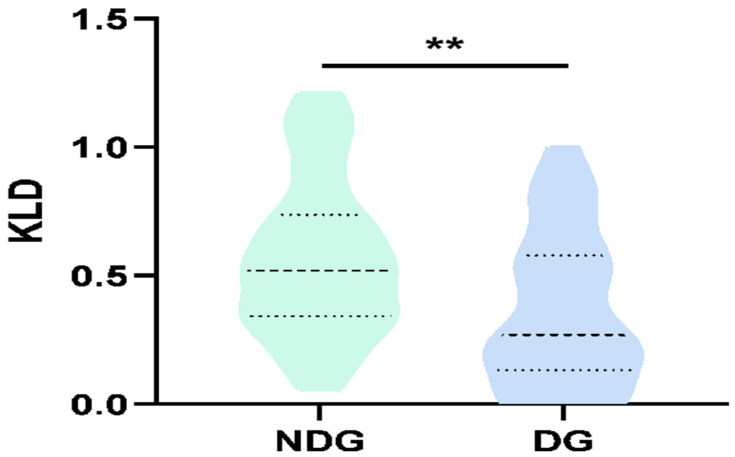
(1) Objective: Whether abnormal sleep-wake rhythms were associated with depressive symptoms in patents with epilepsy had remained unclear. Our study aimed to establish relative entropy for the assessment of sleep-wake patterns and to explore the relationship between this index and the severity of depressive symptoms in patients with epilepsy. (2) Methods: We recorded long-term scalp electroencephalograms (EEGs) and Hamilton Depression Rating Scale-17 (HAMD-17) questionnaire scores from 64 patients with epilepsy. Patients with HAMD-17 scores of 0-7 points were defined as the non-depressive group, while patients with scores of 8 or higher were defined as the depression group. Sleep stages were firstly classified based on EEG data. We then quantified sleep-wake rhythm variations in brain activity using the Kullback-Leibler divergence (KLD) of daytime wakefulness and nighttime sleep. The KLD at different frequency bands in each brain region was analyzed between the depression and non-depression groups. (3) Results: Of the 64 patients with epilepsy included in our study, 32 had depressive symptoms. It was found that patients with depression had significantly decreased KLD for high-frequency oscillations in most brain areas, especially the frontal lobe. A detailed analysis was conducted in the right frontal region (F4) because of the significant difference in the high-frequency band. We found that the KLDs at the gamma bands were significantly decreased in the depression groups compared to the non-depression group (KLD = 0.35 ± 0.05, KLD = 0.57 ± 0.05, = 0.009). A negative correlation was displayed between the KLD of gamma band oscillation and HAMD-17 score (r = -0.29, = 0.02). (4) Conclusions: Sleep-wake rhythms can be assessed using the KLD index calculated from long-term scalp EEGs. Moreover, the KLD of high-frequency bands had a negative correlation with HAMD-17 scores in patients with epilepsy, which indicates a close relationship between abnormal sleep-wake patterns and depressive symptoms in patients with epilepsy.
(1) 目的:癫痫患者的异常睡眠-觉醒节律是否与抑郁症状相关尚不清楚。我们的研究旨在建立用于评估睡眠-觉醒模式的相对熵,并探讨该指标与癫痫患者抑郁症状严重程度之间的关系。(2) 方法:我们记录了64例癫痫患者的长期头皮脑电图(EEG)和汉密尔顿抑郁量表-17(HAMD-17)问卷得分。HAMD-17得分0-7分的患者被定义为非抑郁组,得分8分及以上的患者被定义为抑郁组。首先根据EEG数据对睡眠阶段进行分类。然后,我们使用白天清醒和夜间睡眠的库尔贝克-莱布勒散度(KLD)来量化大脑活动中的睡眠-觉醒节律变化。分析抑郁组和非抑郁组之间每个脑区不同频段的KLD。(3) 结果:在我们纳入研究的64例癫痫患者中,32例有抑郁症状。发现抑郁患者大多数脑区高频振荡的KLD显著降低,尤其是额叶。由于高频带存在显著差异,在右侧额叶区域(F4)进行了详细分析。我们发现,与非抑郁组相比,抑郁组γ频段的KLD显著降低(KLD = 0.35±0.05,KLD = 0.57±0.05, = 0.009)。γ频段振荡的KLD与HAMD-17得分呈负相关(r = -0.29, = 0.02)。(4) 结论:睡眠-觉醒节律可以使用从长期头皮EEG计算出的KLD指数进行评估。此外,癫痫患者高频带的KLD与HAMD-17得分呈负相关,这表明癫痫患者异常的睡眠-觉醒模式与抑郁症状之间存在密切关系。